
NASA Orbiter Finds Rare New Moon Crater and a Wider Cold Zone
A crater formed on the Moon in 2024 has given scientists an unusually clear before-and-after view of a large impact. NASA’s Lunar Reconnaissance Orbiter team identified the feature in October 2025 and described it in research reported in September 2026. The discovery is new; the collision itself did not occur this week.

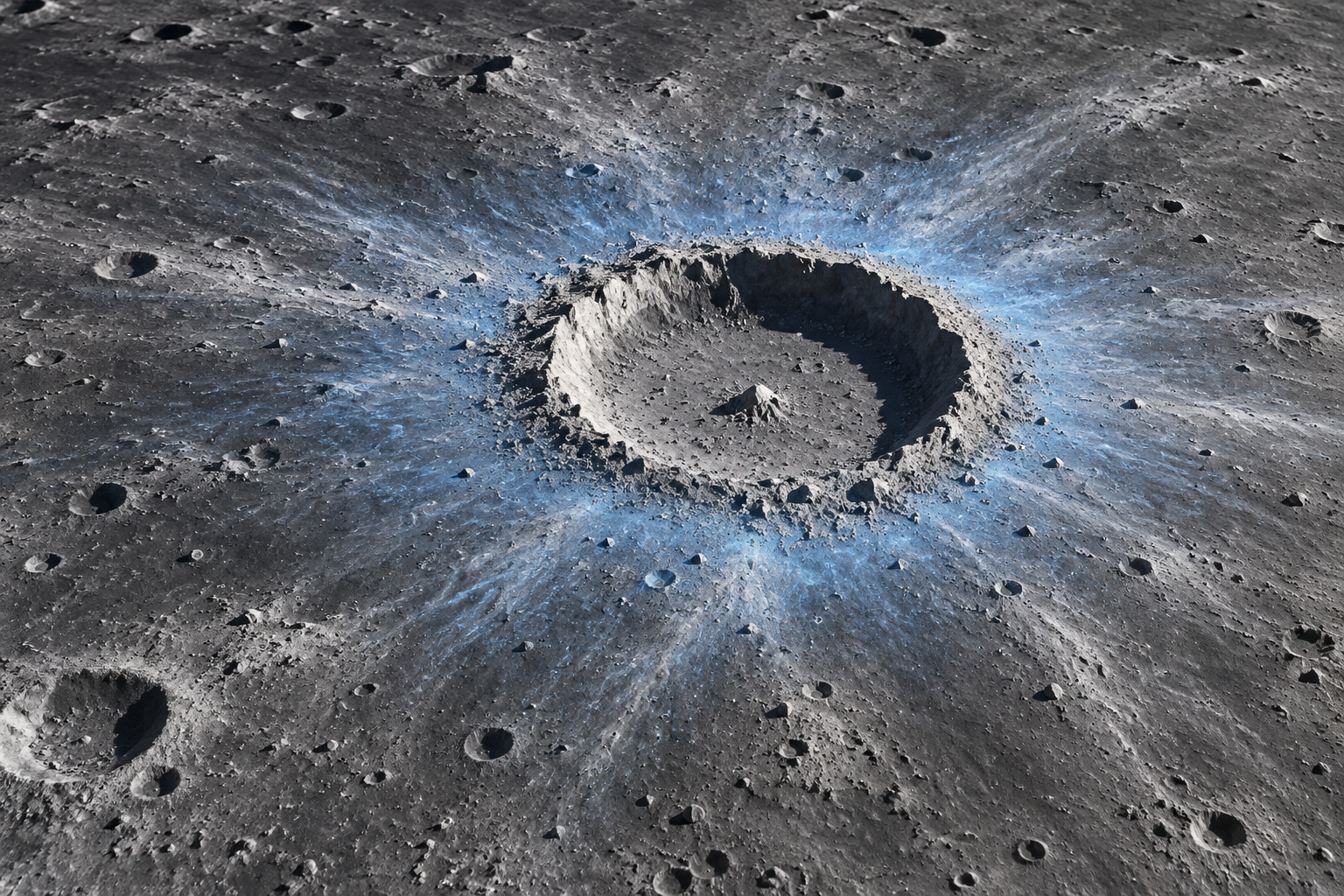
Named McGetchin after lunar scientist Tom McGetchin, the crater is about 728 feet wide and 141 feet deep on the Moon’s eastern edge. Comparison images constrain the impact to the period between April 11 and May 22, 2024. Researchers estimate that an impact of this size occurs on the Moon roughly once a century or less often. NASA describes it as the largest newly formed crater yet discovered in the solar system.
The visible crater is only part of the change. Measurements from the orbiter’s Diviner thermal instrument show an area roughly four miles wide around it that is about 16 degrees Fahrenheit cooler at night than nearby terrain. Researchers explain the temperature difference by the impact loosening lunar regolith. Less dense surface material retains heat differently, so the thermal effect extends well beyond the rim.
That distinction matters for interpreting the Moon’s surface. A bright mark in broad orbital maps can indicate displaced material rather than the crater itself. Scientists used the orbiter’s higher-resolution camera to inspect the depression and then thermal data to test how far the disturbance spread. Combining images made at different times with measurements made by different instruments turns a single new hole into evidence about how impacts rearrange soil.
The result also has a practical implication for future lunar exploration: disturbed ground could behave differently under rover wheels. That is a question for engineering and field assessment, not evidence that a planned route has become unsafe. The orbiter has identified many smaller new craters over more than 17 years; McGetchin is notable because its size lets researchers examine a rare large collision against a well-documented earlier surface.