Trump Questions Brazil Election Without Evidence After Lula’s Runoff Victory
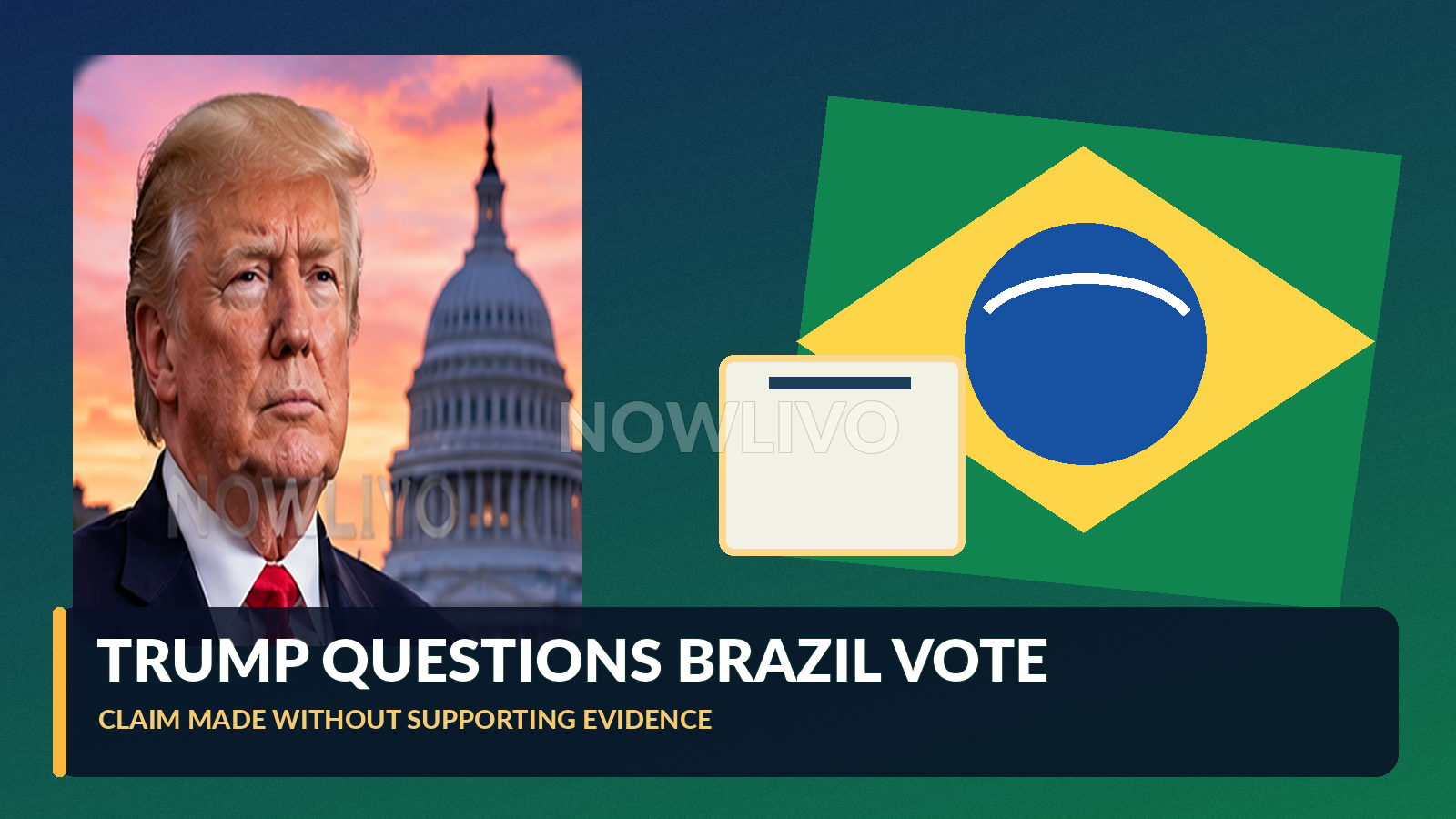
US President Donald Trump has questioned the legitimacy of Brazil's presidential runoff without presenting evidence of fraud, adding an international dimension to the dispute over Sunday's election result. Speaking to reporters on Monday, October 26, Trump said the vote appeared to have been rigged. His comments came a day after Brazil's electoral authorities declared President Luiz Inácio Lula da Silva the winner against Senator Flávio Bolsonaro. The allegation is a claim by Trump, not an established finding about the conduct of the election.
The distinction is particularly important because the Brazilian result had already been reported and the new development is the American president's reaction. Brazil's electoral court reported Lula winning about 51.8% of the vote, with a margin of roughly 4.4 million votes. Flávio Bolsonaro has refused to concede and has challenged aspects of the voting process. None of that, on its own, proves that the official result was manipulated. Trump's remarks raise questions about how Washington will respond to Lula's renewed mandate, but they do not change the certified figures.
What Trump said and what is missing
Reuters reported that Trump described the election as looking rigged while offering no supporting evidence. He also said he had not taken sides in the race. The comments were striking because the Bolsonaro family has longstanding political links with Trump's movement and because a disputed election result can affect relations between two large democracies. An assertion from a president can be politically consequential even when it is unsupported by a demonstrated factual case.
Readers should separate several issues that are sometimes blended together. One is whether the official vote count was conducted accurately. Another is whether election rules, including decisions made close to polling day, were appropriate. A third is whether losing candidates accept the result. Disagreement over a procedural decision does not automatically establish that the count was falsified. The evidence available in public reporting on October 26 did not substantiate Trump's broad allegation that the election was rigged.
Why Bolsonaro is challenging the outcome
Flávio Bolsonaro's objections followed a last-minute judicial decision extending voting hours in some circumstances because of transportation difficulties and severe weather, according to Associated Press reporting. His campaign criticised the decision and questioned the judge's background. Brazilian election authorities maintained that the extension did not alter the result, and legal experts cited in the reporting expressed doubt that the challenge had a strong basis. These are competing positions about a specific procedural decision, not a demonstrated finding of nationwide electoral fraud.
Lula's supporters celebrated the result in major Brazilian cities, while the defeated candidate's refusal to concede left an immediate political dispute. Brazil's institutions have processes for handling complaints and challenges, and those proceedings matter more to the legal status of the vote than comments made abroad. A politician's refusal to concede may prolong uncertainty in public debate, but it does not by itself reverse an electoral court's declaration. Any legal change would require a decision by the appropriate Brazilian authority.
Why the US reaction matters
Brazil is Latin America's largest economy and a major diplomatic partner for the United States. Its government takes positions on trade, climate policy, regional security and relations with other powers that can diverge from Washington's priorities. Lula's victory comes amid a broader regional political contest in which different leaders have aligned themselves with, or opposed, the Trump administration. Trump's public challenge could complicate the tone of future dealings even if it has no direct effect on the Brazilian count.
The reaction also puts US officials in a position where they may be asked to distinguish the president's political assessment from any formal diplomatic position. There was no verified announcement in the October 26 reporting of sanctions, recognition changes or other official US action against Brazil because of the runoff. Suggesting that Washington has already rejected the government or moved to invalidate the result would therefore be premature. A public remark and a concrete policy decision are different developments.
Lula's mandate and the road ahead
The Associated Press reported that Lula is due to begin a fourth non-consecutive term in January 2027. He campaigned amid concerns about living costs, public security and Brazil's economic direction, and his victory defied expectations that right-wing candidates would continue gaining ground across the region. Those political conditions help explain why the result has attracted attention outside Brazil. They do not resolve the defeated campaign's objections, which must be considered through Brazilian procedures if formally pursued.
Lula has spoken about representing the whole country and defending Brazil's sovereignty. For the new administration, the immediate challenges include governing a politically divided electorate and navigating relationships with international partners. For Bolsonaro's supporters, the question is whether their objections develop into a legally supported case or remain political rhetoric. The next material update would be a formal court ruling, new documented evidence or an official diplomatic response with consequences beyond public commentary.
For now, the news is Trump's unsupported allegation following an official Lula victory. It is legitimate to report the statement because of the speaker's position and the possible diplomatic effects. It is equally important not to convert the allegation into fact. The Brazilian vote count, the losing candidate's challenge and the American president's reaction are three related but distinct elements of the developing story.