Israel Election Exit Polls Show Deadlock as Netanyahu and Eisenkot Seek a Majority
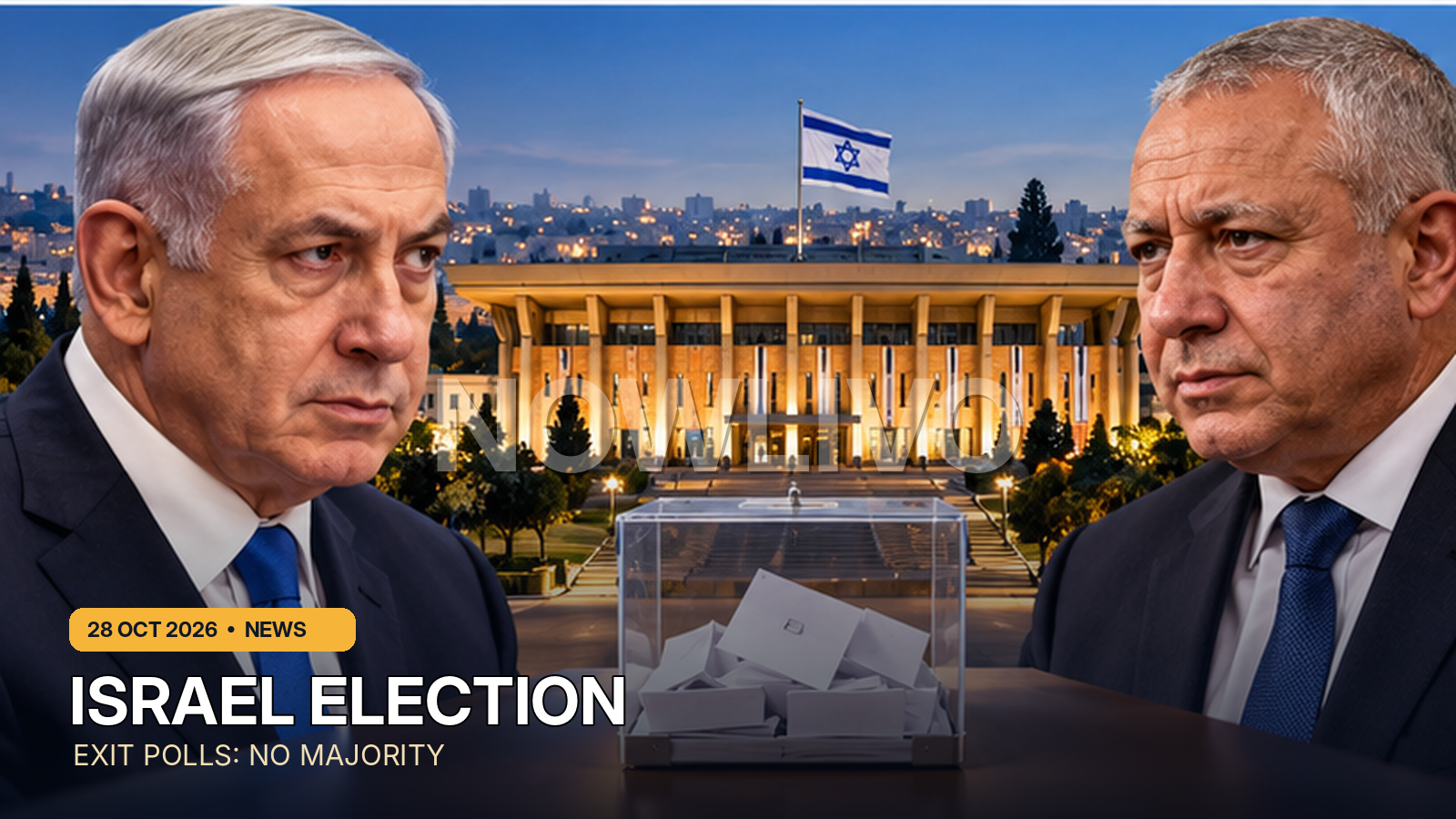
Israel's October 27 general election ended with no clear winner in the first exit-poll projections, leaving Prime Minister Benjamin Netanyahu and opposition challenger Gadi Eisenkot without an obvious route to a governing majority. The projections placed their competing blocs close together in a 120-seat parliament, with neither reaching the 61 seats needed to form a government. This is a substantive change from the earlier election-day story about voting and turnout: ballots have now been cast, projections have been released, and coalition arithmetic has become the central question.
Reuters reported that public broadcasters Kan 11 and Channel 13 showed the two main camps level, while Channel 12 gave Netanyahu's side a narrow advantage as its projections changed through the night. None showed a secure majority for either side. Exit polls are estimates based on voter surveys and other modelling, not certified election results. Official counting was still under way, and small changes in party totals could alter which leaders have a realistic chance of assembling a coalition.
A record turnout but no straightforward verdict
Turnout reached 77.7 percent, according to Israel's Central Elections Committee, the highest in more than two decades. That level of participation shows the importance voters attached to the election after years of conflict and political division. It does not, by itself, establish which coalition the electorate preferred. The vote was the first national election since the Hamas-led attacks of October 7, 2023, and the wars in Gaza, Lebanon and Iran that followed.
Netanyahu has argued that his experience and security policies are essential in a dangerous region. His critics have questioned his leadership, including the security failures before the 2023 attack and the political consequences of the wars. Eisenkot, a former military chief who previously served in Netanyahu's war cabinet, has presented himself as a centrist alternative with strong security credentials. He left the war cabinet after disputes over the prime minister's conduct of the conflict, and his campaign sought to turn dissatisfaction into a change of government.
Why 61 seats matters more than first place
Israel uses proportional representation, and no single party is expected to win the 61 seats needed to govern alone. A party can finish first in the seat count yet still fail to build a majority if potential partners refuse to join it. That is why a close contest between the two blocs may produce weeks of negotiation rather than a rapid handover of power. Smaller parties can become decisive even when their own seat totals are modest.
The Arab-led parties outside the two main blocs may hold important seats in the new Knesset. But the arithmetic is not a simple instruction to add every party that opposes Netanyahu to one coalition. Eisenkot has largely ruled out forming a government with Arab parties, a position that complicates his route to 61. Parties also differ on security, religion, military service and economic policy. A majority on paper may be difficult to translate into an agreement to govern.
What the leaders said after the projections
Netanyahu told supporters that Israel needed a strong right-wing government and defended his record, according to Reuters. Eisenkot told his supporters that voters had rejected Netanyahu's continued leadership and urged a change in government. Those statements reflect competing political interpretations of a still-incomplete count. Neither declaration is equivalent to a certified victory, and a leader's claim to a mandate does not determine whether coalition negotiations will succeed.
The projections also suggested a setback for some of Netanyahu's far-right allies, though the final allocation of seats could change. Analysts cited by Reuters cautioned that Eisenkot had not emerged as a clear winner either. The result could therefore weaken the governing coalition without producing a replacement immediately. Netanyahu could remain in office in a caretaker capacity while negotiations continue, a possibility that would preserve continuity but leave major political questions unresolved.
The war and the domestic agenda
Security was central to the campaign, but it was not the only dividing line. Arguments over the government's handling of the October 7 attack, the conduct of military operations, relations with international partners and domestic institutional disputes have all shaped public debate. Eisenkot's challenge was not a simple choice between a hard-line and a pacifist platform: he also takes a hawkish position on several security questions. The sharper contrast concerned leadership, accountability and the composition of the next government.
Other contentious issues, including military service requirements for ultra-Orthodox men, could affect negotiations with religious parties. These questions can determine whether a coalition holds together long after an election. A government formed by a narrow majority may face repeated tests when legislation or budgets reach parliament. Voters may therefore wait longer than the count itself to learn who will actually lead the next administration.
What the next update should establish
The next verified milestones are the official seat totals, party consultations and any formal nomination to attempt government formation. Some special-station and absentee ballots were still to be counted when the exit polls were published. It would be premature to declare Netanyahu defeated, Eisenkot victorious or a second election inevitable. What is established is that unusually high turnout produced a projected deadlock, and the fight over Israel's next government has moved from the ballot box to coalition bargaining.