
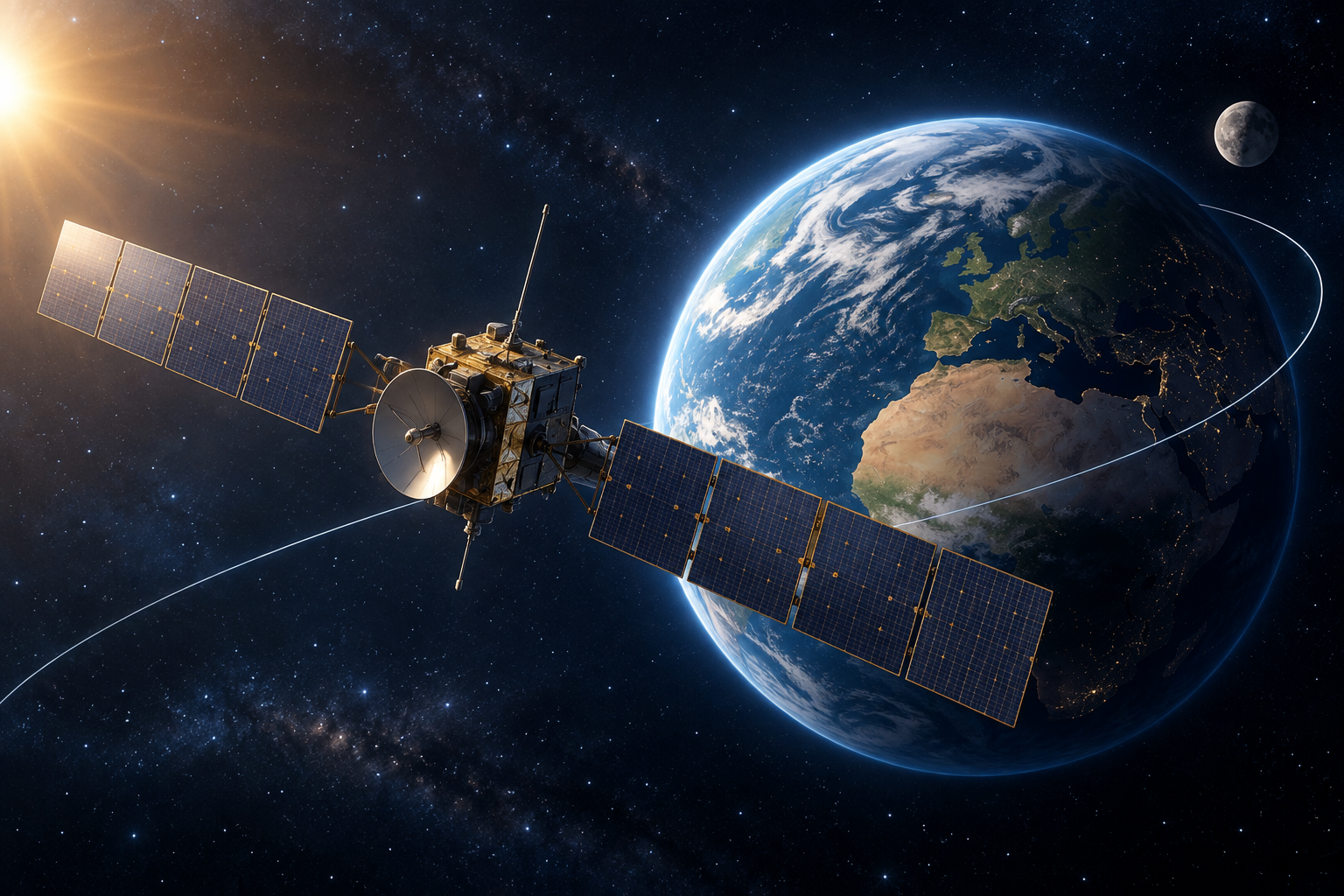
Juice Begins Earth–Moon Observations Ahead of September 28 Gravity Assist
The European Space Agency is preparing its Juice spacecraft for a close Earth flyby on September 28, while its ten science instruments are scheduled to observe Earth and the Moon from September 23 through October 3. The observations are a test opportunity during a navigation manoeuvre, not a discovery at Jupiter. ESA says the spacecraft will approach to about 8,640 kilometres and use Earth’s gravity to bend its route toward a further Earth encounter in January 2029 and arrival at Jupiter in July 2031.

A gravity assist changes a spacecraft’s path and speed by exchanging a tiny amount of momentum with a planet as it passes. It allows mission planners to build a long trajectory without carrying all the propellant a direct route would require. ESA expects this encounter to turn Juice’s trajectory by about 20 degrees and increase its speed by about 3.5 kilometres per second. Those are planned outcomes of the September 28 pass, not measurements already made.
The nearest point is forecast over the Indian Ocean at 11:45 UTC. Flight controllers have reserved correction opportunities, although ESA says only one small adjustment has been needed so far. A final contingency manoeuvre is available on the day of the encounter if a navigation or collision concern arises. Juice will also spend several hours in Earth’s shadow immediately before the pass, relying on batteries and prioritising essential instrument operations.
The scientific work is more than a camera rehearsal. Instrument teams can compare measurements against the comparatively well-known Earth and Moon environment, refine calibration and test analysis methods before the spacecraft reaches the Jovian system. ESA also expects measurements in Earth’s magnetotail and plans to test optical navigation with images of the lunar horizon. Data collection and later analysis are separate steps; the planned switch-on does not establish any new finding yet.
Juice launched in 2023 to study Jupiter and the ocean-bearing moons Ganymede, Callisto and Europa. The September flyby is one stage in a sequence of planetary encounters designed to leave enough fuel for operations at Jupiter and, later, orbit around Ganymede. The next immediate check is whether the September 28 encounter achieves the planned trajectory.