
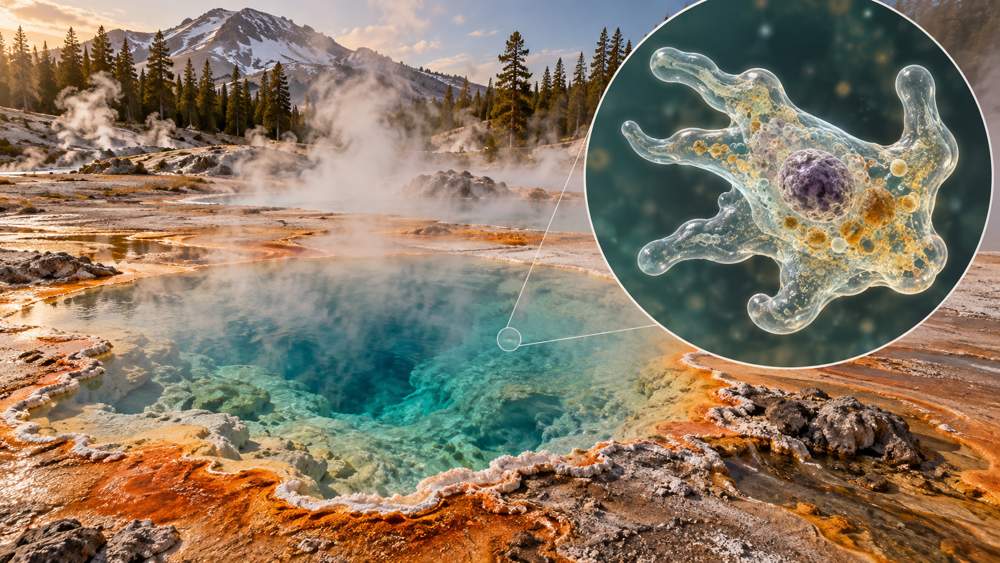
Fire Amoeba Rewrites the Heat Limit for Complex Cells
A newly identified amoeba from the geothermal waters of California’s Lassen Volcanic National Park can reproduce at 63°C (145°F), a reported record for organisms whose cells contain a nucleus. The finding pushes past the previous observed ceiling of about 60°C for such life and gives researchers a more demanding test of where complex cells can function.

The species, named Incendiamoeba cascadensis, is a single-celled eukaryote. That distinction matters: unlike bacteria and archaea, eukaryotes package genetic material in a nucleus and use other membrane-bound structures. Heat can damage proteins, DNA and cell membranes, making sustained growth at these temperatures a particularly striking result. The study appeared in Cell this week.
The team observed cell division at 63°C. Above that, reproduction stopped, though the amoeba still moved and sought food at 64°C. In laboratory tests it could recover after five minutes at 70°C, while exposure to 80°C proved fatal. These are different thresholds: brief survival at 70°C does not mean a population can grow there. The distinction between reproduction, activity and recovery is central to interpreting the record.
Genetic analysis offered possible clues to its resilience. Researchers found activity in genes associated with protecting DNA and maintaining protein folding as temperatures rose. They also identified similar genetic fragments in geothermal samples from other places, including Yellowstone and New Zealand. Those traces point to places worth investigating, but they do not yet establish that the same species lives there.
The discovery matters for astrobiology because researchers use the limits of Earth life to decide which environments might be habitable elsewhere. It expands one measured limit for a eukaryotic organism; it does not demonstrate life beyond Earth. A suitable environment would also need water, food and the right chemical conditions. This amoeba depends on an ecosystem and could not simply persist in any hot location.
The next questions are whether related amoebas can be found in other geothermal settings and which of the observed molecular responses actually enable growth at 63°C. Answering them could show whether this is a rare biological exception or evidence that the known temperature range for complex cells has been constrained by where scientists have looked.