
Bengaluru CEO’s Four-State Hiring Policy Sparks Regional Bias Debate
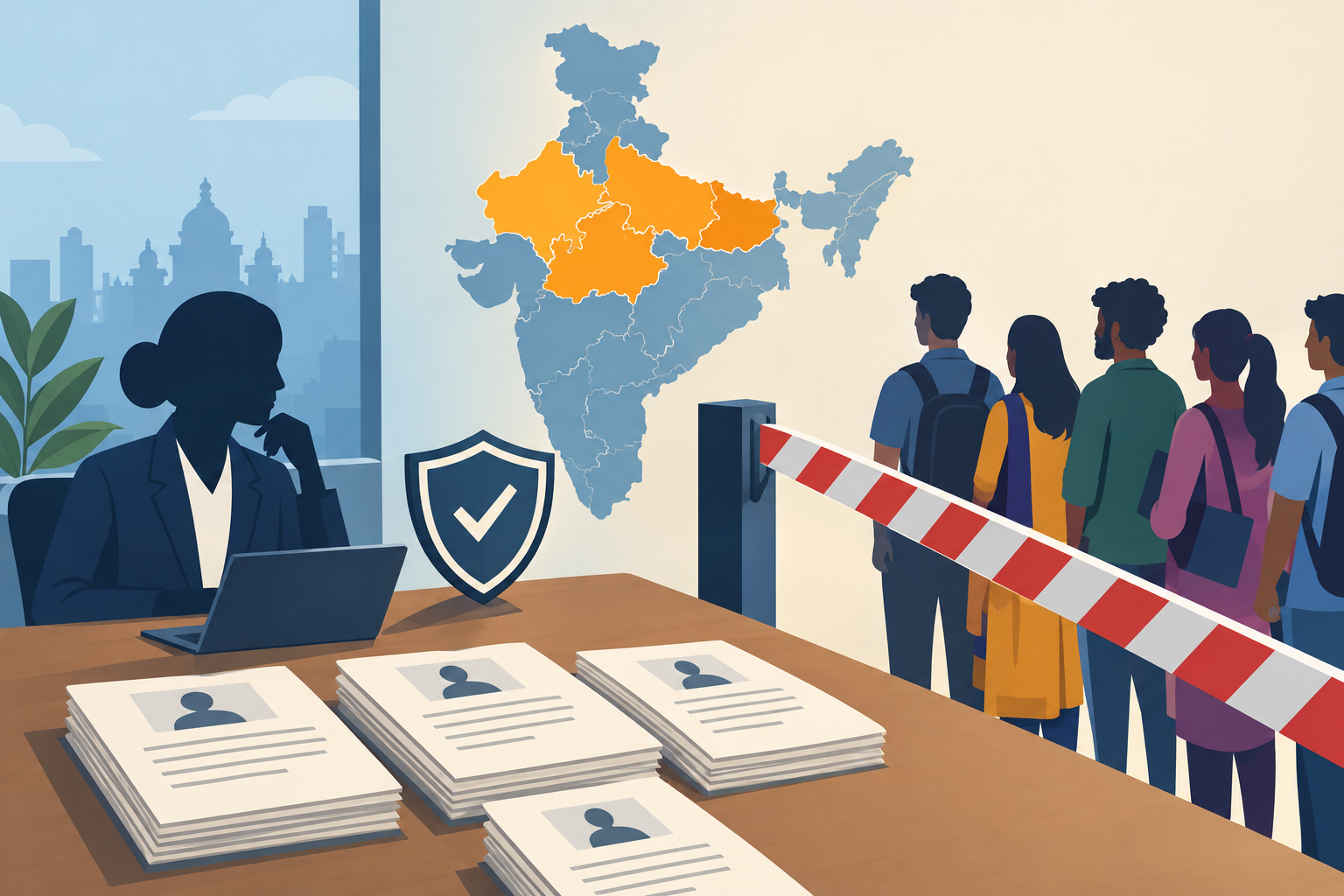
A Bengaluru-based company has become the centre of a heated employment debate after its founder and CEO, Karthik SG, announced that it would not hire male candidates from four Indian states.
The September 22, 2026, announcement named Uttar Pradesh, Bihar, Rajasthan and Madhya Pradesh. Karthik, who heads A1 Sports World, said the position followed extensive discussion within the organisation. His statements described a categorical restriction based on both gender and state of origin rather than an assessment limited to a particular applicant or vacancy.

CEO links policy to an alleged workplace incident
Karthik claimed that the decision arose from the conduct of a former employee from one of the four states. According to his account, the employee appeared suitable during recruitment but later became abusive toward female colleagues and allegedly attempted to force himself on one woman. These allegations have not been independently established, and the former employee has not been publicly identified.
The CEO said the employee had received warnings before being dismissed. He argued that protecting female staff and the children with whom the organisation works was more important than continuing with its previous approach to recruitment.
Karthik also claimed that women employees supported the new policy, including a staff member from Rajasthan. He said the company had 32 employees, 14 of them women, and employed people from several states and religious backgrounds. In a later interview, he acknowledged that the decision was regionally biased but said he intended to retain it despite being willing to apologise for the wording of his public post.
He further argued that the nature of the company’s sports-training work required additional caution because trainers interact directly with children, sometimes while demonstrating posture or physical technique. He said the business was exploring psychological screening as another way to evaluate prospective employees.
Online reaction divides over safety and collective blame
The announcement spread rapidly online, where many users accused the company of stereotyping millions of people because of one individual’s alleged actions. Critics said workplace misconduct should be addressed through documented complaints, investigations, reference checks and individual accountability rather than a blanket regional restriction.
Several users compared the policy to an overseas employer refusing to hire Indians because of misconduct attributed to one Indian worker. Others warned that publicly declaring such criteria could damage an employer’s reputation among applicants, clients and existing staff, including workers who may wonder whether another identity-based restriction could be introduced later.
A smaller group defended the CEO’s emphasis on women’s and children’s safety or argued that a privately run company should have broad control over recruitment. Even among those sympathetic to the safety concern, however, questions remained about why birthplace or state affiliation would serve as a reliable measure of an individual applicant’s behaviour.
Employment and workplace implications
The controversy does not produce a simple legal answer. Article 16 of the Constitution expressly protects equality of opportunity in public employment and prohibits discrimination by the state on grounds including sex, place of birth and residence. It does not automatically resolve every recruitment decision made by a private employer.
Other employment rules may still be relevant. The Code on Wages addresses gender discrimination in recruitment for the same or similar work, subject to limited situations in which employing women is legally prohibited or restricted. Because the announced policy applies specifically to male candidates, its implementation could invite scrutiny based on the jobs involved and the precise facts. State of origin, meanwhile, is not covered by a single comprehensive private-sector hiring rule equivalent to Article 16’s public-employment protection. Any firm legal conclusion would therefore require examination of the company, vacancies, applicable rules and evidence of how the policy was used.
Separately, employers have defined responsibilities for preventing and addressing sexual harassment at work. The workplace sexual-harassment law requires a safe environment, a complaint and inquiry process, employee awareness measures and an Internal Committee in establishments meeting the statutory threshold. Where work involves children, safeguarding procedures, supervision, reporting channels and role-appropriate background checks become particularly important.
For employers, the dispute highlights the difference between responding firmly to an individual allegation and assigning risk to an entire demographic group. Structured interviews, documented references, clear conduct standards, lawful background verification, trained complaints committees and consistent disciplinary procedures offer ways to address safety while evaluating candidates on job-related evidence.
For job seekers, the episode also illustrates how publicly stated screening criteria can affect access to opportunities before qualifications are considered. Whether the announced restriction leads to a formal complaint or regulatory action remains unclear, but the reaction has already turned a company-level decision into a wider national debate about regional identity, workplace trust and fair hiring.