Police Use Tear Gas as Ujjain Mosque Road-Widening Dispute Escalates
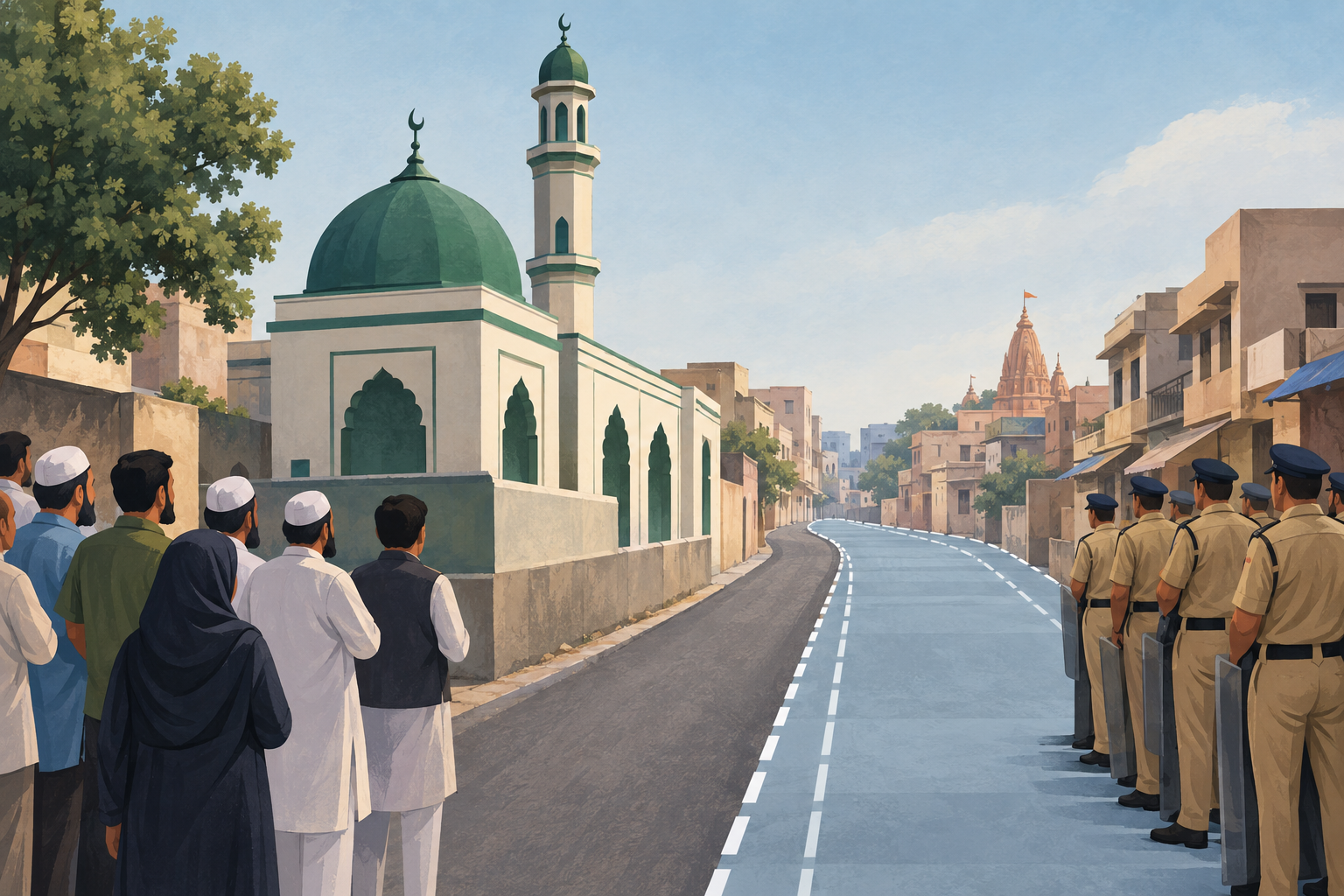
Police fired tear gas near the Shahi Masjid in Ujjain, Madhya Pradesh, on Monday, September 28, after a confrontation over plans to remove part of the mosque for a road-widening project. Police said stones were thrown as people tried to approach the work area. Some residents continued to oppose the removal, while officials and a senior community representative said an agreement had been reached for mosque members to carry out the work themselves.

The immediate reason for the planned demolition is the Ujjain Municipal Corporation’s decision to widen the road between Kanthal Chauraha and Gopal Mandir to 15 metres. Part of the mosque falls within the designated road alignment. City officials say the wider route is needed to manage traffic and the large number of visitors expected for the Simhastha religious gathering in 2028. The proposal concerns the affected portion of the mosque, not the demolition of the entire building.
From an overnight standoff to a morning clash
Residents and worshippers gathered at and around the mosque on Sunday as police and municipal teams prepared to begin the removal. Some stayed through the night. Ujjain Superintendent of Police Pradeep Sharma said at that stage that officers were speaking with mosque representatives and were seeking a resolution without immediately proceeding with demolition.
By Monday morning, removal work had begun and another crowd had gathered nearby. Police said some people tried to push past restrictions around the site and threw stones at officers. Officers then used tear gas and force to disperse the crowd. Security personnel remained deployed around the mosque. The available accounts do not establish who threw the first stone or settle every detail of how the confrontation began.
Officials gave a further account of the work inside the restricted area. District Collector Roshan Kumar Singh said discussions on Sunday night had produced an understanding that people associated with the mosque would remove the affected portion themselves rather than have municipal machinery do it. Sharma said the mosque committee had begun that work and that it was continuing despite the disturbance outside. Those statements should not be taken to mean that all worshippers or local residents accepted the arrangement; opposition was still visible on Monday.
Ujjain city Qazi Khaliqur Rahman urged people to remain calm, avoid gathering in markets and disregard rumours. He said the issue had been resolved overnight and that those concerned were carrying out the agreed work. His account contrasts with the objections voiced by residents who want the mosque spared, making the scope of any community agreement an important point of distinction.
What the court has decided
The dispute has already been before the Madhya Pradesh High Court’s Indore bench. On September 9, a single judge dismissed two petitions challenging the municipal corporation’s decision. The petitioners argued that the proposed removal would affect prayer facilities and other parts of a registered Waqf property. They questioned the notices and procedure used by the corporation and argued that authorities should consider taking land elsewhere, including opposite the mosque.
In dismissing the petitions, the court found that the corporation had given the affected parties an opportunity to object and had followed the required process. It accepted the public-interest case for widening the road and rejected the claim that the mosque was being singled out because it was a religious site. The judgment recorded that portions of 10 temples and another mosque had already been removed along the same road. The court also rejected the alternative alignment put forward in those petitions.
Mosque representatives subsequently approached a division bench, with the matter scheduled for a hearing on September 28. The September 9 ruling is therefore the established court decision, while the further challenge must be distinguished from a ruling in the mosque’s favour. A new decision on that challenge had not been confirmed at the time of this report.
Why objections remain
Imam Mohammad Ibrahim has called for religious sites to be excluded from the widening exercise. He says the community has already given up nearby shops and disputes the need to remove part of the mosque. Mohammad Zakir, a member of the Muslim Representative Committee, has also said residents gathered there because they wanted the structure protected.
The central disagreement is now both practical and legal: whether the road can be widened without affecting the mosque, and whether the larger bench will alter the position left by the September 9 judgment. Meanwhile, police and community representatives are urging calm as work and opposition continue around a closely guarded site.