
Katra–Banihal rail speed rises to 100 kmph: What changes on the Chenab and Anji bridges?
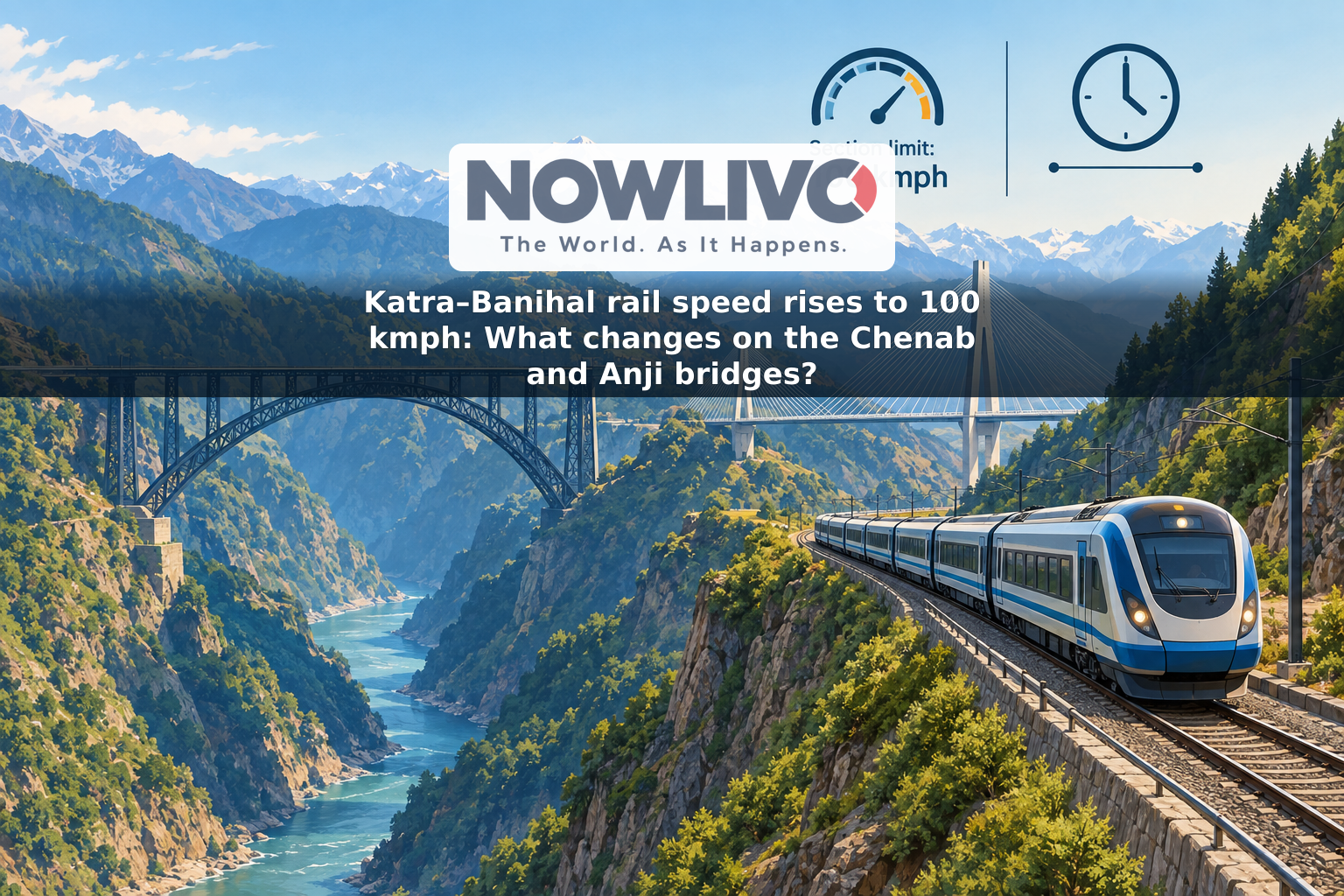
Trains on the 111-kilometre Katra–Banihal rail section can now operate at up to 100 kilometres per hour, and a Vande Bharat train crossed both the Chenab and Anji bridges at that speed during a successful test on October 2, 2026. For passengers, the change creates scope for shorter journeys through this part of Jammu and Kashmir. It does not mean a train will travel at 100 kmph for its entire trip to Srinagar, or that every arrival time has already changed.
What changed on the railway?
Northern Railway raised the maximum permissible speed for the section between Shri Mata Vaishno Devi Katra and Banihal. In announcing the October 2 test, railway officials described the increase as a move from 75 kmph to 100 kmph. Earlier limits were not identical throughout the route: before the upgrade, the Katra–Sangaldan stretch had an 85 kmph limit, while Sangaldan–Banihal was limited to 75 kmph.
The distinction between approval and actual operation matters here. Approval for a 100 kmph limit had been reported in August, but Northern Railway subsequently clarified that no train had yet crossed the Chenab or Anji bridge at that speed. The October 2 report concerns a later, successful run: officials said Vande Bharat service numbers 26401/26404 crossed both bridges at 100 kmph. That is a report of the train reaching the new speed, not merely a statement about what the track is allowed to support.
What does 100 kmph mean on the bridges?
The Chenab Bridge carries the line high above the Chenab River; the Anji Bridge is a cable-stayed railway bridge on the same Katra–Banihal route. Reaching 100 kmph while crossing them demonstrates the operational effect of the higher limit at two of the section’s most recognisable points. The bridges themselves are not new to passenger service: they were inaugurated in June 2025, when Vande Bharat services connecting Katra and Srinagar were launched.
A speed limit is a ceiling for operation, not a constant speed or an average. A train must accelerate after stops, slow before others and follow the instructions that apply along its route. The short crossings of the bridges are only parts of a 111-kilometre section, which is itself only part of a longer journey for passengers travelling between Jammu and Srinagar. Even if a train reaches 100 kmph on both bridges, it will spend other parts of its trip moving more slowly or standing at stations.
Nor should travellers divide the Katra–Banihal distance by 100 to estimate their arrival. That calculation would assume an uninterrupted run at the maximum speed from one end of the section to the other, with no time for acceleration, braking or station stops. The higher limit can help a train cover suitable stretches faster, but the minutes saved on a booked journey depend on how the service is operated and whether its timetable is adjusted.
What should passengers expect?
Railway officials expect the higher permitted speed to make operations smoother and reduce travel time. They have not, in the announcement of the bridge run, specified a new journey time or a confirmed number of minutes saved for passengers. The practical takeaway is therefore narrower than the headline speed: trains have been cleared to run faster on Katra–Banihal, and a Vande Bharat has demonstrated 100 kmph across both bridges, but passengers should use the timetable for their particular train rather than treat 100 kmph as its journey-wide pace.