Downtown Boston safety survey: What the “more than half” claim actually measures
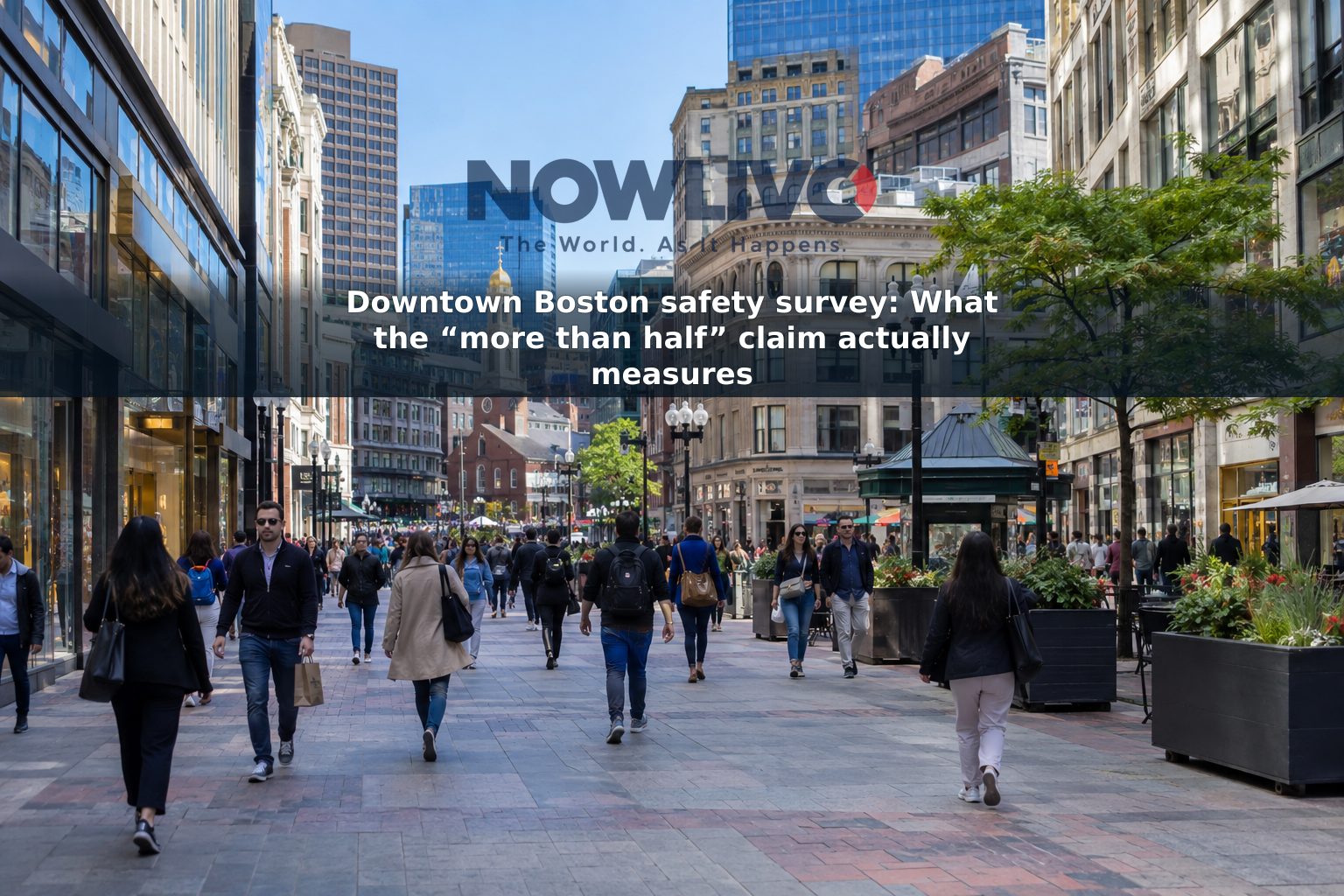
The claim that more than half of residents feel unsafe in downtown Boston appears to refer to a November 2024 neighborhood survey, but that is not quite what the survey asked. Of its 320 respondents, 71% said they felt less safe in Downtown Boston and Boston Common than they had at the beginning of 2024. That measures a change in perception, not the share who felt unsafe overall. A repeat survey in October 2025 found a smaller share—about 34%—felt less safe than they had at the start of 2025. A cluster of violent incidents in summer 2026 has since brought downtown safety back into focus.
What the surveys found
The Downtown Boston Neighborhood Association conducted the November 2024 survey ahead of a City Council hearing on safety in the area. Most respondents were downtown residents, though the survey also included other people connected to the neighborhood. It was a survey of people who chose to respond, not a representative poll of everyone living in Boston. Its finding cannot be used to say that a majority of all city residents feel unsafe downtown.
The distinction between “less safe” and “unsafe” matters. Someone might still feel comfortable walking through an area while believing conditions have worsened. Conversely, a person who reports no change might have felt unsafe throughout the period. The survey’s year-to-date comparison does not establish either person’s absolute sense of safety.
When the association repeated the same question before an October 30, 2025, public safety summit, it received 371 responses. About 34% said they felt less safe than at the beginning of 2025, down from 71% in the 2024 survey. The share who felt more safe rose from 2% in 2024 to 17% in 2025. Those results pointed to an improvement in respondents’ assessments during 2025, not to an end to every safety concern.
Why the issue resurfaced in 2026
A series of violent incidents near Downtown Crossing and Boston Common during summer 2026 renewed calls for action. The neighborhood association said five people were shot in three incidents between June 29 and July 15 within roughly half a mile of one another. It requested more visible policing and additional resources on July 15. On July 22, a man was fatally beaten near the Boylston and Tremont streets edge of Boston Common.
The association and public officials returned to the issue at an August 5 working session. Participants examined trouble spots block by block and discussed targeted interventions. The association said its requests included a sustained police presence, more staffing in District A-1 and coordination among city agencies and local organizations.
Those incidents are serious, but they should not be confused with a new survey showing that most residents now feel unsafe. The association’s published comparison remains between its November 2024 and October 2025 surveys. Its account of the summer 2026 violence describes renewed concern; it does not provide an updated percentage for residents’ perceptions.
What police figures can—and cannot—show
Police counts add a separate measure. Preliminary Boston Police Department figures show 1,495 reported major violent and property offenses in District A-1 from January 1 through September 13, 2026, compared with 1,600 during the same period in 2025, a decline of about 7%. District A-1 covers more than the specific blocks around Downtown Crossing and Boston Common. Its year-to-date total therefore cannot rule out a shorter surge in violence at particular locations.
Crime reports also do not measure how comfortable people feel using a street, park or transit stop. The clearest reading is narrower than the original claim: a majority of respondents in a 2024 neighborhood survey said downtown felt less safe than earlier that year; respondents reported improvement in 2025; and violent incidents in 2026 prompted a renewed response. No single one of those findings establishes that more than half of Boston residents currently feel unsafe downtown.