Singeetham Srinivasa Rao dies at 95: Why the Aditya 369 director stood apart
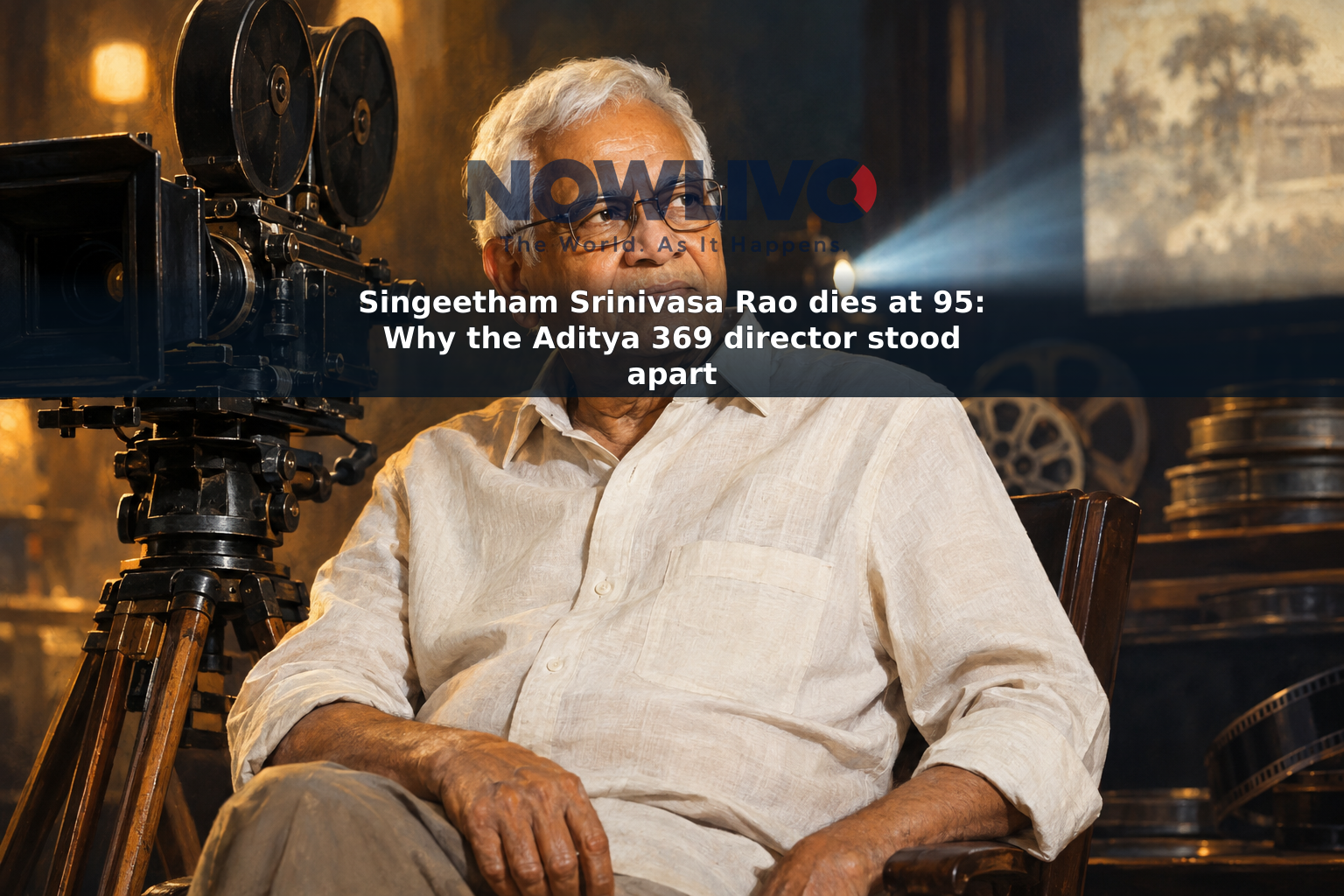
Filmmaker Singeetham Srinivasa Rao died in Chennai on October 3, 2026, his family confirmed. He was 95. The director of Pushpaka Vimana and Aditya 369 stood apart for making ambitious, accessible films in several languages without settling into one genre: he moved from wordless comedy to science fiction, biographical drama and folklore-inspired fantasy.
Rao had been receiving treatment at Kauvery Hospital after his health deteriorated. His grandson Ashwin shared details of the family’s plans for his cremation. Born on September 21, 1931, Rao had turned 95 less than two weeks before his death. Some accounts have given his age as 94, but his published birth date makes him 95 on October 3, 2026.
A filmmaker who changed the rules of each story
Perhaps the clearest example of Rao’s approach is Pushpaka Vimana (1987). The black comedy stars Kamal Haasan but has no spoken dialogue. Its story depends instead on performance, framing, sound and the audience’s ability to read what characters want from one another. Released under different titles in different languages, including Pushpaka Vimanam in Telugu and Pushpak in Hindi, it could travel without relying on dubbed speech. The film won a National Film Award for popular entertainment.
Four years later, Rao took a very different risk with the Telugu film Aditya 369. Starring Nandamuri Balakrishna, the 1991 adventure sends its characters through time, bringing a science-fiction device into a story that also visits the court of the Vijayanagara ruler Krishnadevaraya. Rao treated the time machine not simply as a spectacle but as a way to connect historical settings, comedy and adventure for a mainstream audience.
His next prominent collaboration with Balakrishna, Bhairava Dweepam (1994), left the machinery of science fiction behind for an island fantasy drawn from folklore. Taken together, those films show why describing Rao as only a Telugu science-fiction pioneer misses much of his appeal. He was interested in how a premise could reshape the entire world of a film.
Across languages, stars and genres
Rao’s career began long before those experiments. He worked with filmmaker K. V. Reddy early on and made his directorial debut with the Telugu film Neeti Nijayiti in 1972. His Tamil film Dikkatra Parvathi (1974) won the National Film Award for Best Feature Film in Tamil. Mayuri (1985), inspired by dancer Sudha Chandran’s return to performance after losing a leg, demonstrated his ability to build a film around a real person’s determination rather than a fantasy premise.
He also became a familiar creative partner to major stars in different industries. In Tamil cinema, his work with Haasan included Apoorva Sagodharargal and the four-role comedy Michael Madana Kama Rajan. In Kannada cinema, he directed films featuring Rajkumar, as well as Anand, which introduced Shivarajkumar as a leading actor. His credits extended to Hindi cinema too. The range was more than a matter of translating a successful formula: the performers, comic rhythms and storytelling demands changed from project to project.
That willingness to start again remained visible late in his life. Rao returned to directing with Sing Geetham, a musical fantasy released in 2026, more than five decades after his first film. Its emphasis on song as a means of carrying the story offered another variation on a career-long question: what else can a film do when its director refuses to take familiar conventions for granted?
Paying tribute, Haasan remembered Rao as someone he had admired and hoped to emulate. Director S. S. Rajamouli highlighted the breadth of his imagination, from a film without dialogue to a journey through time. Their responses reflect the achievement at the center of Rao’s career: he made unfamiliar ideas feel inviting to audiences across generations and languages.