What Is Anduril Building in Maryland? A $3.7 Billion Submarine-Parts Shipyard at Sparrows Point
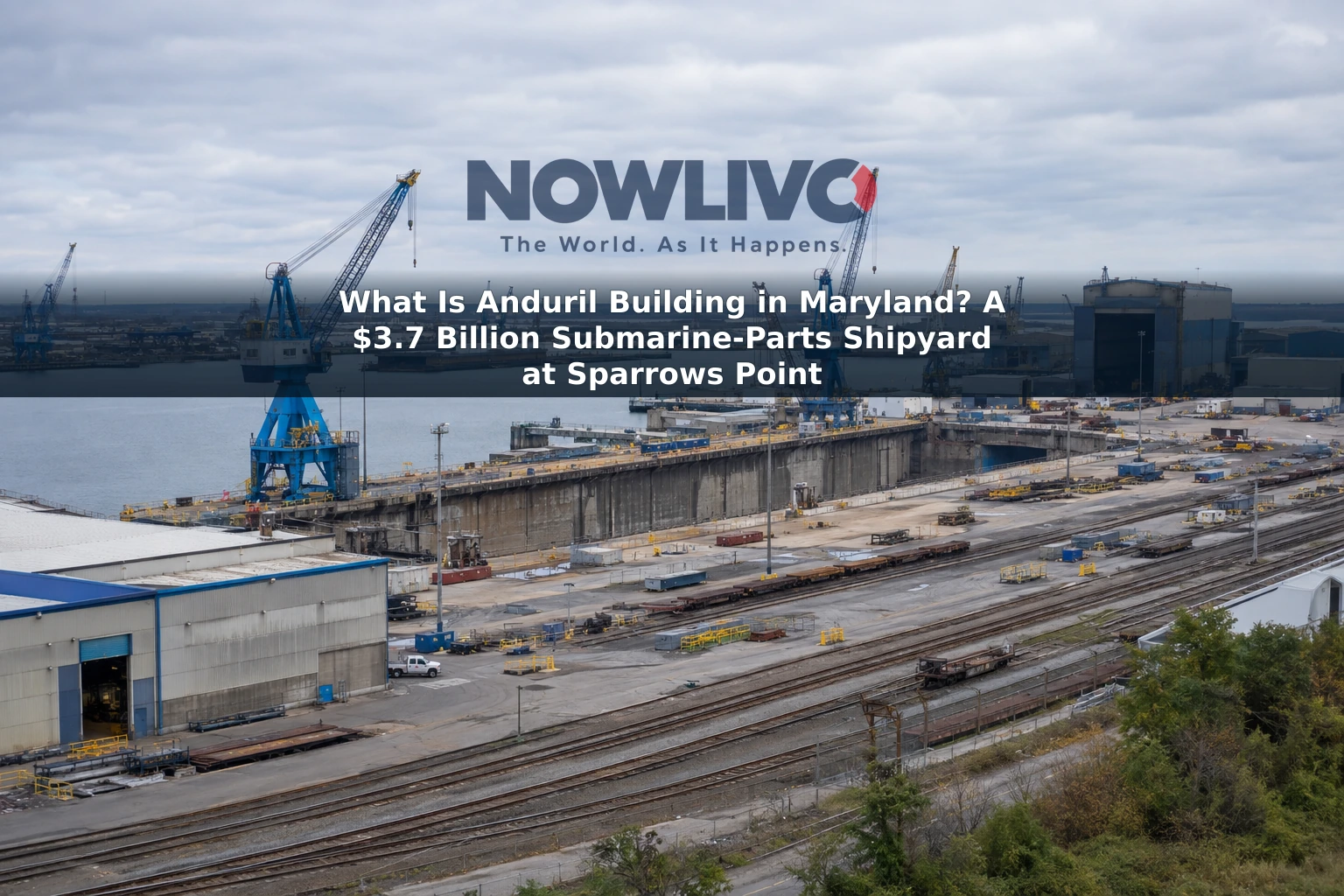
Anduril is planning a shipyard at Sparrows Point in Baltimore County, Maryland, to manufacture parts and large assemblies for the Navy’s Virginia-class nuclear-powered submarines. President Donald Trump highlighted the company’s planned $3.7 billion investment during a visit on October 6, 2026. The facility, called Arsenal-2, would supply submarine builders elsewhere—not assemble complete submarines in Maryland.
What will the Maryland shipyard make?
Anduril says Arsenal-2 will produce complex components and larger sections for Virginia-class attack submarines. Those parts will go to General Dynamics Electric Boat and Huntington Ingalls Industries’ Newport News Shipbuilding, which build the submarines and handle final assembly. Torpedo tubes are among the components Anduril is preparing to manufacture as it develops its production methods; the company expects to expand into larger assemblies over time.
The distinction matters for anyone searching for a “submarine factory near Baltimore”: Sparrows Point is intended to become a significant part of the submarine supply chain, but it is not slated to deliver finished boats. The submarines are nuclear-powered; the announcement does not say Anduril will build nuclear reactors at the site.
Where is the project, and when could it open?
The proposed shipyard is at Tradepoint Atlantic on the former Bethlehem Steel property at Sparrows Point, outside Baltimore City. Anduril describes a site of about 187 acres with more than 2 million square feet of planned manufacturing space. Its design calls for fabrication and assembly areas, a large graving dock and software to coordinate production and inspections.
Permitting and site preparation are expected to begin first, with construction dependent on the necessary approvals. Anduril targets initial operations in 2030 and says production would increase gradually afterward. That means the investment announcement is not the same as a fully built or operating shipyard.
In the meantime, Anduril plans to develop submarine-component manufacturing at a separate facility in Orange County, California. The company says that work will help establish production processes and train an early workforce before the Maryland yard opens.
Why does the $3.7 billion investment matter?
The $3.7 billion is Anduril’s planned private investment in establishing the facility, its workforce and manufacturing capabilities. Separately, the Navy has awarded the company a contract worth up to $2.9 billion for production, with payments tied to demonstrated results. The figures are sometimes combined as a project worth up to $6.6 billion, but the Navy contract is not an additional $2.9 billion that Anduril is spending to construct the shipyard.
For the Navy, the purpose is to add manufacturing capacity to a submarine program that depends on specialized workers, suppliers and shipyards. Having another company produce sections could let more work proceed alongside construction at Electric Boat and Newport News. Whether the project ultimately speeds submarine deliveries will depend on Anduril’s ability to build the facility, qualify its production processes and meet the Navy’s requirements.
What should local residents watch?
Maryland officials say the project is expected to create more than 3,100 permanent jobs and support more than 11,000 additional jobs indirectly. Those are projections, not positions already filled. Anduril identifies skilled trades such as welding, pipefitting, electrical work, shipfitting and inspection as important to the planned operation.
Public support is also part of the local picture. Maryland and Baltimore County say they have committed to incentives of up to 13% of Anduril’s anticipated private investment. Some of that support would require approval by the Maryland General Assembly and Baltimore County Council, and the state’s proposal includes help for a workforce-training facility.
For Baltimore-area readers, the near-term questions are when permits and construction move forward, what public incentives receive approval and how local workers can access training and future jobs. The larger promise is a new manufacturing use for a historic industrial site—but its economic impact will become clearer as the shipyard takes shape.