India Says UN Security Council Cannot Remain Bound to 1945, Calls for Reform Talks
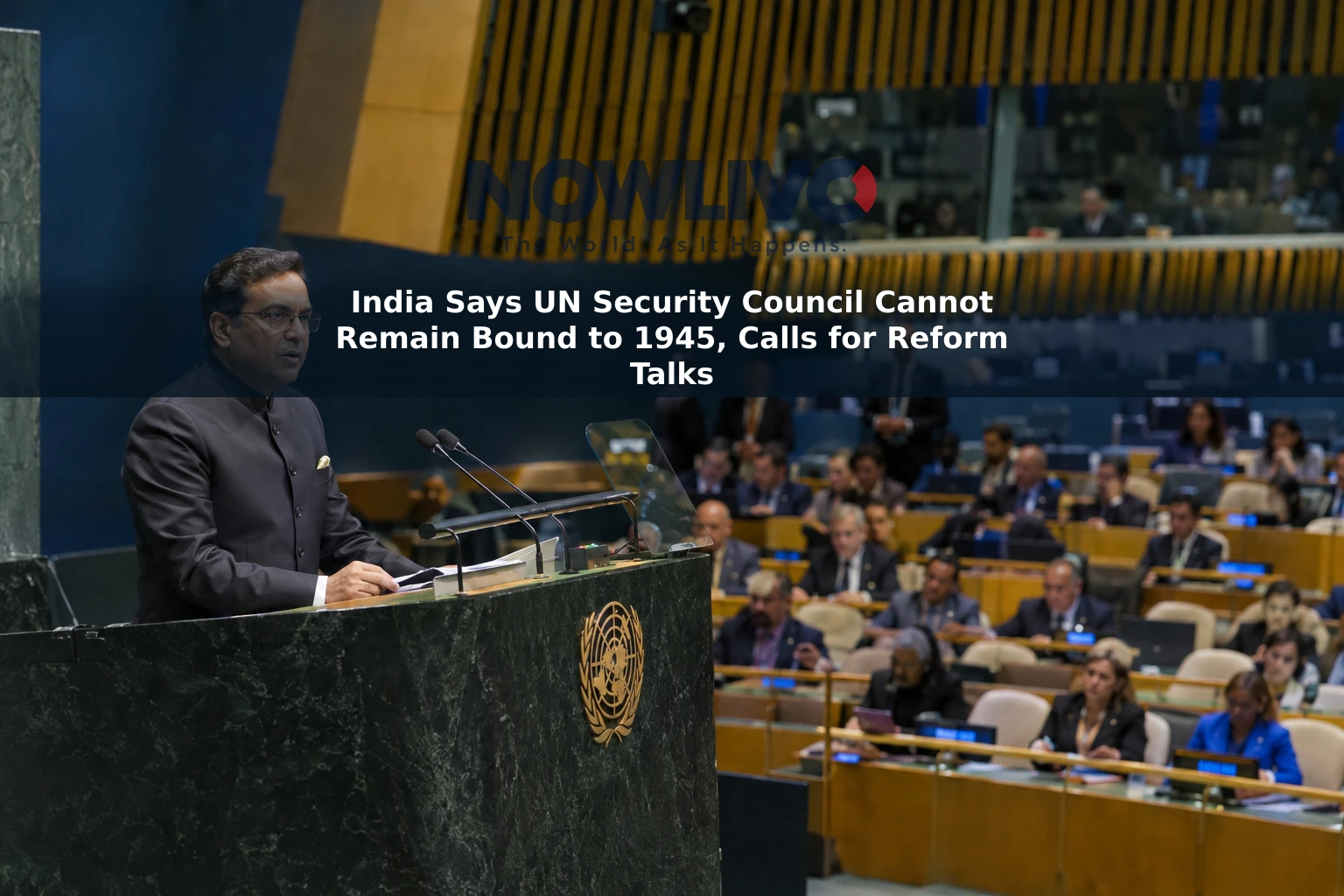
India has renewed its call to reform the UN Security Council, saying the outcome of World War II cannot remain the basis for deciding who holds permanent power in the body today.
Speaking to the UN General Assembly on October 22, 2026, India’s permanent representative, Ambassador Parvathaneni Harish, said a Security Council that does not adequately represent the wider UN membership faces a deficit in legitimacy. He also pressed countries to begin negotiations on a written text instead of allowing the reform process to remain open-ended.
India challenges the Security Council’s wartime structure
The Security Council has 15 members. Five—China, France, Russia, the United Kingdom and the United States—hold permanent seats and can veto substantive resolutions. The other 10 are elected for two-year terms.
Harish argued that the authority associated with victory in a war more than 80 years ago cannot make up for the lack of representation he sees in the Council today. He pointed to India’s contribution to the Allied war effort, saying about 2.5 million Indians served during World War II and about 90,000 died in military service.
His remarks linked India’s longstanding push for a permanent seat to a broader question: whether the Council can retain the confidence of UN members while its permanent membership remains unchanged.
The Council is responsible for maintaining international peace and security. Its decisions can bind UN member states, making the question of who has a lasting voice—and a veto—especially consequential.
Reform talks remain divided
India wants the Council expanded in both its permanent and elected categories. It works with Brazil, Germany and Japan in the Group of Four, or G4, which supports new permanent seats, including greater representation for regions that lack them.
Other countries disagree on how to make the Council fairer. The Uniting for Consensus group opposes adding new permanent members and favors an expansion built around seats that are elected or rotate. Those competing proposals have kept countries divided over the shape of a reformed Council.
Harish focused on the way the negotiations are being conducted. He said the intergovernmental talks should proceed on the basis of a text that sets out proposals for countries to debate and revise. In his view, waiting for agreement before adopting a negotiating text reverses the usual order of diplomacy.
A written text would not settle the dispute over permanent seats or veto power. It would, however, give countries a shared document on which to negotiate. Harish argued that the absence of such a text should not be used to delay the process indefinitely.
Why a change would be difficult
The Security Council has expanded once. An amendment that took effect in 1965 increased its membership from 11 to 15 by adding four elected seats. It did not change the five permanent seats.
Any further change to the Council’s membership would require an amendment to the UN Charter. That means approval by two-thirds of the General Assembly, followed by ratification by two-thirds of UN members, including all five permanent Council members.
India’s latest appeal did not change those rules or deliver an agreement on new seats. It sharpened its demand for the next step in the talks: a negotiating text that would force countries to work through their differences over representation and power in the Security Council.