How to Check Whether an AI Citation Is Real and Supports the Claim
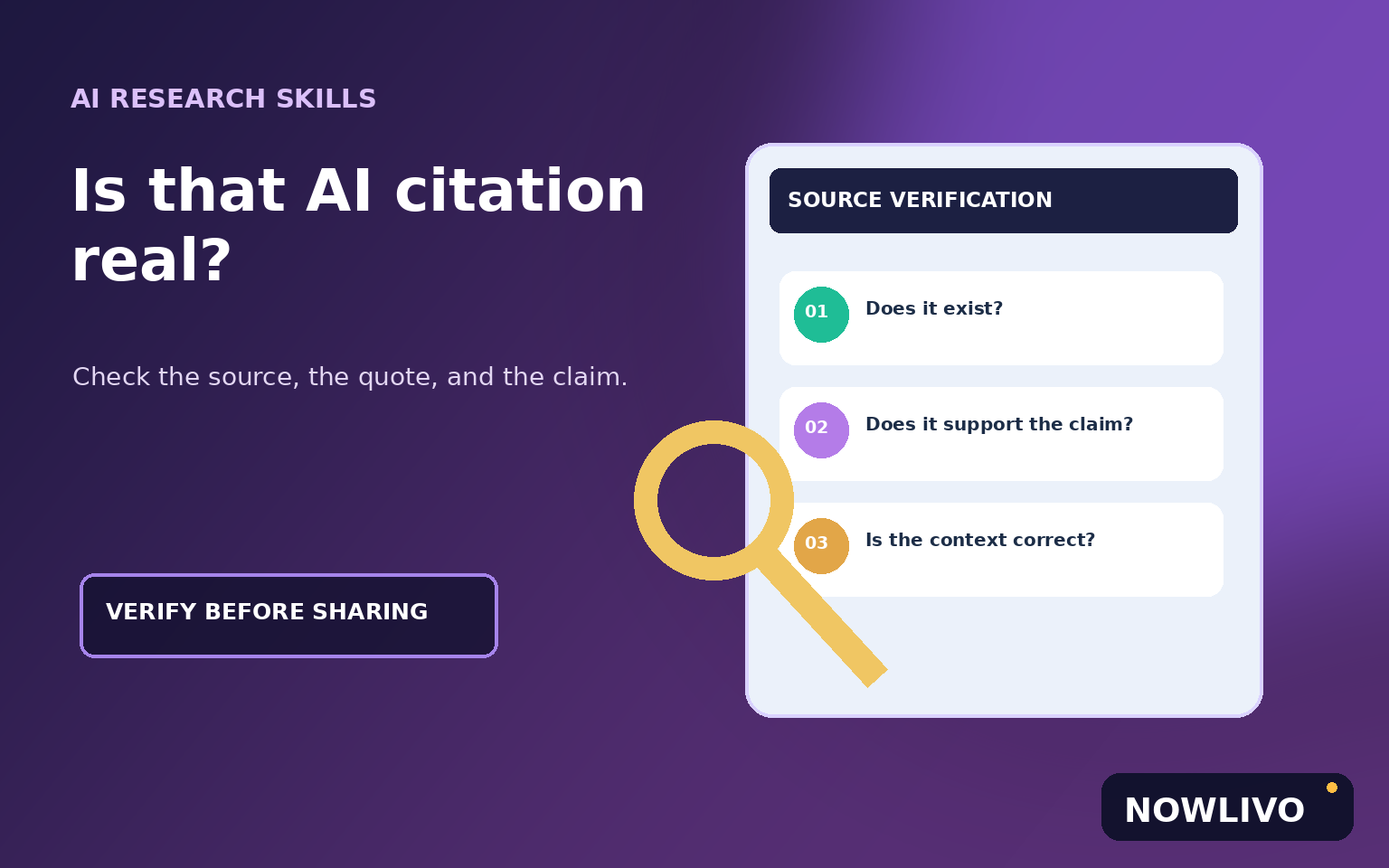
An AI answer arrives with six polished footnotes, a journal title and a confident quotation. It looks researched, but the references may be inaccurate, unrelated or nonexistent. A link is not proof of the sentence placed next to it, and a correct-looking citation can still point to material that says something else. The practical solution is a source-checking workflow: verify that the source exists, then verify that it actually supports the claim, and finally confirm the claim has not been stripped of essential date or context.
This guide is for students, job seekers, journalists, managers and everyday readers using AI-generated summaries to make decisions. It does not require a paid research tool or an advanced degree. It does require refusing to treat fluent writing as evidence.
Split one AI paragraph into checkable claims
Suppose an AI assistant writes: 'A university study proved that a new app improves concentration by 40%, and experts recommend it for all students.' There are several independent propositions here: a study exists, the university conducted it, the study tested that app, a particular improvement was measured, and the result supports a recommendation for every student. One paper could support only part of that chain. The quoted statistic may apply to a tiny subgroup, a different outcome or no real study at all.
Highlight each statement that needs evidence. For a practical user guide, start with the few claims that would change your action: safety instructions, financial charges, application deadlines, eligibility, scientific results and direct quotations. A decorative background sentence may need less urgent checking, but consequential instructions deserve primary-source confirmation. This is a better use of time than asking the same AI to assure you that its first answer is '100% accurate.'
Test whether the cited document really exists
Take the exact article title, named author, publisher, date or DOI and search independently. For scholarly work, use a university library catalogue, a recognized academic search index or Crossref's metadata search. Crossref explains that its search tool accepts titles, authors, DOIs and full citations. A DOI that resolves is useful identity evidence, but it is not automatic proof of quality, relevance or the claim in the AI answer.
If you find a close title with different authors or year, pause and reconcile the mismatch. Sometimes the AI has blended two real publications. Sometimes the source exists but is a working paper, commentary or publisher summary rather than the peer-reviewed article the answer described. If you cannot find a supposedly important source after a reasonable search, label the claim unverified instead of creating a citation from memory.
Open the source and inspect the exact passage
Finding a real source clears only the first hurdle. Follow its link, check the date and read the relevant section. Use search within the page or PDF to locate the phrase, number or subject. Then read the surrounding paragraph and, where available, the methods, limitations or footnotes. A source may mention a topic without endorsing the AI's interpretation of it. A study about adult volunteers cannot automatically justify a claim about children; a survey of one organization is not a measure of an entire country.
Be alert to different types of evidence. A press release can establish what an institution announced. It may not independently establish whether the announcement's predicted benefits happened. An official website can state its current procedure; a four-year-old screenshot cannot guarantee the same menu still exists today. A personal testimonial illustrates a person's experience but cannot, by itself, prove what usually happens to everyone.
Identify the source closest to the decision
For a train boarding rule, check the operator. For scholarship registration, check the government portal and relevant scheme notice. For software menus, check official product documentation. For a scientific claim, find the study and its underlying methods rather than quoting a marketing recap. This is not an argument that official bodies can never be wrong; it is a way to find the publication responsible for the particular rule or assertion you need to confirm.
Secondary reporting can be valuable for explanation or challenge, especially when it compares multiple sources. But avoid a loop in which five blogs copy the same unsupported claim from one another. Look for genuinely independent corroboration. MIT Libraries' research guidance recommends lateral reading: open other tabs and assess the claim outside the original page. That habit also helps detect copied errors and unusually confident summaries.
Check dates, geography and definitions
An accurate answer for last year may be wrong for this year. Admissions portals change, app features move, subscription terms evolve and government procedures can be revised. Record both the publication date of the source and the date to which the claim applies. Ask whether it is a rule, a proposal, a pilot program or an already implemented service. The date a blog page was updated does not necessarily mean every paragraph was reverified.
Geography is equally important. A payment feature documented for India may differ elsewhere. A tax statement for one jurisdiction is not general financial advice. Definitions can also create hidden errors: 'application approved', 'verified', 'amount sanctioned' and 'payment received' are not synonyms. Write the actual term used by the original source before paraphrasing it. Small distinctions prevent large downstream mistakes.
A practical five-column source-check sheet
Use a spreadsheet or a notebook with five headings: AI claim; cited source; source found?; passage supports claim?; final wording. Here is a hypothetical example. The AI claim is 'All applicants receive funds immediately after registering.' The cited source is a scholarship website. The website exists, but its instructions say registration is only the first stage. The proper final wording becomes 'Registration creates a credential; applicants must still submit the scholarship form and meet the scheme's review stages.'
This approach produces an audit trail. You can tell a colleague not just that something looked suspicious, but exactly which leap in reasoning failed. Add the access date for sources that change frequently. If a passage is unavailable because of a paywall, identify that limitation rather than suggesting you read a document you did not open. For controversial or high-stakes claims, seek another reliable source or a qualified human review.
When an AI gives you a quotation
Verbatim quotations need special scrutiny. Search the exact wording in the claimed speech, paper, interview or official statement. Confirm the speaker, date and complete context. If you find only a paraphrase or another person's summary, do not present the sentence in quotation marks. If the original statement is in a different language, separate your translation from an authoritative English quotation.
AI systems can also merge wording from different interviews, assign a sentence to the wrong expert or convert a cautious conclusion into a dramatic endorsement. If the quotation matters to the article, find the primary recording, transcript or authenticated written statement. Otherwise, remove the quote and accurately paraphrase only what the source establishes. A modest, verifiable sentence is stronger journalism than a memorable line nobody actually said.
Why a DOI or a citation count isn't a truth certificate
A DOI is an identifier that helps locate and match a publication. Crossref can help check metadata, but the presence of a DOI does not automatically confirm the study's conclusions, methodology or suitability for your question. Some legitimate sources have no DOI at all. Conversely, an article with a long list of references can still misuse those sources or contain mistakes of its own. Verification is about claims, not decorative citation formatting.
Read the paper's actual results and limitations when possible. Ask about sample, comparison, uncertainty, context and whether the research was later challenged. It may be reasonable to say 'the study reported an association' when it would be unreasonable to write 'the study proved the cause.' If you cannot assess a specialist paper, seek help from a librarian or domain expert rather than allowing the AI to adjudicate its own reliability.
Make the AI useful without handing it authority
AI tools can still accelerate the workflow. Ask one to list the checkable claims in a paragraph, extract dates and names, suggest alternative search terms, or draft a checklist for what to confirm. You can also ask it to identify possible counterexamples or unanswered questions. Treat the output as a research assistant's working notes, not as an independently verified final statement.
A good prompt is: 'Separate these statements into claims. For each, say what kind of source would verify it and what uncertainty remains. Do not invent citations.' Then conduct the source search outside that same generated answer. MIT Libraries' guidance makes the responsibility clear: verify AI-provided information and cite the actual underlying evidence in addition to acknowledging AI use where appropriate. When writing for a school or employer, follow its current AI-disclosure rules.
Three cases where checking changes the answer
In a health question, an AI summary may turn a preliminary result into personalized treatment advice. Confirm the evidence and ask an appropriate clinician for decisions involving your circumstances. In a career question, an AI may invent a company's application deadline or an employee quotation; use the company's official recruitment page for the live requirement. In a travel question, a booking app might estimate waitlist confirmation, but the railway's current PNR is the relevant source for an actual boarding decision.
The common lesson is to match the evidence to the action. If a mistake can cost money, a journey, an application opportunity or a person's reputation, raise the verification standard. NOWLIVO's original analysis of what search trends can and cannot establish offers a related example: popularity of a search term is not evidence that the underlying claim is true.
A two-minute final check before sharing
Read every statistic and quotation aloud, then ask: could I open the original source for this? Check at least the most consequential statements, make the time and location boundaries visible, and remove any reference that does not resolve or does not support its sentence. If the claim remains disputed or unconfirmed, describe that uncertainty directly. Do not conceal it under phrases such as 'research proves' or 'experts agree.'
For a report or article, keep a short private verification log showing the original claim, real sources consulted and any correction you made. That habit has a second benefit: when a source changes, you can update the existing page instead of producing a new near-duplicate article. Strong research is not the absence of uncertainty; it is making clear what the evidence can support.
Questions worth asking
What if the citation link opens a real website but not the claimed article?
Treat it as an unverified reference. Search the title and author independently. If you cannot locate the cited work, do not use the citation as support.
Does getting the same answer from two AI systems count as confirmation?
No. The systems may draw on overlapping material or reproduce the same mistake. Independent source verification is stronger than agreement between generated responses.
Do I need to verify every harmless sentence?
Prioritize statements that are specific, surprising, quoted, numerical or consequential. Then apply the same standard to anything your audience will rely on as a fact.
Sources and review note
Reviewed 25 October 2026 against MIT Libraries' guide on evaluating AI content, MIT's guidance on citing and checking AI-generated material, Cornell University Library's research guide, and Crossref metadata search help. AI products and institutional disclosure rules change; check the applicable policy when publishing or submitting work.