India Gives Initial Approval to ₹2.12 Lakh Crore Defence Purchases Including Drones and Artillery
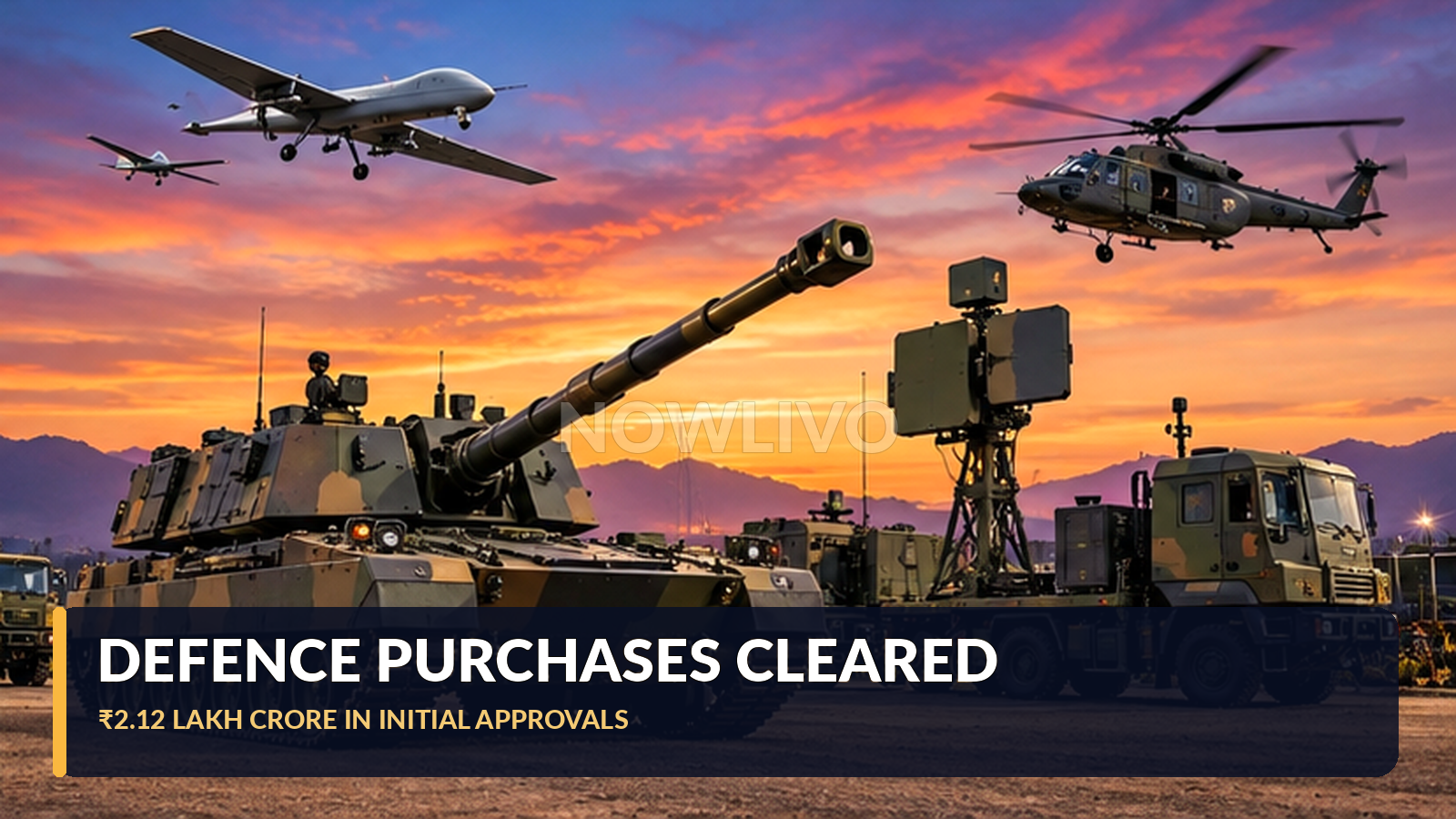
India's Defence Acquisition Council has granted initial approval to military procurement proposals valued at about ₹2.12 lakh crore, a major package covering drones, air defence equipment, artillery, helicopters and other systems. The decision was announced on Monday, October 26, after a council meeting chaired by Defence Minister Rajnath Singh. It is a significant step in the acquisition process, but it should not be confused with the government signing contracts for the entire amount or delivering equipment to the armed forces.
The Defence Ministry said roughly 82% of the proposed procurement value is expected to be sourced from Indian industry. That makes the announcement relevant to domestic manufacturers as well as the Army, Navy and Air Force. The items described in reporting include additional K9 Vajra self-propelled tracked guns, very short-range air defence systems, counter-drone platforms, long-range surveillance equipment, strike systems, helicopters and loitering munitions. Individual suppliers, prices and delivery schedules for all proposals have not been established in the public reporting.
What the council actually approved
The Defence Acquisition Council is a key body for assessing and clearing major capital procurement proposals. Its Acceptance of Necessity is a formal indication that the military requirement can move forward under the acquisition framework. It is not the final stage. Detailed specifications, bidding or other procurement steps, negotiations, contract approvals and production or delivery arrangements may still be needed. A headline saying India has already bought every item worth ₹2.12 lakh crore would therefore be inaccurate.
The scale of the package is nevertheless substantial. Reuters put the value at about $22.27 billion using the exchange rate cited in its October 26 report. The rupee figure is the more direct reference for the Indian decision, while the dollar equivalent will change with currency movements. Readers comparing the announcement with the defence budget should also distinguish a set of proposed capital acquisitions from spending that will necessarily occur in a single financial year.
Drones and counter-drone systems stand out
A notable feature of the package is the emphasis on unmanned systems. Long-range surveillance drones can help armed forces observe terrain and movements without placing a crew directly over the area. Strike-capable systems and loitering munitions serve different missions, while counter-unmanned-aircraft equipment is designed to detect or defeat hostile drones. These categories have gained attention because recent conflicts have shown how inexpensive unmanned platforms can challenge much more expensive conventional equipment.
The council's proposed purchases should not be read as a claim that one specific drone type will solve every operational problem. Performance depends on sensors, communications, weather, training, integration and how equipment is used with other forces. Air defence is also layered: very short-range systems are not interchangeable with longer-range missile networks or electronic countermeasures. The reported list reflects a broad attempt to address several kinds of threats rather than a single flagship weapon.
Artillery, helicopters and mobility
Additional K9 Vajra tracked artillery guns are among the most recognisable proposals. Self-propelled artillery is intended to combine firepower with the ability to move alongside mechanised formations. High-mobility vehicles and utility helicopters can also affect how quickly units deploy, reposition or support troops in difficult terrain. Reports on the council meeting identified proposals for naval equipment as well, although the public accounts did not provide a complete contract-by-contract schedule.
A useful distinction is between the military service requesting a capability and the manufacturer that may eventually supply it. The council's clearance identifies needs and advances the procurement process. It does not, by itself, award every contract to a named company. Investors following defence stocks should avoid treating an approval headline as proof that a particular firm has secured an order or that revenue will arrive immediately.
The domestic industry target
The ministry's statement that approximately 82% of the procurement will come from Indian industry places the decision within a broader push to build domestic defence capacity. Local sourcing can support assembly, manufacturing and maintenance capabilities, but the precise economic benefit depends on how much design, technology and component production takes place domestically. A platform built in India can still include imported components, so the headline percentage should not be equated automatically with complete technological self-sufficiency.
The package could create opportunities for established suppliers and smaller companies involved in electronics, sensors, vehicle systems and unmanned platforms. Those possibilities remain conditional on later procurement stages. Timelines, competitive procedures, production capacity and testing requirements will determine how quickly any opportunity turns into a contract. The government's announcement does not provide enough information to forecast company-specific earnings from the full headline amount.
What happens next
The next meaningful milestones are tender documents, selected procurement routes, final approvals, contract awards and delivery schedules. These would show which of the proposed capabilities move from initial clearance to funded orders. A future revision in specifications or cost would also be a substantive development. Until then, the October 26 decision is best understood as a large, official statement of procurement intent, with a strong domestic sourcing component and a clear focus on drones, air defence and battlefield mobility.
For readers, the central takeaway is the distinction between ambition and completion. India has taken a formal step toward acquiring a wide range of equipment, but the armed forces have not received ₹2.12 lakh crore of new hardware overnight. That distinction preserves the significance of the decision without overstating what the council's approval means.