Meloni’s New Protest Crackdown: Five-Year Jail Terms and Parents Paying for Damage
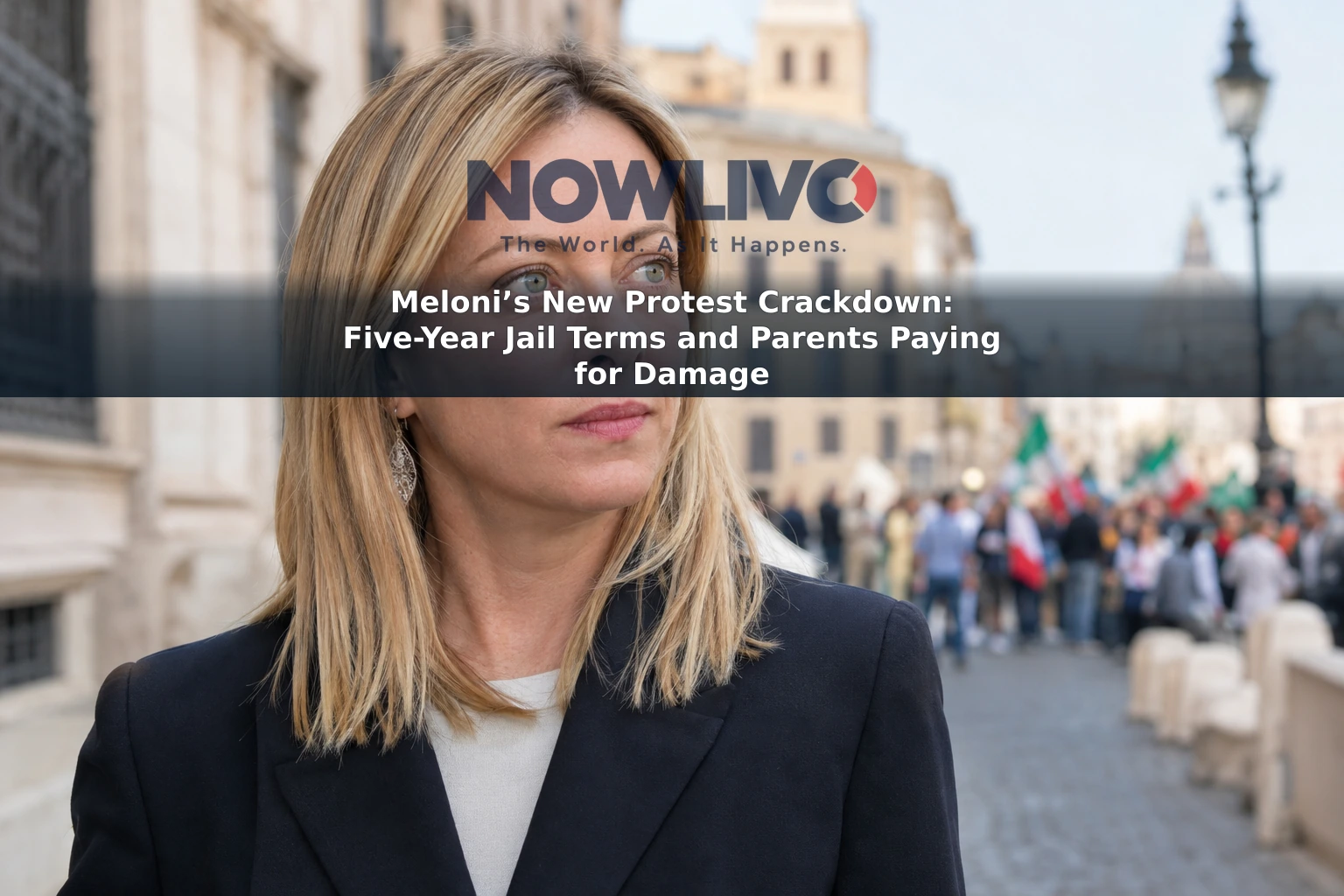
Italian Prime Minister Giorgia Meloni announced a new crackdown on violent protests on October 20, 2026, after unrest in Milan and other cities. Under a decree approved by her cabinet, people who take part in a group of at least five and throw dangerous objects during a demonstration could face up to five years in prison and a fine of up to €20,000. The government also wants parents to pay for damage caused by their minor children.
The announcement has prompted a question for India: should it adopt the same rules? The comparison starts with a fact often missed in that debate. India already has laws against damaging public property, including a penalty of up to five years in prison. What Italy’s decree adds is a specific offence aimed at violent conduct during demonstrations, alongside new ways to recover the cost of damage.
What Italy’s decree would punish
Meloni described the new offence as violent participation in a demonstration. Her example was a person joining a group of five or more and throwing stones, firecrackers or sticks in a way that endangers others. She said penalties would increase in certain circumstances, including when someone covers their face or injures another person.
The group size does not mean that five people standing together at a peaceful march would commit a crime. The conduct Meloni described involves throwing or using dangerous objects and creating a risk to people’s safety.
The cabinet approved the decree following a weekend of disorder that included damage to shops in Milan. Approval by the cabinet is the development announced on October 20; the terms of the decree, rather than a final court ruling in any particular case, set out the proposed penalties.
Meloni also set out a principle that those responsible for breaking property should pay for it. She said the measures would allow authorities to seek payment for damage to public property and give private owners a route to claim for damage to shops, vehicles or other belongings. If a minor caused the damage, her government intends to make the parents liable for payment.
India already has penalties for protest-related damage
India’s Prevention of Damage to Public Property Act, 1984, applies to damage to property such as government facilities and public transport. Its general penalty can reach five years in prison, as well as a fine. It is not limited to damage caused during protests.
There are also routes to seek compensation. The Supreme Court has laid down guidelines for assessing and recovering losses when public or private property is destroyed during mass protests. Uttar Pradesh has a separate 2020 law providing for claims tribunals to award compensation for damage to public or private property during riots, protests and other public disturbances.
That does not make India’s rules identical to Italy’s new decree. The Italian measure singles out dangerous group conduct at a demonstration, even where the central issue is the risk created by thrown objects. Its stated approach to recovering money from parents is another distinct feature. India’s existing public-property law, by contrast, addresses damage to property; it does not establish a blanket national rule that parents automatically pay whenever a child causes damage at a protest.
The line between accountability and peaceful protest
India’s Constitution protects the right to assemble peacefully and without arms. Throwing stones or damaging a bus falls outside peaceful protest, but being present at a march where somebody else turns violent is not the same as committing that act.
That distinction would matter if India considered a law modelled on Italy’s decree. Investigators would need to identify who threw an object or caused damage, and claims for payment would need a fair way to test the evidence and the amount sought. Those safeguards are especially important when a crowd contains people who took no part in the violence, or when a claim is made against a minor’s family.
India can punish vandalism and seek repayment under laws it already has. The practical choice raised by Meloni’s announcement is whether a more specific offence or stronger recovery process would improve accountability without treating peaceful demonstrators as responsible for the actions of others.