Buying Gold Jewellery in India? Check the BIS HUID Before You Pay
A hallmark is a checkable record, not just a sales claim
Gold jewellery is often bought for a wedding, a family occasion or long-term personal use. The price can be substantial, and a buyer may focus on design and weight while assuming the seller’s description of purity is correct. India’s Bureau of Indian Standards (BIS) hallmarking system provides a way to examine and verify certain jewellery markings. The useful habit is to check the item before payment rather than discovering a mismatch after the invoice is filed away.
The modern HUID, or Hallmark Unique Identification, is a code associated with a hallmarked article. BIS provides a Verify HUID function in its BIS Care app. This guide focuses on gold jewellery with the relevant hallmark; rules and treatment for older articles or other precious metals may differ. Verification helps you ask better questions but does not replace an appropriate bill or an independent test when a genuine dispute exists.
Understand the three familiar hallmark components
BIS guidance for jewellers describes the hallmark information that buyers should be able to inspect. For contemporary HUID-hallmarked gold, look for the BIS standard mark, a purity or fineness marking and the alphanumeric HUID. These are physically marked on the article, sometimes in a small or inconspicuous location. A salesperson should help you find the markings without damaging the jewellery.
The purity mark communicates fineness. For example, 22K/916 is commonly used to indicate a gold alloy with nominal fineness of 916 parts per thousand. That is different from a claim that the whole ornament, including stones and non-gold components, consists entirely of pure gold. Ask how the jeweller separates metal weight, stone weight and other components in its bill. Do not assume every product marked “gold” is hallmarked.
Find the HUID on the actual item
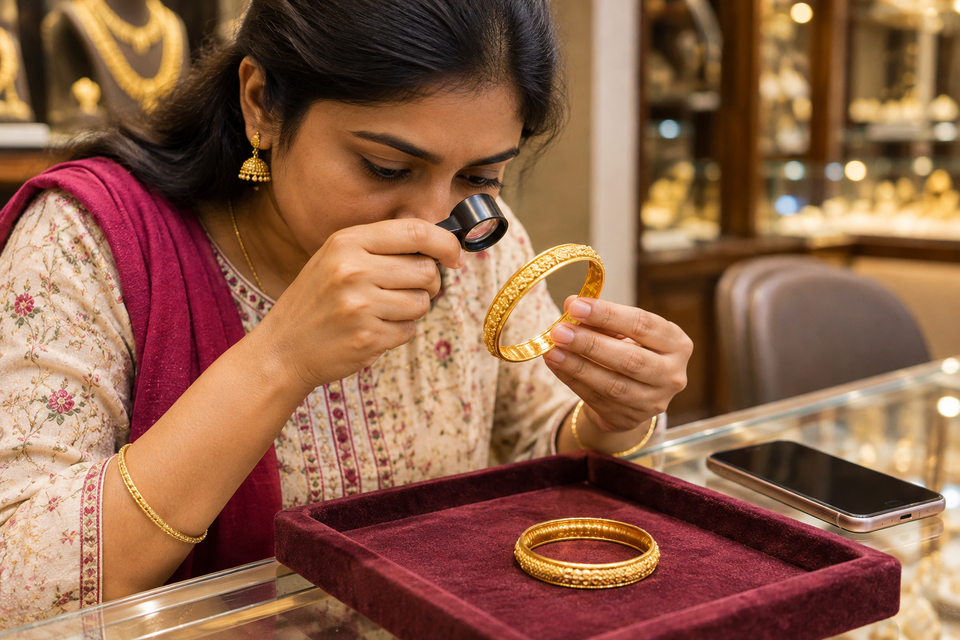
Ask to inspect the exact bangle, ring or chain you intend to buy, not another sample from the same display. The HUID may be tiny; a magnifying glass or loupe helps. BIS guidelines require registered jewellers to make magnification available for consumers to verify hallmark details. Take your time and ensure the code you enter belongs to the actual piece you are purchasing.
For a pair of earrings or a set, ask the seller how each article is marked and invoiced. Do not rely on a handwritten code copied onto a separate slip without seeing its relationship to the item. If the marking is too worn to read, ask the shop for an explanation and an appropriate verification route before you agree to the sale.
Verify the code using BIS Care
Install the official BIS Care app from a trusted app store and confirm that the publisher is the Bureau of Indian Standards. Use its Verify HUID feature and enter the code engraved on the article. Review the result carefully. Depending on the app version and the record, the returned details can include the article type, purity and hallmarking-related information. The exact fields displayed may change as BIS updates the service.
The official app is a more reliable starting point than a seller’s screenshot or an unfamiliar website asking for payment to “unlock” the HUID. If the service is temporarily unavailable, do not conclude automatically that the jewellery is counterfeit. Retry later or ask the seller to help verify through the official channel. A network failure and a genuine record mismatch are different problems.
Compare the result with the physical jewellery
A valid-looking code is only the beginning. Compare the purity grade and article description in the app with the ornament in your hand and the sales invoice. If the HUID result indicates a different type of article or fineness, stop and ask the jeweller to explain. Save the code and the relevant result, but avoid publicly posting personal details or unverified accusations.
Some jewellery is modified, resized or repaired after purchase. Such history can complicate a simple visual comparison. Ask whether the piece has been altered and whether the hallmark still accurately describes the metal being sold. If you cannot resolve the discrepancy, consider a BIS-recognized testing or complaint route rather than accepting a verbal assurance that all codes are interchangeable.
Read the invoice as carefully as the design
Ask for a proper invoice showing the seller’s identity, description of the item, purity, relevant weight details, pricing components, applicable taxes and the HUID where relevant. The total payable amount can include the metal value, making charges, stones or other components, and taxes. These are distinct from the metal’s fineness. A high price or a prestigious store interior does not itself prove purity.
Before paying, check whether the invoice’s description matches the actual piece and whether the quoted rate and charges were explained. Keep the bill in a secure place; it may be important for a complaint, insurance, exchange or future sale. Do not rely on a photograph of the display tag as your only record. Ask the store for a corrected invoice if the HUID or purity has been entered incorrectly.
Hallmarking is not the same as valuation
A hallmark relates to declared fineness and a verification framework. It does not tell you whether the design suits you, whether the making charge is competitive or what another buyer will pay later. A heavy stone-set ornament can have a gross weight quite different from the net gold weight used in a metal-value calculation. Clarify these terms before comparing two shops’ offers.
Similarly, a resale or exchange policy is a commercial promise with conditions. Ask in writing about deductions, testing, damaged items, stones and how the store calculates any exchange value. Do not assume the entire invoice amount is recoverable simply because the gold is hallmarked. Purity verification and financial comparison answer different questions.
What about inherited or older jewellery?
An old family ornament may predate the current HUID approach or may carry an earlier style of hallmark. Absence of a modern HUID on an older piece does not, by itself, establish that the gold is fake. Equally, a family story about a piece’s age is not a laboratory purity test. If the value matters, seek advice from a reputable testing facility and understand the method used.
For a repair or exchange, ask whether testing or melting will be required and what that means for the design, weight and any sentimental value. Get a written estimate and acknowledgement before leaving valuable jewellery with a third party. A modern retail HUID verification workflow should not be misapplied to every historical object.
How to respond to a mismatch or refusal
If a seller refuses to show the hallmark or a HUID result does not correspond to the article, pause the transaction. Ask for the exact code, an explanation in writing and an invoice that accurately describes the piece. If you have already purchased it, preserve the bill, photographs of the markings, relevant app result and communications with the shop.
BIS Care includes consumer complaint functionality relating to misuse of marks and product quality. Use official BIS channels for an issue within its remit, and consider appropriate consumer-redressal routes for commercial disputes. Do not pay an unknown “verification agent” or share banking credentials to file a complaint. A dispute may require physical testing, so an app screenshot is evidence to preserve, not always a final technical conclusion.
A two-minute shop counter routine
First identify the actual piece and its metal-purity description. Second, locate the BIS hallmark and HUID on that piece. Third, verify the code through BIS Care and compare the returned details. Fourth, review the invoice line by line, especially purity, net gold weight, other components and charges. Fifth, confirm the seller’s written exchange or return terms if they matter to you.
For a gift purchased on someone else’s behalf, keep the invoice and HUID record together so the recipient can refer to them later. For an online order, repeat the physical inspection after delivery; a listing photograph is not proof of the markings on the item received. If anything important does not match, document it before removing tags or altering the jewellery.
Common buyer questions
Does a HUID tell me the current price of the jewellery? No. It is a hallmark identification and verification tool, not a live valuation or buyback guarantee.
Is a jewellery-shop certificate enough? A seller’s document may be useful, but verify official hallmark information independently where applicable and keep the purchase invoice.
What if the app is down? Retry through the official service and ask the jeweller to help. Do not label an item fake solely because a network request failed.
Does 22K mean the entire ornament weighs that much gold? No. Purity and weight are separate concepts; stones, fittings and other components may affect gross weight.
Build a record that will still help years later
Keep a clear invoice, the HUID, a photograph of the item and a record of any testing or alterations. Store the digital copy securely, and do not share identifying purchase details publicly unless necessary. If the jewellery is later resized or exchanged, keep those records with the original bill so its history is not lost.
The useful principle is to verify what can be verified before purchase, distinguish purity from price, and insist that the physical item, app result and invoice tell a consistent story. That process remains valuable even as the BIS Care interface or hallmarking rules are updated.
Official references and update note
Guidance reviewed 1 November 2026. Interfaces, regulations and service procedures can change; verify current requirements at the official source before acting.