
Bank Strike Planned for September 28–30: Services, Sunday Opening and Customer Checklist
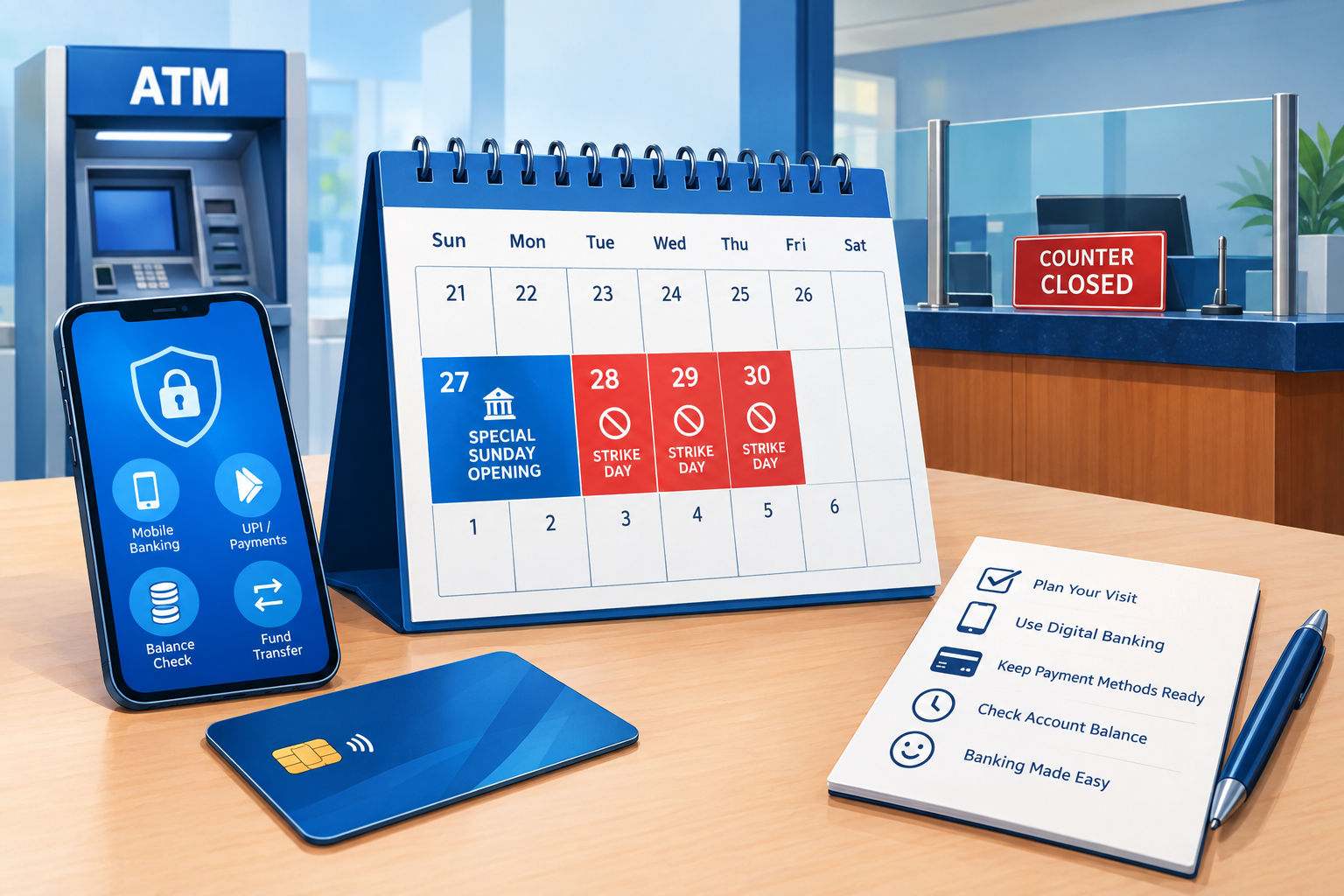
Bank customers across India should prepare for possible service disruptions during a three-day nationwide strike planned for Monday, September 28, through Wednesday, September 30, 2026.

The United Forum of Bank Unions has directed participating employees and officers to proceed with the industrial action after talks failed to resolve the central demand for a five-day banking week. As of Friday, September 25, the strike remained scheduled, although customers should monitor official messages from their own banks in case negotiations produce a late change.
Why are bank employees planning to strike?
The immediate dispute originally centred on two principal issues: implementation of five-day banking and withdrawal of a Performance Linked Incentive scheme opposed by unions. The government subsequently placed the incentive scheme in abeyance, leaving the five-day workweek as the main unresolved trigger for the September strike.
Bank branches currently observe holidays on the second and fourth Saturdays. Unions want every Saturday declared a holiday and say the arrangement was discussed as part of the March 2024 wage settlement framework. Their proposal includes extending working hours from Monday to Friday to offset the additional Saturday holidays.
Union organisations have also raised longer-running pension concerns, including pension revision, a common dearness allowance formula for pensioners and an option for employees under the National Pension System to move to the old pension framework. However, the five-day week is the principal issue driving the current strike call.
Public sector banks will open on Sunday
September 26 is the fourth Saturday and would normally be a bank holiday, while September 27 falls on a Sunday. To prevent customers from facing an extended interruption, the Ministry of Finance has directed all public sector banks and regional rural banks to function normally on Sunday, September 27.
Branches, offices, currency chests and ATM-linked branches in these categories have been cleared to operate that day. Customers who require demand drafts, passbook updates, cash deposits, document submission, account corrections or other counter-based services should consider using the special Sunday opening rather than waiting until the strike period.
The arrangement does not necessarily mean every type of transaction will be available at every location. Customers should confirm their branch hours and service availability through the bank’s official app, website, helpline or verified communication channel before travelling.
Which services could be disrupted?
The greatest impact is expected on work that requires branch employees. Cash deposits and withdrawals at counters, cheque acceptance and clearing support, loan documentation, account-opening requests, locker access and government-related banking work may be delayed. Business customers could also encounter slower processing of trade, treasury and reconciliation transactions.
Public sector banks and regional rural banks are likely to see the widest disruption, but participation may vary among institutions, branches and regions. Some employees from private, cooperative and foreign banks are represented by participating unions, so customers should not assume that every private bank branch will operate normally.
September 30 is also the half-yearly closing date for banks, increasing the possibility of processing backlogs when regular branch operations resume.
Salary and pension payments are being advanced
Central government ministries and departments have been advised to release September salaries on September 25. September wages for eligible central government industrial employees and pensions for central government pensioners may also be processed on September 25 through banks and Pay and Accounts Offices.
This advance arrangement does not automatically apply to every private-sector employee, state government worker or pension recipient. Those customers should check with their employer, pension authority or bank if a payment is normally credited near the end of the month.
Digital banking precautions for customers
- Complete urgent branch work and large-value transactions by September 27 wherever possible.
- Check mobile and internet banking passwords, transfer limits and registered phone numbers before the strike begins.
- Keep more than one payment option available, such as UPI, a debit or credit card and a modest amount of cash.
- Do not wait until the final day to fund an account needed for rent, loan instalments, insurance premiums or scheduled payments.
- Use only the bank’s official application or website. Strike-related messages may be exploited for phishing.
- Never disclose an OTP, card PIN, CVV, internet-banking password or UPI PIN to anyone claiming to help complete a transaction.
- Remember that receiving money through UPI does not require entering a PIN or approving a collect request.
- Retain transaction references and screenshots if a payment remains pending, but avoid repeatedly sending the same amount.
UPI, cards, ATMs, cash deposit machines, mobile banking and internet banking are expected to remain available. Nevertheless, ATM replenishment, failed-transaction resolution and customer support could be slower if employee participation is high. Planning essential payments in advance is the safest way to limit inconvenience.