Trump-Xi Talks Extend Trade Truce but Leave Bigger Disputes Unsettled
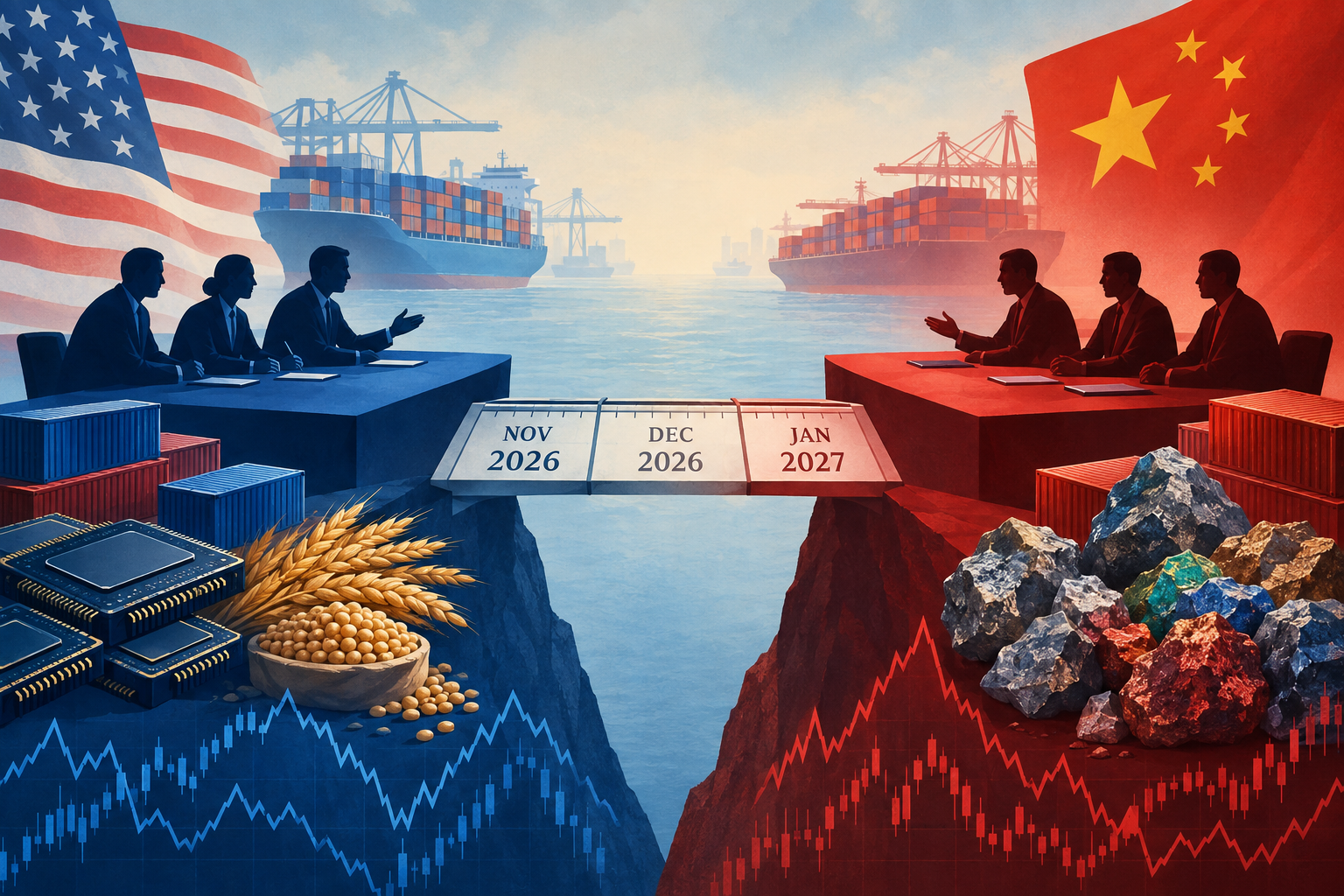
The clearest near-term outcome of President Donald Trump’s Washington talks with Chinese President Xi Jinping was additional time rather than a comprehensive settlement. The United States and China reportedly agreed to extend an existing trade arrangement by two months, moving its expiration from November 10, 2026, to January 10, 2027.

The extension reduces the immediate risk of another sharp escalation between the world’s two largest economies. It does not eliminate the tariffs already affecting bilateral trade, nor does it resolve the disagreements that could trigger new restrictions after the revised deadline.
What the two-month extension covers
The arrangement originated in negotiations that followed the countries’ 2025 tariff confrontation. It paused several measures, including a 24% additional U.S. tariff on Chinese goods and related Chinese countermeasures. It also suspended certain export-control steps and actions connected to maritime, logistics and shipbuilding disputes.
Keeping those measures suspended matters because the earlier confrontation had pushed threatened tariffs above 100% on some trade flows, raising the possibility of severe disruption to shipping, manufacturing and retail supply chains. The extension preserves the lower-risk status quo while negotiators continue working.
However, a two-month reprieve is much shorter than the multiyear certainty sought by many companies. Importers must still prepare for several scenarios in January, including another extension, a broader agreement or renewed escalation.
Limited progress alongside the truce
The U.S. government said the countries had advanced recommendations for more favorable tariff treatment covering $30 billion in non-sensitive goods in each direction. Potential U.S. exports include agricultural products, seafood, timber, cosmetics and medical devices, while potential Chinese exports include toys, small appliances, holiday decorations and children’s car seats.
Those reductions are not equivalent to removing the wider tariff structure. Their commercial value will depend on the final product lists, implementation dates and whether businesses can qualify without facing new regulatory barriers.
Washington also said the two governments had activated bilateral trade and investment boards intended to provide a regular channel for addressing market-access problems. An agricultural working group will examine barriers affecting farmers and food producers. The U.S. government additionally announced that China would import at least 10 million metric tons of American coal in both 2027 and 2028.
Beijing described the economic discussions as a mutually beneficial joint arrangement and called for both governments to expand cooperation while reducing their list of disputes. China’s government has maintained that further talks should lead to the removal of unilateral tariffs and should be conducted on the basis of equality, respect and reciprocity.
Major strategic disagreements remain
Critical minerals are still a central pressure point. The U.S. government wants more dependable Chinese shipments of rare earths and other materials essential to vehicles, electronics, aerospace equipment and defense manufacturing. China’s government says its export controls are administered under Chinese law and that compliant civilian applications are reviewed, while also calling for U.S. restrictions on Chinese technology companies to be eased.
Advanced semiconductors and related manufacturing equipment remain similarly unresolved. Washington treats access to the most capable chips and production technology as a national-security issue. Beijing argues that broad U.S. technology restrictions obstruct legitimate commerce and damage global supply chains.
Agricultural commitments are another test. The United States has pressed China to meet purchasing targets and widen access for American beef, poultry and other products. China has tied progress to regulatory reviews and reciprocal access for Chinese agricultural exports.
Taiwan also remains outside any economic compromise. China’s government urged the United States to oppose Taiwanese independence and handle the issue cautiously. No announced summit outcome indicated that Washington had changed its established approach, and no resolution of the dispute was reported.
The governments did establish a dialogue on advanced artificial intelligence and agreed to create a communication channel for serious AI-related incidents. That represents a potential guardrail, but not an agreement over which country may develop or export the most powerful technology.
What it means for businesses and consumers
For businesses, the extension lowers the chance of an immediate tariff shock and allows shipments, contracts and inventory plans to proceed through the end of 2026 with somewhat greater confidence. Retailers importing seasonal merchandise and manufacturers dependent on Chinese components may avoid sudden cost increases during that period.
The benefit is limited by the January deadline. Companies may continue diversifying suppliers, building inventories or delaying major investments because the long-term tariff and export-control environment remains uncertain. Industries dependent on rare earths face particular risk if licensing delays or shipment shortages continue.
Consumers should not expect an immediate, broad decline in prices. Existing tariffs remain, and any reductions on selected products will take time to reach store shelves. Still, avoiding a renewed tariff escalation reduces the risk of higher prices for electronics, household goods, toys and other imports.
For global markets, the extension removes one near-term threat to trade and growth. Yet it also creates another deadline capable of generating volatility. The Washington talks therefore amount to a managed pause: meaningful enough to prevent an immediate confrontation, but too limited to end the economic and strategic rivalry.