
Centre Extends AFSPA Across Most of Manipur and Parts of Nagaland, Arunachal
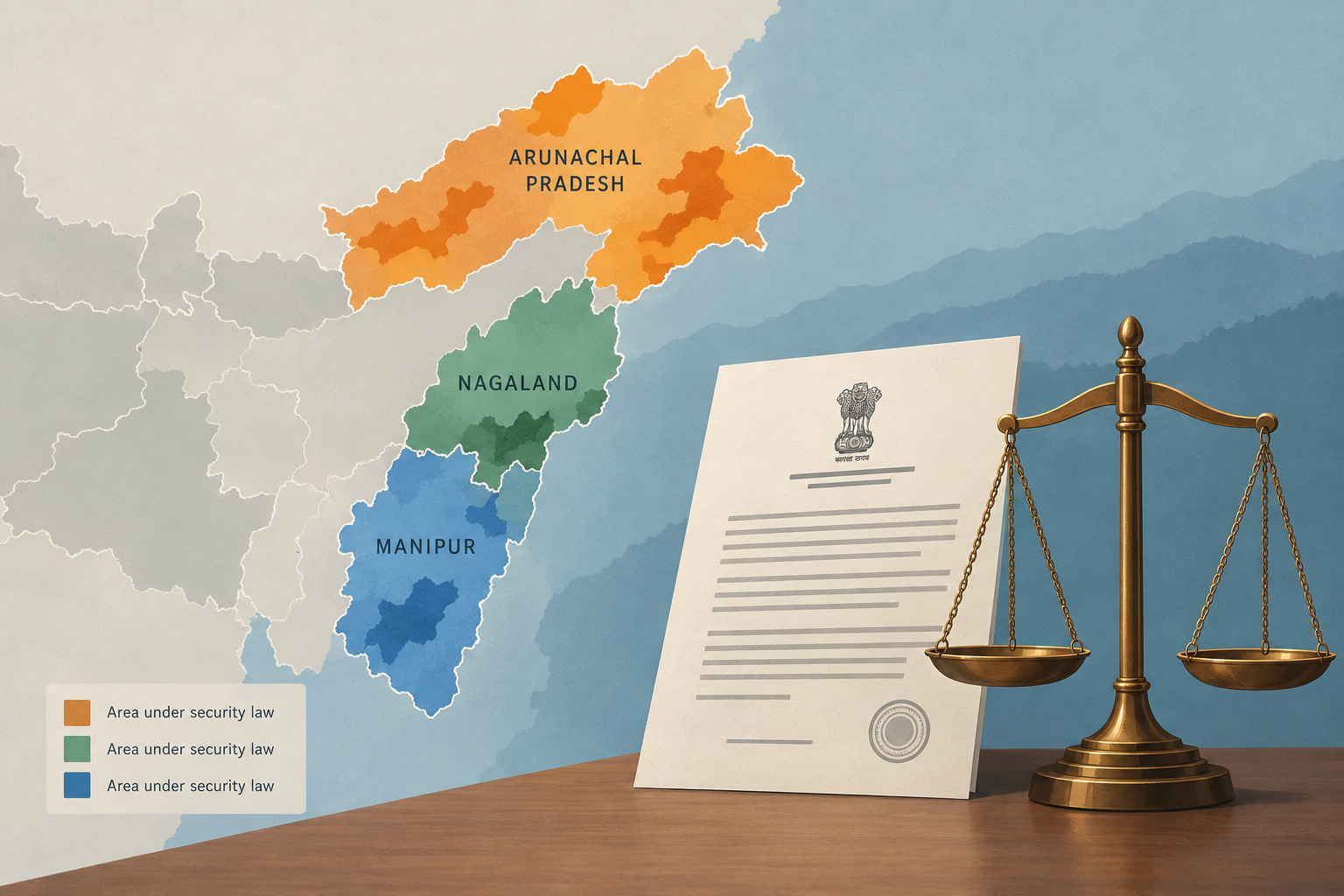
The Union Ministry of Home Affairs has extended the Armed Forces (Special Powers) Act, 1958, across most of Manipur and specified areas of Nagaland and Arunachal Pradesh for another six months from October 1, 2026.

The three disturbed-area declarations will remain effective through March 31, 2027, unless the Centre withdraws them earlier. The notifications follow a government review of the law-and-order situation and largely retain the geographical coverage applied during the preceding six-month period.
Most of Manipur remains covered
In Manipur, the disturbed-area declaration covers the entire state except the jurisdictions of 13 police stations in five districts.
The exempted areas are Imphal, Lamphel, City, Singjamei, Patsoi and Wangoi police stations in Imphal West district; Porompat, Heingang and Irilbung police stations in Imphal East district; Thoubal police station in Thoubal district; Bishnupur and Nambol police stations in Bishnupur district; and Kakching police station in Kakching district.
All other parts of Manipur remain under AFSPA. The arrangement means that several central and urban police-station areas in the Imphal valley are outside the declaration, while extensive hill, border and outlying areas continue to be covered.
Nine Nagaland districts and 21 police-station areas
In Nagaland, AFSPA has been extended across nine complete districts: Dimapur, Niuland, Chumoukedima, Mon, Kiphire, Noklak, Phek, Peren and Meluri.
The declaration also covers 21 police-station jurisdictions in five additional districts. These are Khuzama, Kohima North, Kohima South, Zubza and Kezocha in Kohima district; Mangkolemba, Mokokchung-I, Longtho, Tuli, Longchem and Anaki ‘C’ in Mokokchung district; Yanglok in Longleng district; Bhandari, Champang and Ralan in Wokha district; and Ghatashi, Pughoboto, Satakha, Suruhuto, Zunheboto and Aghunato in Zunheboto district.
Areas of Nagaland not listed in the notification remain outside the disturbed-area declaration.
Limited coverage in Arunachal Pradesh
In Arunachal Pradesh, the extension applies to the complete districts of Tirap, Changlang and Longding. It also covers areas under Namsai, Mahadevpur and Chowkham police stations in Namsai district, near the Assam border.
The rest of Arunachal Pradesh is not included. The state’s AFSPA coverage is therefore considerably narrower than that of Manipur and is concentrated in its eastern belt and selected areas adjoining Assam.
What the notification means in practice
A disturbed-area declaration does not replace the elected government or ordinary police administration. It permits the armed forces to operate in aid of civil authorities with special statutory powers.
Within notified areas, designated armed-forces personnel may arrest without a warrant on reasonable suspicion connected to a cognizable offence, enter and search premises without a warrant, and use force in circumstances defined by the Act. The law also allows action against arms dumps, fortified positions, training camps and suspected militant hideouts.
People arrested under the Act must be transferred to the nearest police station with the least possible delay. Section 6, however, requires prior sanction from the Union government before prosecution or other legal proceedings can be initiated against personnel for acts done or purportedly done under AFSPA.
Government decision and criticism are separate
The notifications represent the Centre’s formal security assessment after reviewing conditions in the three states. They do not provide a detailed public account of the incidents, intelligence or measurable criteria used to retain each area.
Political and civil-society criticism is distinct from that official determination. The Nagaland Legislative Assembly has previously adopted a unanimous resolution seeking AFSPA’s repeal, linking its removal to public confidence and progress towards a political settlement of the Naga issue. In September 2026, the Nagaland Joint Christian Forum also renewed its demand for repeal, arguing that the law undermines civil liberties and institutional dignity in the Northeast.
Rights groups and campaigners in Manipur have similarly maintained that prolonged disturbed-area declarations can normalise military powers in civilian life. Their objections focus particularly on warrantless operations, the use-of-force provision and the requirement for central approval before prosecution.
Why AFSPA remains contentious
AFSPA was enacted in 1958 amid armed insurgencies in the Northeast. The government and security establishment have argued that it provides operational and legal protection for forces deployed in areas where armed groups, difficult terrain and cross-border movement can limit conventional policing.
Critics contend that extraordinary powers should not continue through repeated six-month extensions without greater transparency and stronger accountability. A government-appointed committee led by retired Supreme Court judge B.P. Jeevan Reddy recommended repeal in 2005, with necessary provisions shifted into a different legal framework. The Second Administrative Reforms Commission also recommended repeal.
The Supreme Court has held that AFSPA does not provide unrestricted authority and that allegations of excessive or retaliatory force remain subject to legal scrutiny. The continuing dispute is therefore not simply about security deployment, but about how long exceptional powers should remain, how their necessity is demonstrated and how accountability is ensured.
The October 1 extension answers the immediate operational question by retaining the current map for another six months. It does not resolve the wider political debate over whether recurring renewals are still justified or whether policing, peace negotiations and ordinary criminal law should increasingly take their place.