India’s First LNG-Diesel Train: What the Sabarmati Launch Means
India is preparing to formally launch its first Liquefied Natural Gas-diesel dual-fuel passenger train from Sabarmati Station in Ahmedabad on Sunday, September 27. Union Home and Cooperation Minister Amit Shah is scheduled to flag off the train, which has been developed under Indian Railways’ programme to test alternative fuels in diesel-powered services.

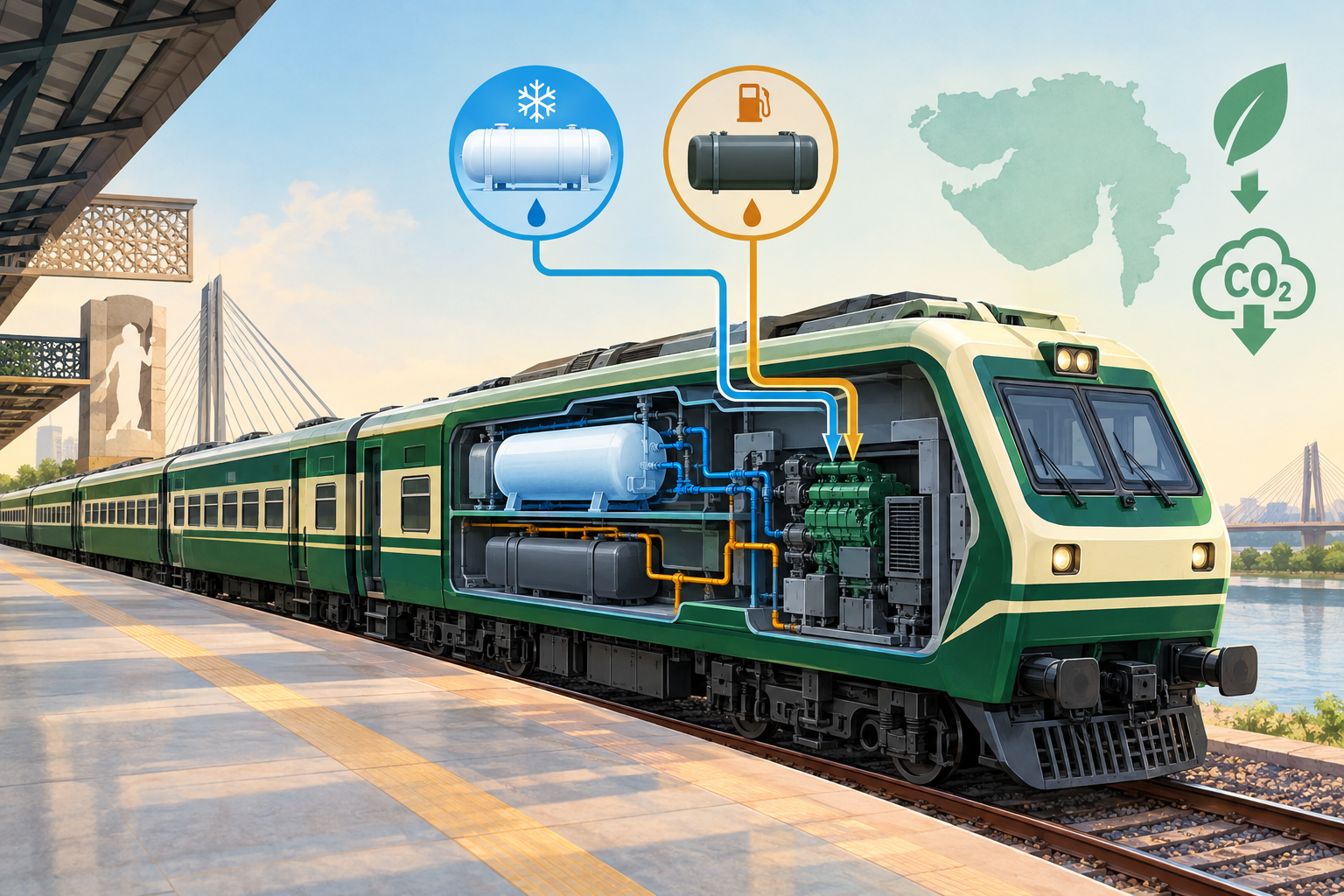
The milestone needs one important qualification: this is not a train powered entirely by LNG. It is a converted Diesel Electric Multiple Unit, or DEMU, whose engines can use LNG alongside diesel. The project had already completed field trials and entered operational testing before the September ceremony, making the event a formal public launch rather than the train’s first movement.
Where will the train run?
The eight-coach DEMU is expected to operate between Sabarmati and Patan in Gujarat, a journey of roughly 102 kilometres each way through stations including Kalol and Mahesana. Existing Sabarmati–Patan DEMU services are local, unreserved passenger trains rather than premium intercity services.
Indian Railways had not attached a clearly confirmed train number or revised public timetable to the launch announcement. Passengers travelling on or immediately after September 27 should therefore check the latest station display, railway enquiry system or ticket counter information instead of assuming that every Sabarmati–Patan service will use the converted rake.
How does the dual-fuel system work?
The train has two 1,400-horsepower Driving Power Cars, one at each end. Both have been modified to use a mixture of LNG and diesel. Diesel remains necessary to initiate and support combustion, while LNG substitutes part of the liquid fuel that would otherwise be consumed.
Each power car is fitted with an approximately 2,200-litre cryogenic tank and an associated storage and regasification system. LNG is stored at extremely low temperatures and converted back into gas before being supplied to the engine. The train can continue operating on diesel if LNG is unavailable or if the gas system cannot be used, reducing the risk of a fuel-supply interruption stranding the service.
The converted power cars completed more than 2,000 kilometres of field trials before the formal launch. Indian Railways says the modification is designed to preserve the power output and reliability of the original diesel system.
How much fuel and money could it save?
The system is designed to replace up to about 40% of the train’s diesel consumption with LNG under suitable operating conditions. Trial-based estimates put the annual fuel-cost saving at approximately ₹11.9 lakh for each Driving Power Car, or about ₹23.9 lakh for the complete eight-coach rake.
Those figures are projections, not a guaranteed saving. The eventual result will depend on the prices of diesel and LNG, the proportion of time spent in dual-fuel mode, daily distance, passenger-service requirements, refuelling logistics and maintenance costs. Wider deployment would also require reliable access to specialised LNG filling and handling infrastructure.
What are the emissions benefits?
Indian Railways expects partial diesel substitution to reduce carbon dioxide, nitrogen oxides and particulate pollution from the train. Burning natural gas generally produces less carbon dioxide per unit of useful energy than diesel and can reduce soot and other local pollutants, potentially improving air quality around stations and along the route.
However, no detailed, independently verified emissions figure per kilometre has been released for this train. LNG is primarily methane and remains a fossil fuel. Methane can escape during production, transport, refuelling or incomplete combustion, a problem known at the engine level as methane slip. Because methane is a powerful greenhouse gas, leakage can reduce the climate advantage suggested by exhaust-only comparisons.
The train also continues to burn diesel and cannot be described as zero-emission. Its environmental performance should ultimately be assessed across the full fuel supply chain and compared with both conventional DEMUs and electric trains, rather than judged only by the percentage of diesel replaced.
What passengers should know
- The change is mainly to the propulsion system; it does not automatically create a faster or more luxurious service.
- No special passenger fare, reservation category or onboard amenity has been announced as part of the conversion.
- The train can revert to greater diesel use when LNG is unavailable, so passengers should not expect every trip to achieve the maximum projected fuel saving.
- Timings, stops and platform details should be confirmed through official railway channels, particularly around the ceremonial launch.
For Indian Railways, the Sabarmati project is best viewed as a practical trial for reducing diesel consumption on routes where diesel trainsets remain in use. Its longer-term significance will depend on dependable LNG supplies, measured emissions, maintenance experience and whether the economics justify converting additional trains.