
India’s ₹7.86 Trillion Bond Plan: What It Means for Yields, Loans and the Rupee
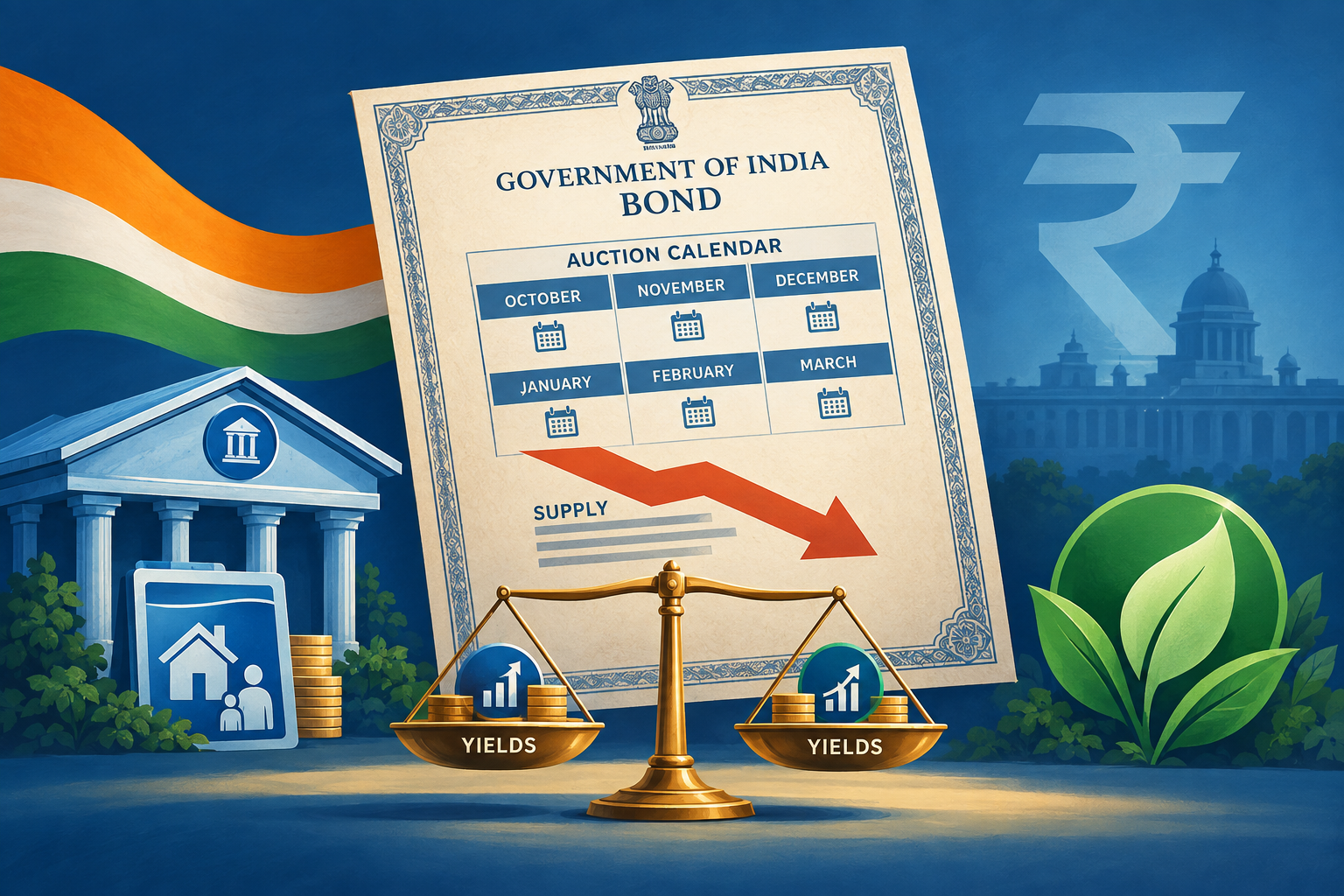
India’s central government plans to raise ₹7.86 trillion, or ₹7.86 lakh crore, through dated government securities between October 2026 and March 2027. The borrowing will be spread across 23 weekly auctions and forms the second-half portion of the Centre’s financing programme for the 2026-27 financial year.

The figure is large, but the most important development for financial markets is that the government has reduced its full-year gross market borrowing estimate to about ₹16 trillion. That is roughly ₹1.2 trillion below the ₹17.2 trillion projected in the Union Budget.
Why does the government borrow?
Government revenue from taxes, dividends and other sources is not sufficient to cover all planned expenditure in a typical financial year. The difference between total spending and non-borrowed receipts is the fiscal deficit. The government finances much of that gap by selling securities to banks, insurance companies, pension funds, mutual funds, foreign investors and individuals.
Gross borrowing also includes money raised to repay bonds that are reaching maturity. Net borrowing, by contrast, represents the additional funds available after repayments and is more closely connected to financing the fiscal deficit.
This distinction matters because the lower gross borrowing number does not mean the fiscal deficit has suddenly fallen by ₹1.2 trillion. Net market borrowing remains around the Budget estimate of ₹11.73 trillion. The main reduction comes from debt-switch operations that replaced securities due for repayment in 2026-27 with bonds maturing later. These transactions lowered the year’s estimated redemption requirement from about ₹5.47 trillion to ₹4.36 trillion.
How the ₹7.86 trillion will be raised
The government has already raised approximately ₹8.14 trillion during the April-September half of the financial year. Adding the October-March programme takes annual gross borrowing to just under ₹16 trillion.
The second-half calendar includes securities with maturities ranging from three years to 50 years. It places greater weight on longer-dated bonds, helping the government spread repayments over a longer period and reduce the risk of having too much debt mature at once. The programme also includes ₹15,000 crore of sovereign green bonds, whose proceeds are allocated to eligible environmental projects.
What could happen to bond yields?
A smaller-than-budgeted supply of government bonds is generally supportive for bond prices. When fewer securities compete for investor money, demand can become stronger relative to supply. Bond prices may rise and yields, which move in the opposite direction, may fall or face less upward pressure.
The reduced issuance is particularly relevant because India’s benchmark 10-year government bond yield ended September 25 near 7.12% after a period of sustained increases. The revised calendar could encourage buying in shorter and medium maturities, where the government has reduced the proportion of planned issuance.
However, the borrowing calendar is only one influence on yields. Inflation, the Reserve Bank of India’s policy decisions, banking-system liquidity, crude oil prices, global interest rates and movements in US government bonds can outweigh the benefit of lower domestic supply. The larger allocation to long-term bonds could also keep pressure on the far end of the yield curve if insurers and pension funds do not absorb the supply comfortably.
Will interest rates and EMIs fall?
Government bond yields act as a foundation for pricing debt across the economy. Lower sovereign yields can reduce funding costs for banks and companies, making it cheaper to issue corporate bonds and potentially supporting lower interest rates over time.
That does not mean home, vehicle or personal-loan rates will decline immediately. Many floating-rate retail loans are linked more directly to the RBI’s repo rate or a bank’s external benchmark. Older loans may be linked to internal benchmarks that also reflect deposit and funding costs.
For borrowers, the announcement is therefore a favourable background signal rather than an instant EMI cut. Meaningful relief would usually require a sustained decline in market yields, easier liquidity, lower deposit costs or policy-rate reductions that banks pass on to customers.
What does it mean for the rupee?
The rupee’s response is not automatic. A lower borrowing requirement can improve perceptions of fiscal and debt management, which may support investor confidence. Strong demand for Indian government bonds, including purchases by overseas funds, can also bring foreign currency into the market.
At the same time, falling Indian yields could reduce the return advantage available to foreign investors, particularly if yields remain elevated in other major economies. Oil-import costs, trade flows, global risk appetite and central-bank policy are likely to have a much larger immediate influence on the currency.
What investors should watch
Existing bond investors can benefit if yields fall because the market value of their securities rises. Long-duration bonds experience larger price movements, offering greater potential gains but also greater losses if yields increase. New investors may receive lower returns if the government can sell bonds at reduced yields.
For households, the key message is that lower gross borrowing is helpful for market stability, but it is not the same as a sharp reduction in new government debt. Investors and borrowers should watch inflation, RBI policy and the actual demand at weekly auctions before assuming that interest rates have decisively turned lower.