
Delhi SIR Deadline Extended: What Voters Must Do Before October 30
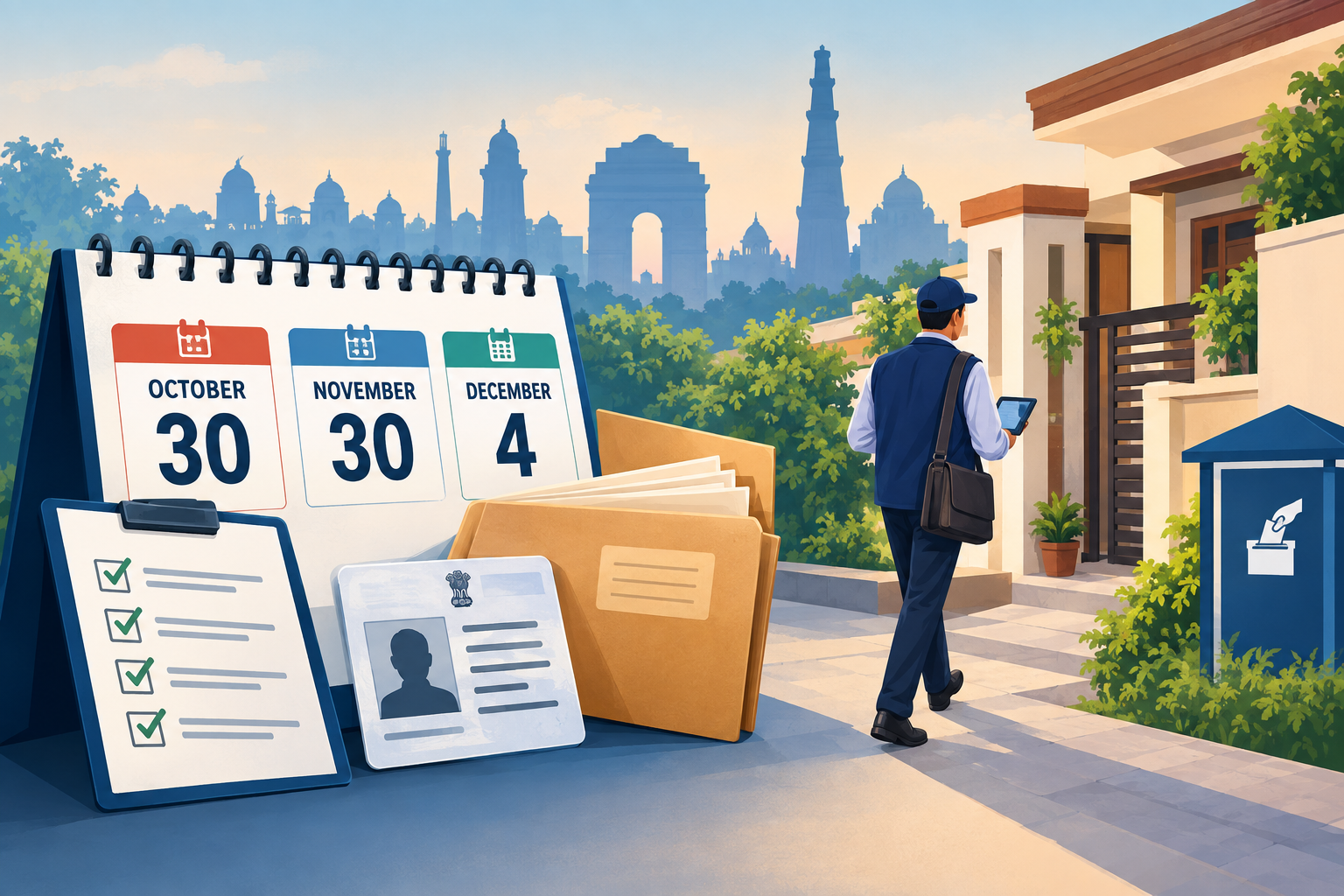
Delhi voters have received more time to correct, restore or challenge entries in the capital’s electoral rolls after the Election Commission revised the Special Intensive Revision timetable for a fourth time. The final electoral roll will now be published on December 4, 2026, one month later than the previous November 4 date.

The extension is particularly important for approximately 33.1 lakh electors who have been issued notices because their records could not be linked to an earlier intensive-revision roll or contained what election officials classified as logical discrepancies. Receiving a notice does not automatically mean that a voter’s name has been deleted. It means the record requires verification before the Electoral Registration Officer takes a decision.
The revised Delhi SIR deadlines
| Stage | New deadline | What it means for voters |
|---|---|---|
| Claims and objections | October 30, 2026 | Eligible residents can seek inclusion, corrections or other changes, while objections may be filed against entries. |
| Notice disposal and decisions on claims and objections | November 30, 2026 | Election officials must complete verification and decide pending cases. |
| Final electoral roll | December 4, 2026 | Voters should check again to confirm that their names and details appear correctly. |
The October 30 deadline replaces the earlier September 30 cut-off for claims and objections. The final-roll publication date has moved from November 4 to December 4. Delhi’s original timetable announced in May had contemplated a final roll in early October, but subsequent extensions shifted the enumeration, draft publication and verification stages.
What changes for people who received notices
Booth Level Officers, or BLOs, have now been directed to visit the homes of electors issued notices for non-mapping or logical discrepancies. The BLO can collect the required documents and upload them to the ECINet system, after which the Electoral Registration Officer will decide the case.
Routine personal appearances before an Electoral Registration Officer are not expected to be necessary. A hearing may still be ordered in exceptional cases, preferably through an online arrangement. If an appearance is required, the elector may authorise an adult family member to attend on their behalf.
This is intended to reduce repeated office visits, but voters should not wait passively for a home visit if they have already received a notice. They should contact their BLO, verify the notice details and prepare the documents requested for their specific discrepancy.
Why were around 33.1 lakh notices issued?
The draft roll published on August 31 contained about 97.5 lakh electors. Within that group, approximately 13.8 lakh records were categorised as not mapped to the relevant earlier SIR roll, while about 19.3 lakh were flagged for logical discrepancies.
A non-mapping notice may arise when current voter details cannot be connected to an elector or relative in the earlier intensive-revision records. Logical discrepancies can involve differences in names, dates of birth, family relationships or age gaps recorded for relatives. Such a flag may result from incomplete, inconsistent or incorrectly matched data and is not, by itself, a finding that the elector is ineligible.
Practical checklist for Delhi voters
- Search for your name: Check the August 31 draft roll using your EPIC number, name or registered mobile details.
- Check the notice list separately: A person can appear in the draft roll and still have a pending notice requiring documents.
- Read the reason carefully: Identify whether the notice concerns non-mapping, a name or date mismatch, family details or another issue.
- Keep the notice reference ready: Save the notice, EPIC details and any application or acknowledgement number.
- Prepare relevant records: Keep available documents establishing the information requested in the notice, such as age, residence, family linkage or other eligibility details. An EPIC can help identify the voter record but may not resolve the underlying discrepancy by itself.
- Coordinate with the BLO: Confirm when documents will be collected and ensure that the copies are readable and complete.
- File the correct form if needed: Form 6 is generally used for inclusion, Form 6A for eligible overseas Indian electors, Form 7 for objections or proposed deletion, and Form 8 for corrections or a change of residence.
- Retain proof: Keep copies of everything submitted and save any acknowledgement, message or application-tracking number.
Do not treat November 30 as a personal filing extension
The November 30 date is the deadline for election officials to dispose of notices, claims and objections. It should not be assumed to be the last day on which an individual voter can respond. Notice recipients should comply with any response date stated in their notice and submit documents as early as possible.
People whose names are missing from the draft roll should file the appropriate claim by October 30. After the final roll is published on December 4, every applicant and notice recipient should check the electoral roll again. Holding a voter card alone does not guarantee that a name is present on the final roll.