Mokama bridge work disrupts Bihar trains on September 28
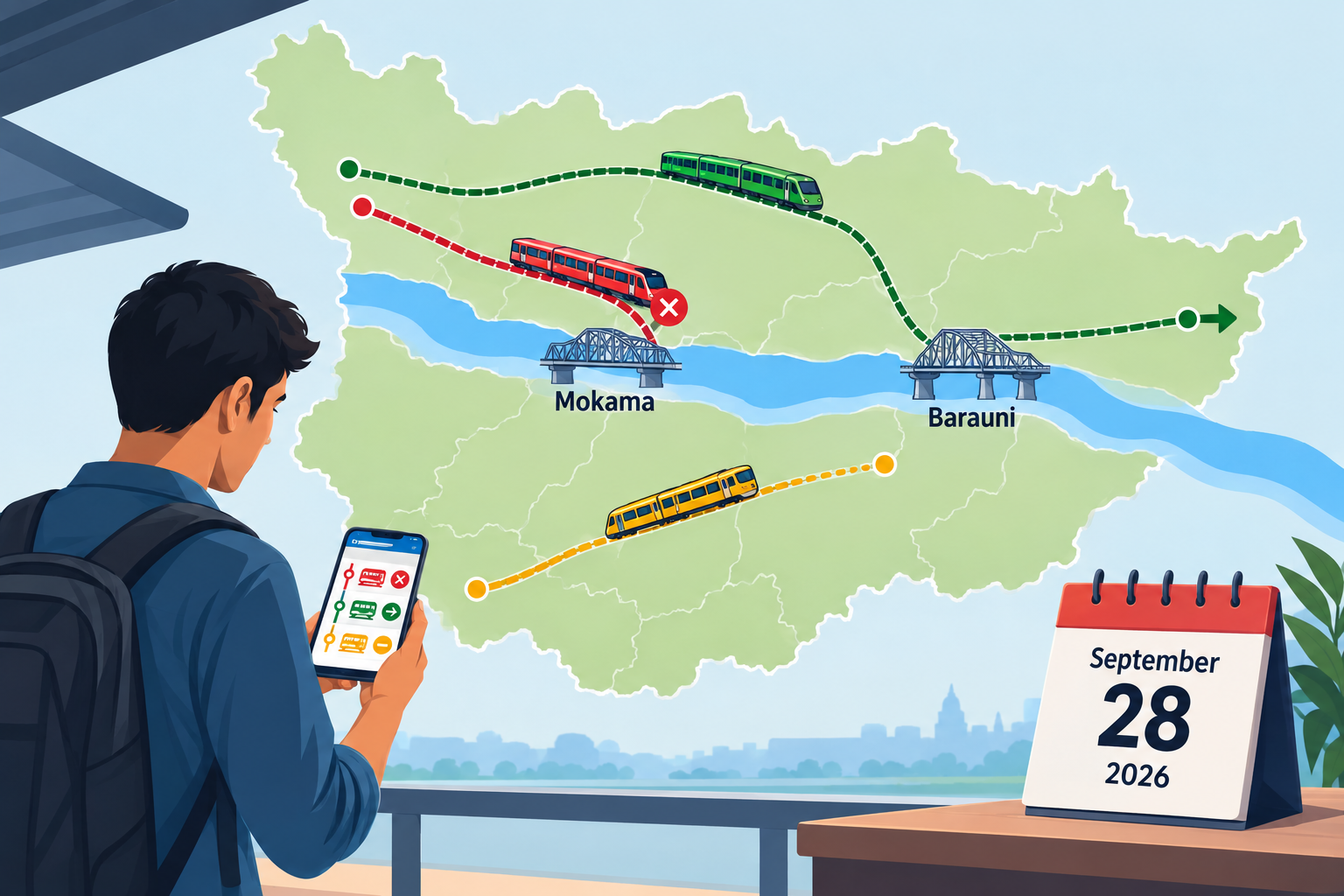
Passengers travelling through Bihar on Monday, September 28, 2026, face widespread changes as Indian Railways carries out work to connect a new rail bridge near Mokama to the existing network. The revised operating plan lists 35 cancelled services, 33 diversions and nine trains that will end early or begin from a station other than their usual origin.

The disruption centres on the rail crossing of the Ganga between the Mokama and Barauni areas. Crews are working on connections around Upper Hathidah Junction, Tal Junction, Rampur Dumra, Dinkar Gram Simaria and Barauni Junction. The new double-line bridge runs alongside the existing Rajendra Bridge. Non-interlocking work is needed before trains can use the new connections.
This is not a blanket cancellation of trains to Bihar. The changes depend on the individual service and, crucially, the date on which it begins its journey. Some trains in the September 28 operating plan originated on September 27 or earlier and would otherwise have passed through the affected area on Monday.
Which journeys are affected?
Cancellations reach well beyond Mokama. The September 28 plan includes both directions of the Howrah–Mokama and Howrah–Jaynagar expresses, the Sealdah–Jaynagar Ganga Sagar Express, the Saharsa–Rajendra Nagar Intercity and the Bhagalpur–Muzaffarpur Jansewa Express. It also lists the Jaynagar–Patna, Patna–Malda Town, Kolkata–Darbhanga and Patliputra–Gorakhpur corridors, along with several MEMU services around Patna, Kiul, Mokama, Ara and Banaras. These examples do not constitute the full cancellation list.
Other trains are scheduled to run but take different routes. The diverted list includes the Howrah–New Delhi Poorva Express, the Jaynagar–Anand Vihar Garib Rath, the Bagh Express between Howrah and Kathgodam, and the Patna–New Jalpaiguri Vande Bharat services in both directions. Connections involving Delhi, eastern Uttar Pradesh, West Bengal and northeastern India also appear in the plan.
A diversion can matter even when a train is still running. The plan shows that some diverted services will miss their usual stops, including stops in and around Mokama, Barh and Patna. Passengers boarding or leaving at an intermediate station should check the revised stop list, not just whether the train is marked as running. Do not assume a ticket for a diverted train means it will call at your booked station.
The nine partial-operation changes involve trains that will not cover their full advertised route. For example, the Bagaha–Patliputra Intercity is listed to end at Hajipur, while the corresponding Patliputra–Bagaha service is listed to begin there. The Jasidih–Mokama MEMU is listed to end at Kiul. Travellers using an affected section should confirm the precise start or end station before making onward plans.
What should passengers do now?
- Match the train number and origin date. Check the date the train starts from its first station, which may differ from the date printed for boarding at an intermediate stop. Earlier notices and the revised operating plan do not always show the same daily total, so use the latest status for the specific service.
- Check running status and stops before departure. Use Indian Railways’ National Train Enquiry System, its NTES app or the 139 railway enquiry service. Look for cancellation, diversion and revised stopping information. Check again shortly before travelling, particularly if you have a tight connection.
- Inspect your booking. Confirm your PNR and journey details through the service used to book the ticket. If your train has been cancelled for its entire run, check the refund status rather than assuming you must travel to a station to claim it. If the train is only partly cancelled or diverted and your booked journey cannot be made, check the applicable cancellation or Ticket Deposit Receipt process promptly; the procedure depends on the ticket and the change involved.
- Allow for a different onward journey. If your train now ends short of your destination, starts beyond your boarding station or skips your stop, arrange an alternative only after confirming the revised route. Leave extra time for transfers and avoid relying on an unchanged arrival time.
The bridge-related work is scheduled to affect different services on different dates through October 4. Monday’s list should therefore not be used as a forecast for Tuesday or any later journey. For every trip in the work period, the safest check is the train number, its date of origin and its current operating notice.