Ireland beat Israel 3–0 after skipping pre-match handshakes
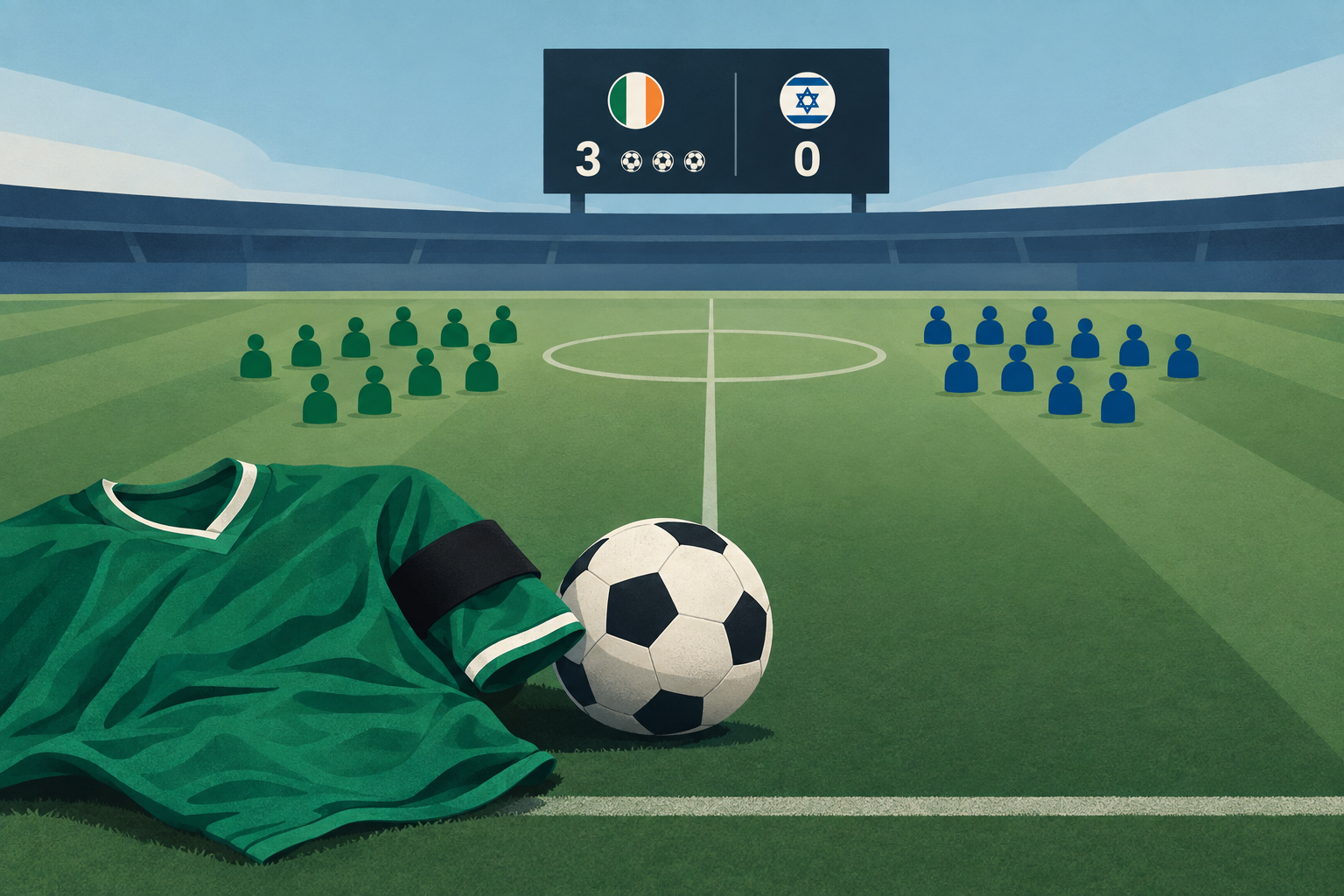
The Republic of Ireland beat Israel 3–0 in a UEFA Nations League match on Sunday, September 27, 2026, after a pre-match ceremony in which the teams did not exchange handshakes. Irish players wore black armbands at the game in Debrecen, Hungary, and bowed their heads during the Israeli national anthem.

Troy Parrott, Adam Idah and Jack Moylan scored inside the opening 25 minutes, giving Ireland a commanding halftime lead that held through the final whistle. The result was Ireland’s first win of its Nations League campaign, following an opening defeat away to Kosovo.
A pre-match decision
The absence of handshakes had been announced before kickoff. Football Association of Ireland chief executive David Courell said the players would not take part in that element of the pre-match ceremony or exchange pennants with their opponents. He said the black armbands were intended to recognize all lives lost in the conflict in Gaza. That explanation describes the association’s stated purpose for the armbands; it should not be taken as a statement of every individual player’s reasons for participating.
After the anthems, the squads moved toward their respective sides without the customary line of player-to-player greetings. Ireland captain Dara O’Shea met match officials and Israel captain Manor Solomon for the coin toss. O’Shea shook hands with the officials, but he and Solomon did not shake hands. The players’ conduct drew attention before a ball had been kicked, although the fixture proceeded as scheduled.
The decision came after a difficult build-up for the Irish squad. There had been calls in Ireland for the team to boycott its fixtures against Israel over Israel’s military campaign in Gaza. Goalkeeper Gavin Bazunu withdrew from the games, explaining his own decision in a public statement by reference to his belief that the killing of innocent people is wrong. Courell said the remaining players discussed whether to go ahead and that a significant majority voted to play. Bazunu’s stated position was his own; the squad’s vote and its pre-match gestures do not establish why each other player made their choice.
Three goals settle the match
On the field, Ireland took control quickly. Parrott opened the scoring in the 14th minute after a move down the right, and Idah doubled the lead two minutes later. Moylan added the third in the 25th minute, leaving Israel with a considerable deficit before halftime. Moylan held up and kissed his black armband during his celebration, a visible action for which his individual intent should not be assumed beyond what he has publicly said.
Israel pressed more strongly after the break, but Ireland goalkeeper Caoimhín Kelleher made saves to protect the lead. Ireland did not add to its first-half goals, while Israel could not find a way back into the contest. The match was played at the Nagyerdei Stadion before a sparse crowd, with Debrecen serving as the venue for Israel’s designated home fixture.
The result gives Ireland three points in Nations League B Group 3, but it does not close the discussion surrounding these fixtures. Ireland and Israel are scheduled to meet again on October 4 in Bačka Topola, Serbia, for Ireland’s designated home game, which is set to take place behind closed doors. Before that rematch, Ireland is due to face Austria on October 1.
Sunday’s record is clear on both the football and the ceremony: Ireland won by three goals, its players wore armbands, and the usual handshakes did not take place. The association has explained the armbands and confirmed the pre-match decision. Beyond those public statements, the reasons held by individual players remain theirs to describe.