Delhi’s Barapullah Phase 3 opens: The route, connections and commute-time promise
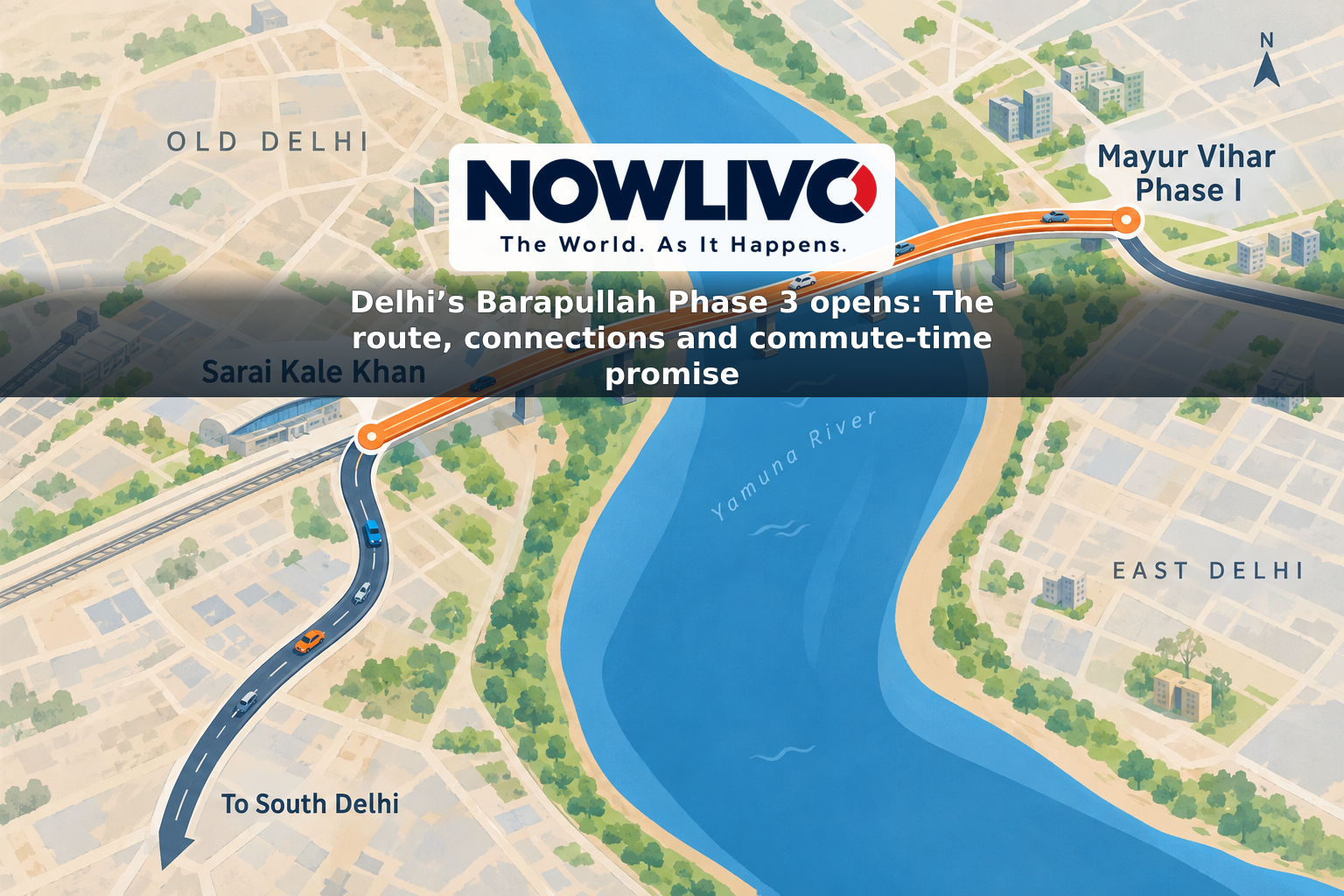
Delhi’s long-delayed Barapullah Phase 3 elevated corridor was inaugurated on September 29, 2026, opening a new route between Mayur Vihar Phase I and Sarai Kale Khan. For commuters, the important change is not just another crossing of the Yamuna: the new section meets the existing Barapullah road at Sarai Kale Khan, allowing travel onward towards parts of South Delhi without returning to the usual sequence of surface-road junctions.
The main new elevated section is approximately 3.5 kilometres long. Some descriptions include its approaches when stating a longer project length. Drivers planning a trip should focus on its endpoints: Mayur Vihar Phase I on the east side and Sarai Kale Khan on the south-east side, where it connects to the established corridor.
Where the new route takes you
From Mayur Vihar Phase I, the corridor crosses the Yamuna area to Sarai Kale Khan. There, motorists can join the existing Barapullah network for travel towards the Jawaharlal Nehru Stadium area, INA and the AIIMS side of South Delhi. In the other direction, it gives drivers already using Barapullah a route towards Mayur Vihar rather than requiring them to leave the elevated network at Sarai Kale Khan.
The connection may also be useful to people travelling from Noida, but Phase 3 does not begin in Noida. Those drivers must first reach the Mayur Vihar side through the surrounding road network. Sarai Kale Khan is also a major interchange area for bus, rail, Metro and regional rail journeys. The flyover improves road access to that area; it does not provide a direct transfer between those services.
Officials expect the new crossing to offer an alternative to routes that put pressure on Ring Road, the DND Flyway and the NH-24 corridor. How much traffic shifts will depend on where individual journeys start and finish, as well as conditions at the entrances and exits.
How to get on and off
The new section connects at the Mayur Vihar Phase I end and merges with the older Barapullah stretch near Sarai Kale Khan. Ramps and loops provide access around the two ends. Drivers should follow the posted destination signs rather than assume every approach road leads directly onto the new flyover or that every exit serves the same direction.
That distinction matters particularly for a journey starting in Noida or ending near the Sarai Kale Khan transport hub: reaching the corridor, or leaving it for a specific local destination, still involves other roads. Check the route before setting off and allow for traffic where the elevated road meets the surrounding network.
The project includes dedicated provision for cyclists and pedestrians. Anyone intending to use those facilities should follow the marked access points and on-site directions rather than enter a vehicle ramp. The traffic restrictions announced around Sarai Kale Khan and Ashram for the September 29 inauguration applied to the ceremony period, not as a standing rule for ordinary commutes.
Will the trip really take 15 minutes?
The Delhi government has projected that a trip from East Delhi or the Noida side towards AIIMS could fall from roughly 35–40 minutes to about 15 minutes. That is an expected benefit, not a measured time that every driver can count on. The estimate depends on the starting point, the roads used to reach Mayur Vihar Phase I, traffic at the connections and the final approach to the destination.
The practical advantage is a more continuous, largely signal-free route across the east–south link. Commuters may still encounter queues before entering the corridor or after leaving it, especially during busy periods. A short journey on the elevated section should not be mistaken for a 15-minute trip from every address in Noida to every address near AIIMS.
What it cost, and why it took so long
The project’s stated cost is approximately ₹1,635 crore, up from an initial sanctioned estimate of about ₹1,261 crore. Approved in 2014, construction began in 2015 and completion was initially targeted for 2017. Land acquisition, environmental clearances and the challenges of building across the Yamuna floodplain contributed to the lengthy delay.
For regular users, the opening closes a missing link in the Barapullah route. The sensible first test is the commute itself: compare the new option with the usual drive at the same time of day, while paying particular attention to the Mayur Vihar and Sarai Kale Khan approaches.