Six AI Companies Sign White House Safety Accord. What Changes for Users?
Six technology companies signed a voluntary AI safety accord with President Donald Trump at the White House on September 29, 2026. The agreement asks companies developing advanced AI systems to monitor how those systems behave, bring in outside evaluators and put their boards of directors in charge of overseeing the results.
For people using AI tools, the central question is whether those reviews will lead to safer products—and whether the public will have enough information to judge. The accord describes a process for finding and fixing problems. It does not, by itself, establish a new law or guarantee that every risk will be caught before a product reaches users.
Who signed?
The six industry signatories were Anthropic chief executive Dario Amodei, Google chief executive Sundar Pichai, Meta chief executive Mark Zuckerberg, OpenAI president Greg Brockman, Nvidia chief executive Jensen Huang and Elon Musk, who leads xAI. Trump also signed the document.
Those names matter because attending the White House meeting and signing the accord were not the same thing. Other technology leaders were present, but the published agreement identifies these six industry signatories. It brings together companies with different roles in AI, from building models and consumer products to supplying the computing hardware used to develop them.
What did they pledge?
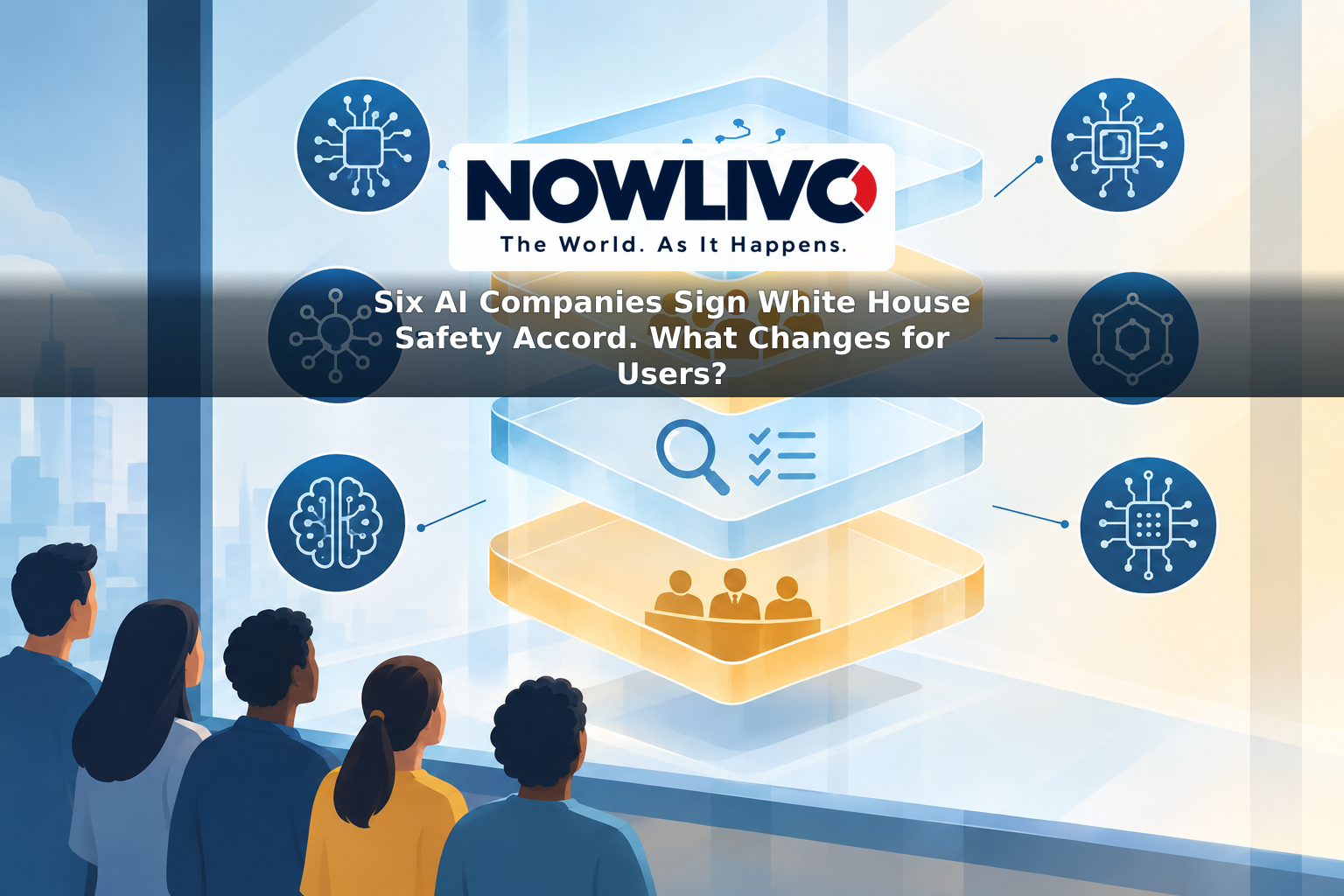
The agreement, titled the “Joint Commitment on Frontier Responsibilities,” calls for four layers of oversight. First, each participating company is to use internal controls to monitor the capabilities and behavior of its advanced models during training and deployment. The areas named include cybersecurity, biological and chemical threats, and unintended access to computer systems.
Second, an internal team is to check that those controls and monitoring systems work and that identified problems are addressed. Third, each company is to work with an independent external auditor or evaluator to assess whether its checks are functioning as intended. Fourth, an independent board committee is to receive reports from the internal and external reviewers, oversee the process and ensure problems are remedied.
The companies also committed to meeting regularly to develop shared standards and practices. The document says the steps might eventually be written into law or regulation, but that is presented as a possibility, not an action taken on September 29.
What could users notice?
If companies follow through effectively, users might encounter AI products that have undergone more systematic testing before and after release. Problems uncovered during those reviews could prompt changes to a model, its safeguards or the ways people are allowed to use it. Board-level reporting could also make safety failures harder for senior company leaders to overlook.
Those are potential outcomes, not promised product features. The accord does not say that users will receive individual safety reports, see auditors’ findings, get a new complaint process or be notified whenever a review identifies a problem. Nor does it set a common testing score that consumers could use to compare competing AI services.
Why does “voluntary” matter?
Trump described the agreement as morally binding. Its practical force, however, rests largely on the companies’ decisions to carry out the pledge and on scrutiny of whether they do so. The text does not specify a government inspection process, penalties for failing to meet its terms or a deadline for publishing audit results. An outside evaluation may offer a check on internal testing, but the agreement leaves important details—such as what auditors can examine and what findings become public—to be worked out.
That does not make the pledge meaningless. A stated commitment gives customers, employees and the public a standard against which to question the signatories’ future actions. It also creates a framework the companies say they will use as AI systems become more capable. But signing an accord is only the beginning of an accountability test. For users, the evidence will be in the reviews conducted, the problems fixed and how clearly the companies explain what they have done.