India’s Supreme Court Questions Drug Markups, Floats Wider 16% Margin Rule
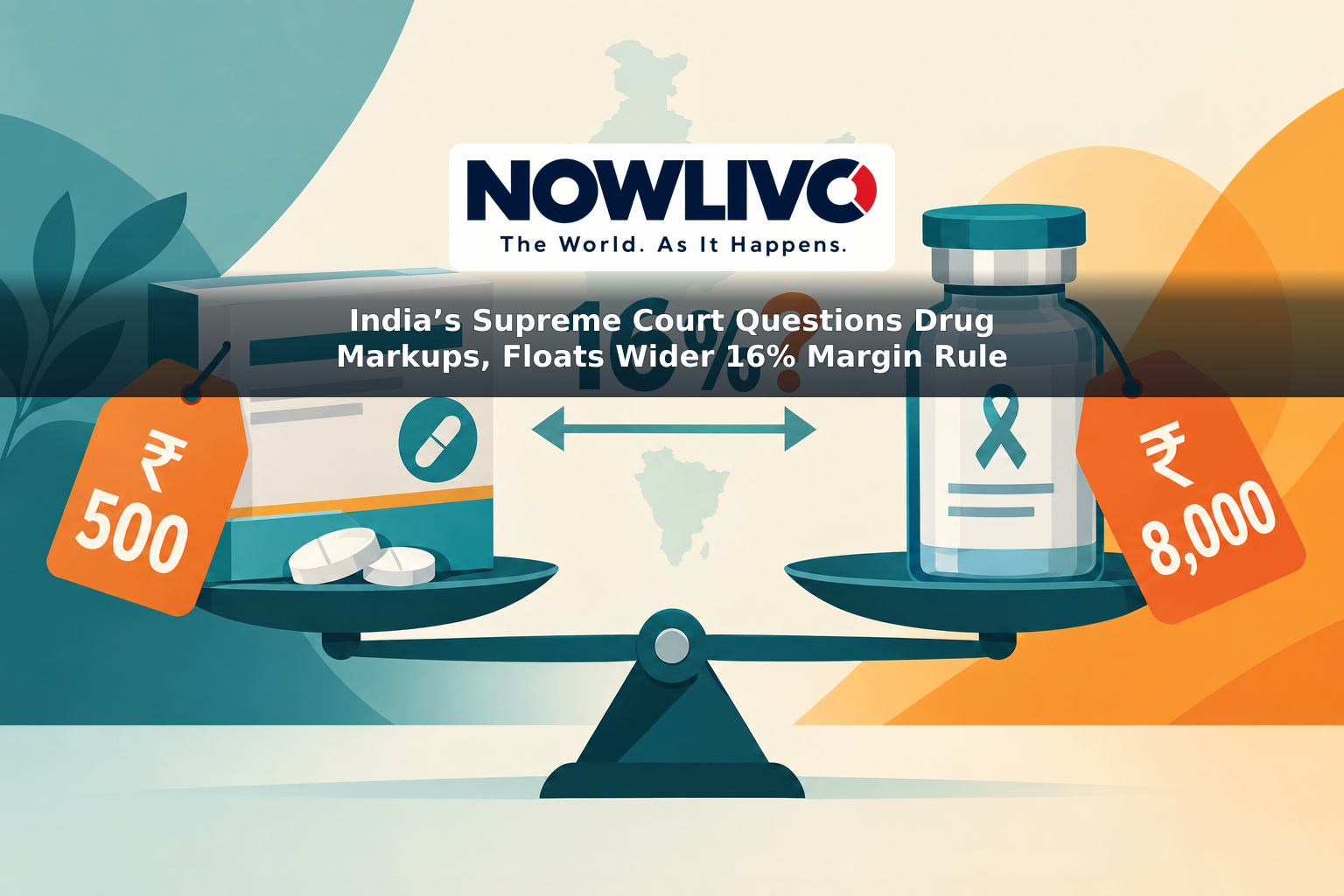
India’s Supreme Court has questioned why medicines can reach retailers at one price yet carry a much higher maximum retail price for patients. At a hearing on September 29, 2026, Justices Vikram Nath and Sandeep Mehta asked the central government to consider whether a 16% retailer margin used in part of the country’s drug-pricing system should apply more broadly.
This was a question raised in court, not a new pricing rule. The bench did not order pharmacies, hospitals or drugmakers to cut prices to a 16% margin. The petitions are due to be heard again on October 12.
Why the court raised the issue
The judges pointed to examples of cancer medicine carrying a printed maximum retail price of about ₹27,000 despite a price to the retailer of about ₹2,700. That difference drew attention to what a patient might be charged when buying a medicine, particularly during treatment in a hospital. The medicine in that example has not been identified by name in the court’s reported remarks, and the figures should not be taken as the price of cancer treatment generally.
The price to retailer is what a pharmacy pays to obtain a product; it is not the manufacturer’s production cost or proof that any one business keeps the entire difference. The court’s concern was whether such a wide gap should be permitted and whether patients have a meaningful chance to shop elsewhere. The bench also asked the government to examine claims that some private hospitals direct patients to their own or designated pharmacies.
What the 16% figure means now
Under the Drugs (Prices Control) Order, 2013, the National Pharmaceutical Pricing Authority sets ceiling prices for scheduled medicines, a category linked to India’s National List of Essential Medicines. Its calculation uses an average price to retailers for qualifying products and adds a 16% retailer margin. That method does not mean every medicine sold in India must be priced at no more than 16% above an individual pharmacy’s purchase price.
Non-scheduled medicines generally do not have the same ceiling-price calculation, although their maximum retail prices are monitored and manufacturers face limits on increases over a 12-month period. There are also targeted controls outside the scheduled list. In 2019, for example, the pricing authority restricted trade margins for 42 selected non-scheduled anti-cancer medicines. It would therefore be inaccurate to say that all cancer drugs are either covered by the existing 16% calculation or entirely free of price controls.
The court asked why the distinction between scheduled and non-scheduled products should leave room for steep markups. A wider rule, if ultimately adopted, could affect essential and non-essential medicines, including cancer treatments, branded products and generics. But the scope, the point in the supply chain at which a margin might be measured, and any exceptions remain unresolved.
Who could be affected?
Patients paying out of pocket have the most immediate interest in a smaller gap between wholesale and retail prices. People receiving treatment in hospitals may have fewer practical opportunities to compare pharmacy prices. The bench also raised the possible cost to taxpayers when medicines supplied during care are paid for through government-funded health schemes such as Ayushman Bharat.
Drug manufacturers, distributors, chemists and hospital pharmacies would all have a stake in any change to how prices or margins are set. The Indian Pharmaceutical Alliance, through its lawyer, argued that the difference between the price paid by a retailer and the printed retail price should not automatically be treated as drugmaker profit. Solicitor General Tushar Mehta told the court that the government would need to find an approach that balances the interests involved.
The petitions also concern generic prescribing and medical devices, but the bench’s question about 16% does not itself establish a new rule for either. Any eventual change would depend on further proceedings or government action, including a clear account of which products it covers and how it would be enforced.
For now, a patient should not expect a 16% reduction at the counter. The practical distinction is between a debate about making medicines more affordable and an enforceable cap: only the former emerged from the September 29 hearing.