
8th Pay Commission: What a 2.57 Fitment Factor Would Mean for Level 6, 7 and 8 Basic Pay
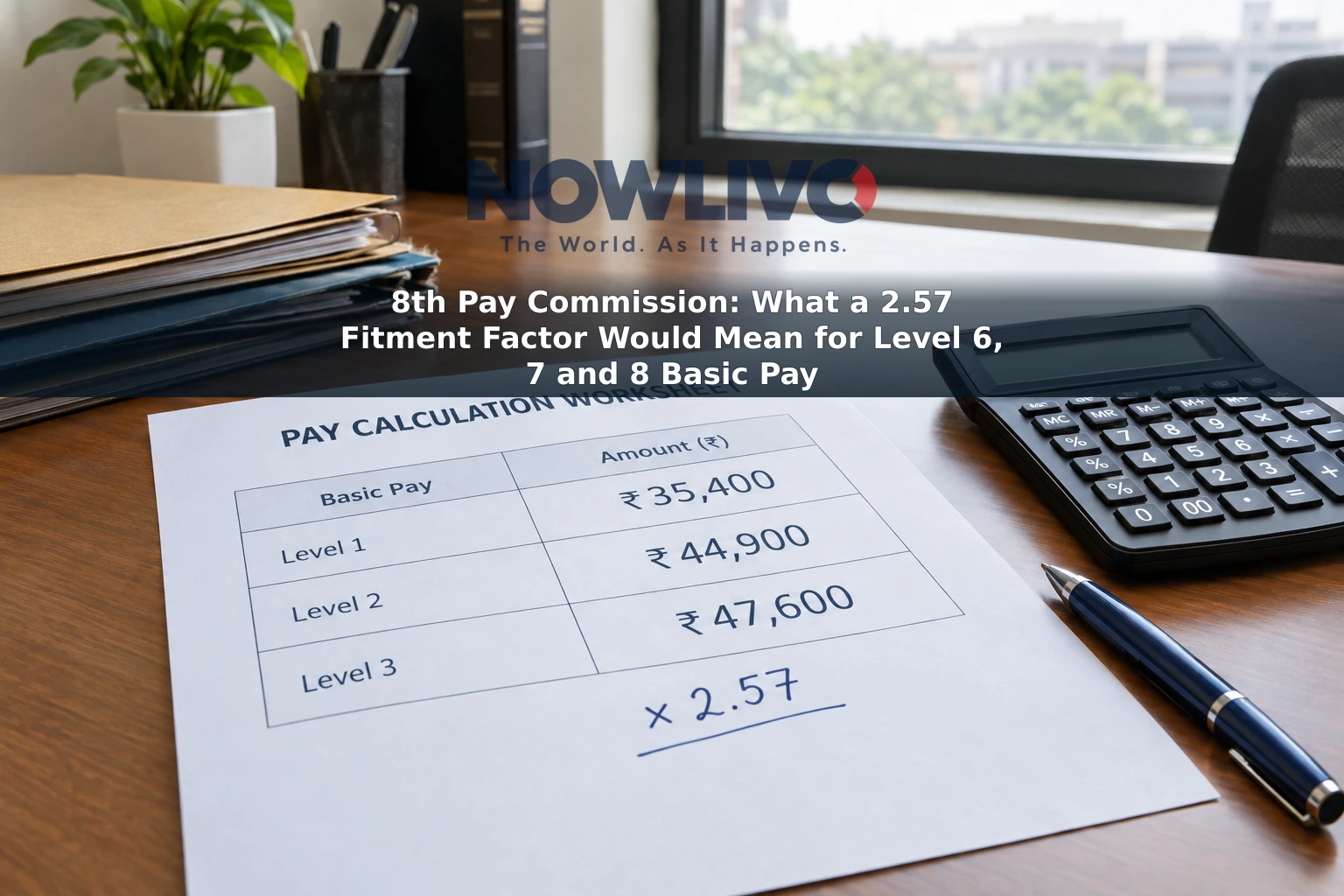
A 2.57 fitment factor would put the illustrative basic pay of a Level 8 central government employee on ₹47,600 at ₹1,22,332 a month. Applying the same multiplier to the current entry-level basic pay for Levels 6 and 7 gives ₹90,978 and ₹1,15,393, respectively. These are calculations, not approved 8th Pay Commission salaries: no new fitment factor or pay matrix has been announced.
The distinction matters as the commission continues its consultations. It scheduled a visit to Bengaluru for October 7–8, 2026, with another visit to Mumbai scheduled for October 22–23. Neither a meeting schedule nor a salary projection establishes what employees will ultimately be paid.
Level 6, 7 and 8 basic pay at a hypothetical 2.57 factor
The current starting basic pay comes from the Seventh Central Pay Commission’s pay matrix. Multiplying each figure by 2.57 produces the following comparison:
| Pay level | Current starting basic pay | Basic pay at 2.57× |
|---|---|---|
| Level 6 | ₹35,400 | ₹90,978 |
| Level 7 | ₹44,900 | ₹1,15,393 |
| Level 8 | ₹47,600 | ₹1,22,332 |
For Level 8, the arithmetic is ₹47,600 × 2.57 = ₹1,22,332. The figures in the table use the starting basic pay at each level. Someone further along in a level’s pay matrix may already draw a higher basic pay, so the entry-level example is not a personal salary estimate.
Has the 8th Pay Commission selected 2.57?
No. The 2.57 figure is familiar because it was the fitment factor used to move employees into the Seventh Pay Commission’s pay structure. Reusing it here makes for a straightforward illustration; it does not mean the Eighth Pay Commission has proposed or adopted it.
The commission was constituted on November 3, 2025, to examine central government pay and related benefits. Its terms give it 18 months from constitution to make recommendations. The government must then decide what to accept and issue the rules needed to implement a revised structure. As of October 7, 2026, the eventual multiplier, pay matrix and date on which revised pay would take effect remain unsettled.
Would basic pay really rise by 157%?
Not in the sense of an equivalent rise in take-home salary. A 2.57 multiplier makes the resulting basic-pay number 157% higher than the old basic-pay number. But current earnings also include dearness allowance and, where applicable, other allowances. A future pay revision would need to specify how those components are treated.
The Seventh Pay Commission’s use of 2.57 illustrates why that distinction is important: its fitment calculation accounted in part for dearness allowance already payable under the previous structure. Comparing only the old and projected basic-pay figures therefore overstates what can be inferred about a change in total earnings.
The final amount could also differ from simple multiplication if the government adopts a different factor or fixes pay within a new matrix. House rent allowance, other benefits, deductions and an employee’s existing position in the pay matrix would affect any eventual payslip. For now, ₹1,22,332 is the answer to a specific Level 8 what-if calculation—not a confirmed new basic pay.