Who Won the 2026 Nobel Prize in Chemistry? Kagan and Soai’s Mirror-Image Discovery Explained
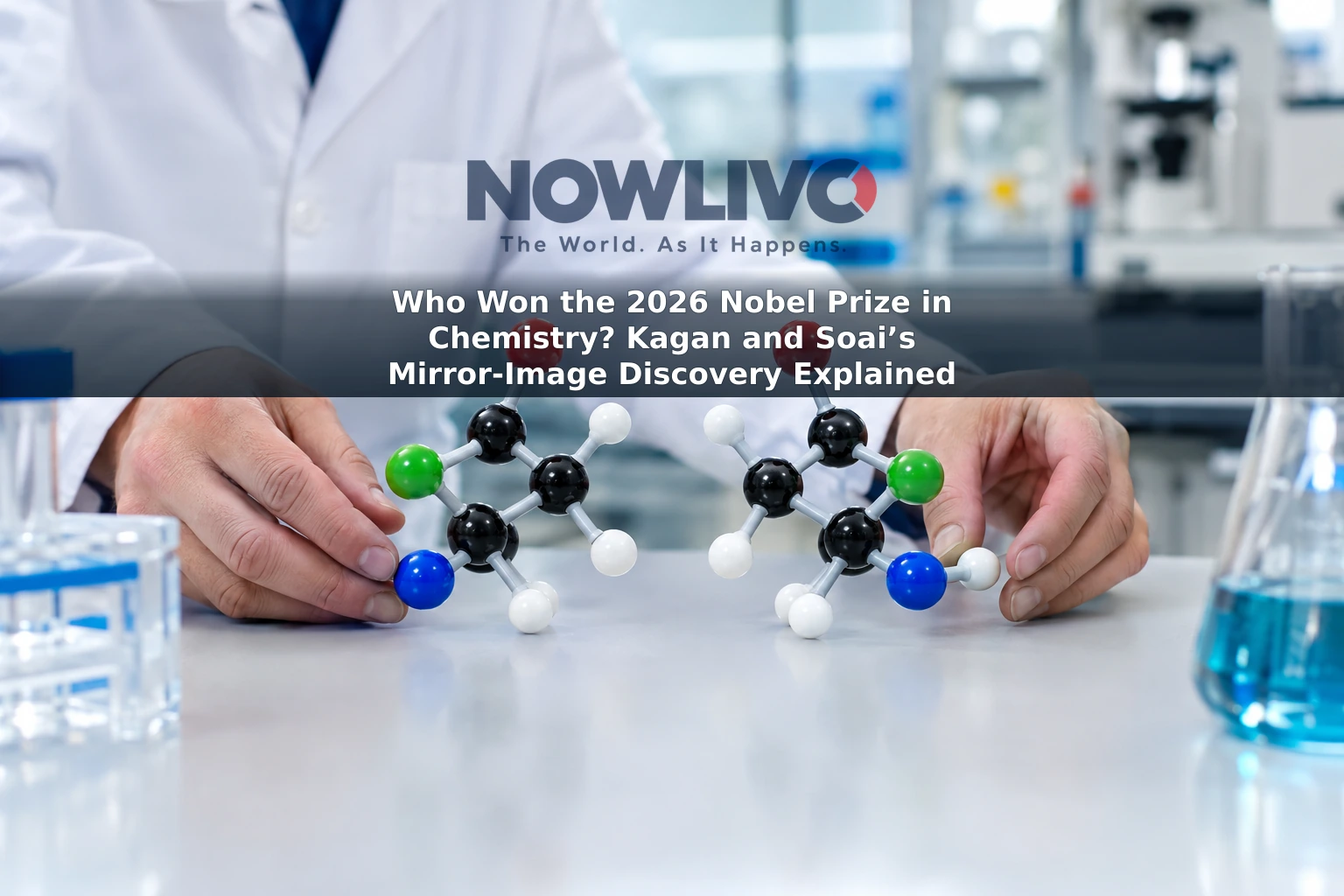
Henri B. Kagan and Kenso Soai won the 2026 Nobel Prize in Chemistry, announced October 7, for discoveries about how chemical reactions can produce one mirror-image form of a molecule rather than the other. Their work showed how a small preference for one form can grow—and, in a remarkable reaction, how a product can help make more of its own form.
The Royal Swedish Academy of Sciences awarded the prize for the discovery of non-linear effects and autocatalysis in asymmetric organic synthesis. In everyday terms, Kagan and Soai helped chemists understand how a reaction can come to favor one molecular ‘hand’ overwhelmingly. The two scientists, from France and Japan respectively, will share the 12 million Swedish kronor prize.
What are mirror-image molecules?
Hold up your hands: they are mirror images, but you cannot place one directly on top of the other with every finger aligned. Some molecules have the same relationship. Chemists call this property chirality, and the two forms are known as enantiomers.
That difference in shape can matter when a molecule meets another molecule. Biological structures are three-dimensional, so two mirror-image forms need not interact with them in the same way. The building blocks of proteins, for example, predominantly have one handedness. Scientists have long sought to understand how such strong preferences for one form can arise.
What did Kagan and Soai discover?
Kagan demonstrated a non-linear effect in asymmetric chemistry: a small imbalance in a reaction’s starting conditions could yield a much larger imbalance between the mirror-image products. That finding challenged the simple expectation that a slight initial preference would produce only a slight difference at the end.
Soai then developed an autocatalytic reaction in which a product helps drive the formation of more product with the same handedness. This creates a reinforcing cycle: an initial advantage for one mirror-image form can increase as the reaction proceeds. His experiments showed a way for a chemical reaction to end up producing one form with extraordinary selectivity.
Together, the discoveries provide a possible chemical explanation for how a strong preference for one molecular form can emerge from a small imbalance. They do not establish exactly how life on Earth acquired its preferred molecular handedness; that broader question remains open.
Why does the discovery matter for medicines?
When a medicine contains a chiral molecule, its two mirror-image forms can have different effects in the body. Depending on the drug, one form may provide the intended benefit while the other may work differently or contribute unwanted effects. Chemists therefore need to identify, test and, where appropriate, make the intended form reliably.
The work recognized by the 2026 Chemistry Nobel deepened scientists’ understanding of how to control that choice in chemical reactions. It is foundational knowledge for asymmetric synthesis, an important part of pharmaceutical chemistry. It would be misleading, however, to credit Kagan and Soai’s particular reactions with creating every modern medicine or to suggest that choosing one molecular form automatically makes a drug safe. A medicine’s effects must still be established through testing.
The prize recognizes both a striking answer to a basic chemistry question and a practical principle: for some molecules, which mirror image you make is as important as what atoms the molecule contains.