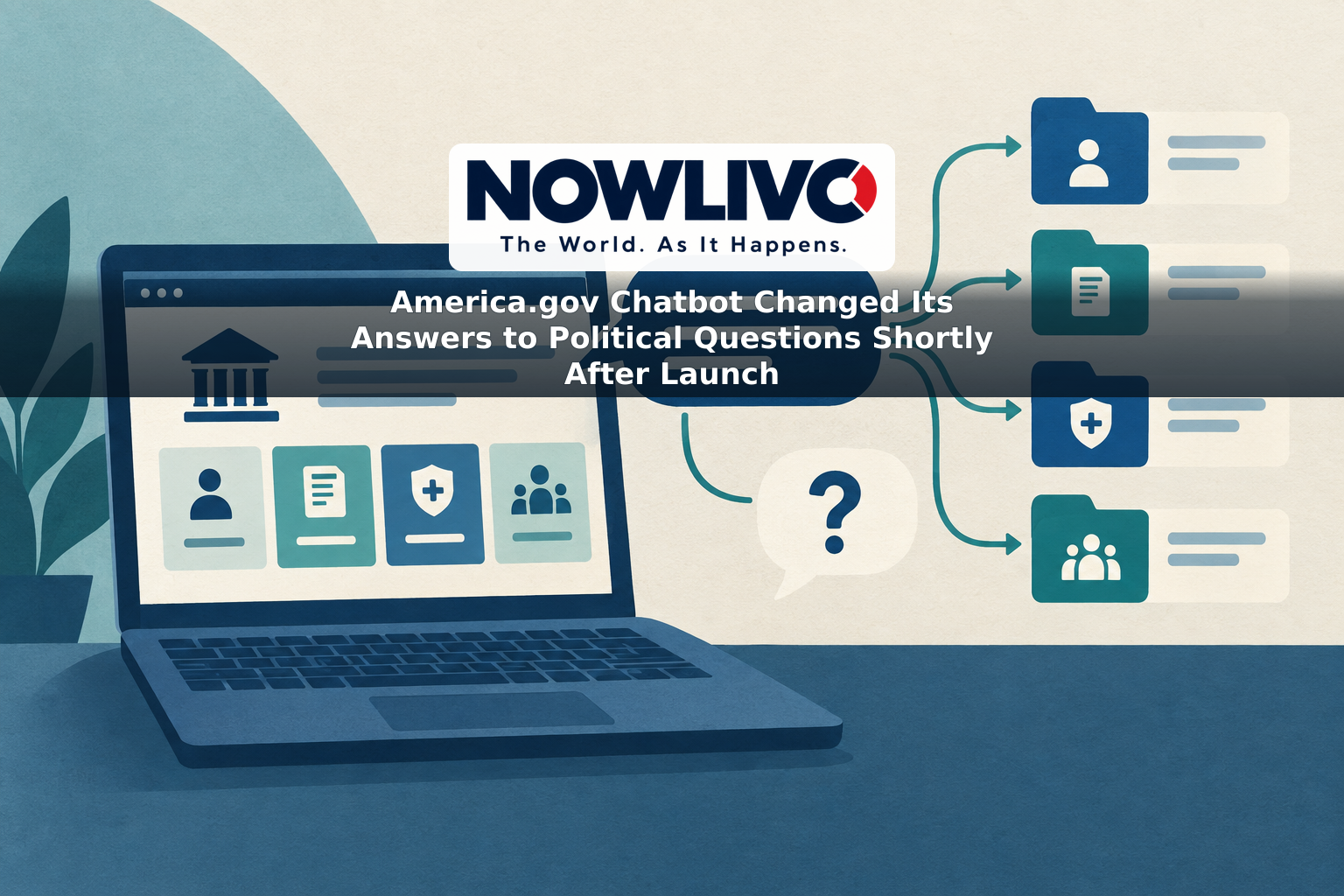
America.gov Chatbot Changed Its Answers to Political Questions Shortly After Launch
WASHINGTON — America.gov launched on September 29, 2026, with a straightforward promise: people could ask a question in plain language instead of searching through multiple federal agency websites. But the new AI chatbot quickly drew attention for something outside that everyday service role. Shortly after launch, some of its answers to politically sensitive questions changed.
The early responses addressed questions directly. The chatbot identified Joe Biden as the winner of the 2020 presidential election and said federal sources did not show that widespread fraud changed its outcome. It also said recent climate change is largely driven by human greenhouse-gas emissions and that Barack Obama’s 2009 inauguration drew a larger crowd than Donald Trump’s first inauguration in 2017.
In another initial answer, the chatbot confirmed that Trump’s name appears in records related to Jeffrey Epstein. The appearance of a name in those records does not, by itself, establish wrongdoing.
When some of the questions were repeated soon afterward, the chatbot declined to answer, saying it did not respond to political questions. The shift included questions about the 2020 election and inaugural crowds. A question about human-caused climate change also received a refusal after an earlier direct response.
What changed — and what remains unclear
The visible change was in the chatbot’s replies, not in the underlying historical record or scientific finding. Its refusal to answer a question about an election result was especially notable because the initial response had treated the result as a matter that could be checked against official information. Declining the later question did not retract or disprove that first answer.
The cause of the shift was not clear from the responses themselves. They do not establish whether someone changed the chatbot’s instructions, adjusted a topic filter or made another technical change. Nor do they establish who, if anyone, authorized a change or why it happened. What users could see was a narrower willingness to answer certain questions soon after the site went live.
That distinction matters for a government tool. A chatbot may be intended to avoid partisan advocacy while still supplying factual information found in public records. When it answers a question one moment and labels a similar question political the next, users have less clarity about what it will handle consistently. That is a reliability issue even when the later response makes no false claim.
A single starting point for services
The Trump administration describes America.gov as a common entry point for federal information and services. Rather than requiring someone to know which agency handles a task, the site invites them to describe what they need. It is designed to draw answers from published government material and point users toward the relevant service.
That could mean asking how to replace a Social Security card, register a business or arrange a visit to a national park. Those examples are different from political fact-checking, but the launch-day exchanges showed that a general-purpose question box can also receive questions about elections, public figures and scientific claims. How it handles those questions is part of the public’s experience of the service.
President Trump also signed an order directing federal agencies to integrate eligible online services with the portal. The plan calls for a secure sign-in and, where available and authorized, a way to complete transactions without moving between several agency sites. Those broader transaction features are an intended expansion, not a reason to assume every federal task can already be completed through the chatbot. The order preserves existing ways to obtain services, including agency websites, phone, mail and in-person options.
How to use its answers
America.gov’s own guidance warns that AI can make mistakes and advises users to check the government sources attached to an answer before making an important decision. That is particularly relevant for questions about eligibility, deadlines or required documents, where an incomplete summary could send someone down the wrong path.
The launch therefore presents two tests for the portal. One is whether it can make routine government tasks easier to find and complete. The other is whether its answers and boundaries remain understandable when questions fall outside a simple service request. Its first day demonstrated the appeal of a single place to ask — and the importance of knowing when the answer might change.