Supreme Court Allows Green Firecrackers in Delhi-NCR on November 7 and 8 Under Strict Limits
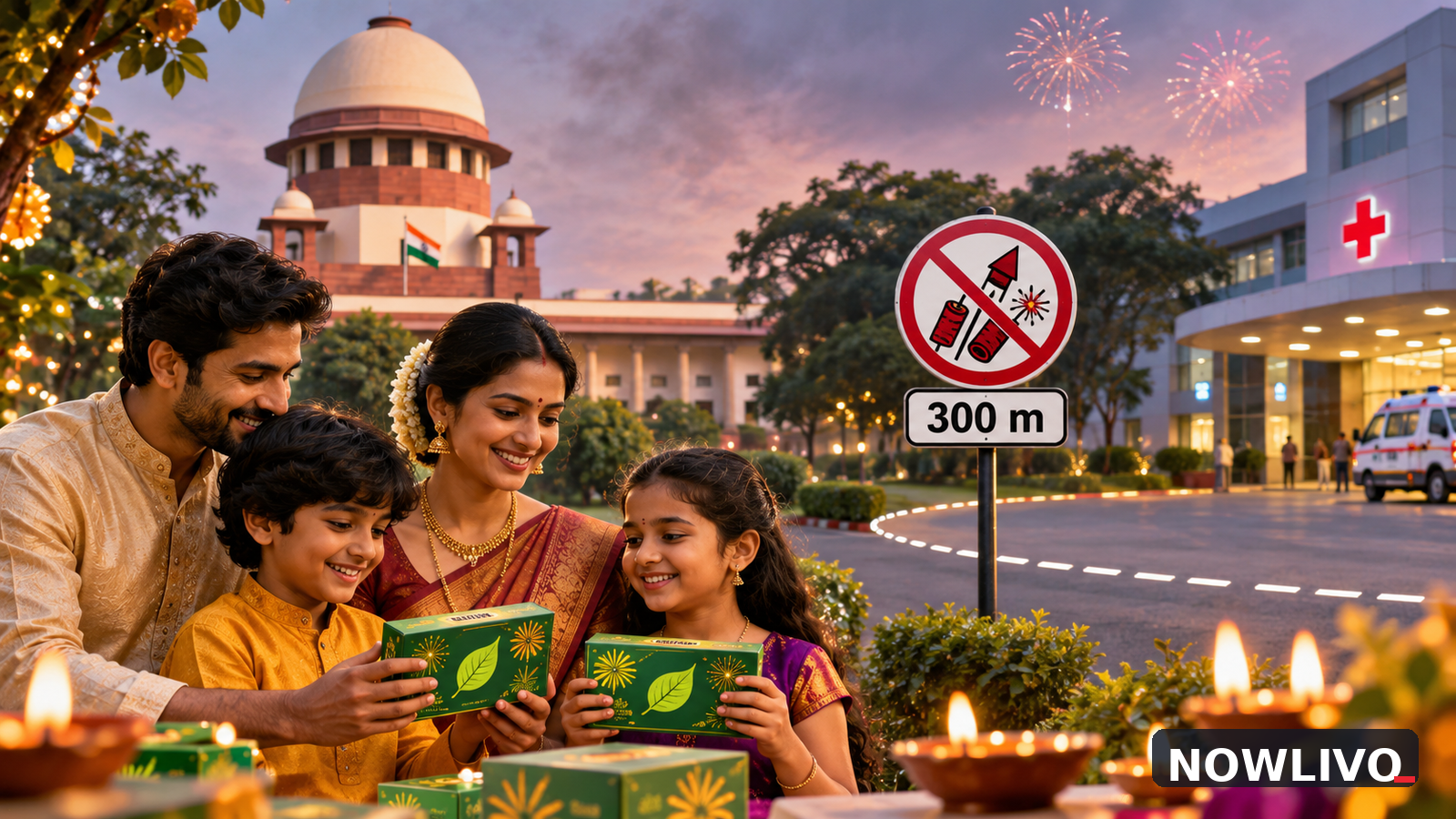
The Supreme Court has permitted a tightly restricted window for certified green firecrackers in Delhi-NCR during Diwali celebrations, allowing their use on November 7 and 8, 2026, while keeping most of the region's broader restrictions intact. The order, reported on Monday, November 2, allows bursting from 6 am to 7 am and from 8 pm to 10 pm on each of the two days. It also prohibits firecrackers within 300 metres of hospitals, nursing homes, health centres, old-age homes and designated silence zones.
The decision is significant because it does not amount to a general lifting of the firecracker ban. The Supreme Court said the complete prohibition would return from November 9. Diwali falls on November 8 this year, and the court has sought to allow a limited celebration without discarding the restrictions intended to protect air quality and vulnerable people.
Two dates and two daily time windows
The permissions apply on Saturday, November 7, and Sunday, November 8. On each date, the morning window runs for one hour, from 6 am until 7 am. The evening window runs for two hours, from 8 pm until 10 pm. Firecrackers outside those periods are not covered by the permission. The court also called for state governments and pollution-control boards to notify and publicise the relevant time slots and local enforcement arrangements.
The distinction between the date and the clock time is central. A resident who buys a certified green cracker does not acquire permission to use it at any hour of the festival weekend. Nor does the order provide a permanent exemption for later celebrations. The Supreme Court explicitly directed that the wider ban resume from November 9, and local police and district authorities have been asked to enforce the restrictions.
Which products the court permitted
Only green firecrackers approved under the relevant certification framework are included. Reports of the order refer to certifications from the Council of Scientific and Industrial Research's National Environmental Engineering Research Institute and the Petroleum and Explosives Safety Organisation. The court directed that only approved products be manufactured during the specified November 2–6 period and that enforcement agencies stop the movement and sale of illegal conventional fireworks.
The court also prohibited joined strings of firecrackers, often called ladis or garlands, and barred products containing barium or lacking the required green-cracker approval. The permitted category is therefore narrower than a shopkeeper's description of a firecracker as environmentally friendly. A green label or a verbal assurance is not equivalent to the certification referred to in the order.
Hospitals and silence zones remain protected
The 300-metre restriction applies around hospitals, nursing homes, primary and district health centres, old-age homes and notified silence zones. The court asked authorities to identify and mark such areas clearly. This provision means that even a permitted time slot cannot be treated as permission to burst crackers next to a hospital. It also reflects concerns about noise and smoke affecting patients, older people and others who may be particularly vulnerable.
The order places responsibility on enforcement authorities in Delhi, Haryana and Uttar Pradesh's NCR districts, as well as other relevant administrations. Local public notices will matter for exact implementation, especially where a residential area lies near a medical facility or a notified silence zone. Residents should use those notices rather than assuming that an informal map or a viral message accurately defines every restricted location.
The decision comes amid worsening pollution
The timing is particularly sensitive because Delhi's air quality deteriorated sharply on Monday. The Commission for Air Quality Management separately invoked GRAP Stage II after the capital's AQI reached 324. The pollution order and the Supreme Court's Diwali permission operate in parallel: the latter creates a narrow exception for certain approved fireworks on two dates, not a suspension of air-pollution controls across NCR.
The court considered submissions about both the right to celebrate festivals and the health impact of smoke and noise. The resulting framework is a compromise with detailed boundaries. It leaves no basis for treating all fireworks as legal, extending the dates, ignoring silence zones or assuming that enforcement will be relaxed during the holiday.
The court's restrictions also create a practical enforcement challenge across multiple police jurisdictions. Delhi-NCR extends beyond the national capital into neighbouring states, so a resident may encounter different local notices while the central conditions remain the same. The prohibition on conventional and joined firecrackers is not a discretionary guideline, and any enforcement action must follow the applicable law. Public clarity on certification and silence zones will matter as much as the court's written order.
For families planning Diwali activities, the practical message is straightforward but precise: check the product certification, follow the November 7–8 time windows, stay outside the protected zones and watch for local implementation notices. The new court directions have made the rules more specific, but they have not removed the underlying restrictions.