Did Quebec separatists win the election? Yes, but the Parti Québécois fell short of a majority
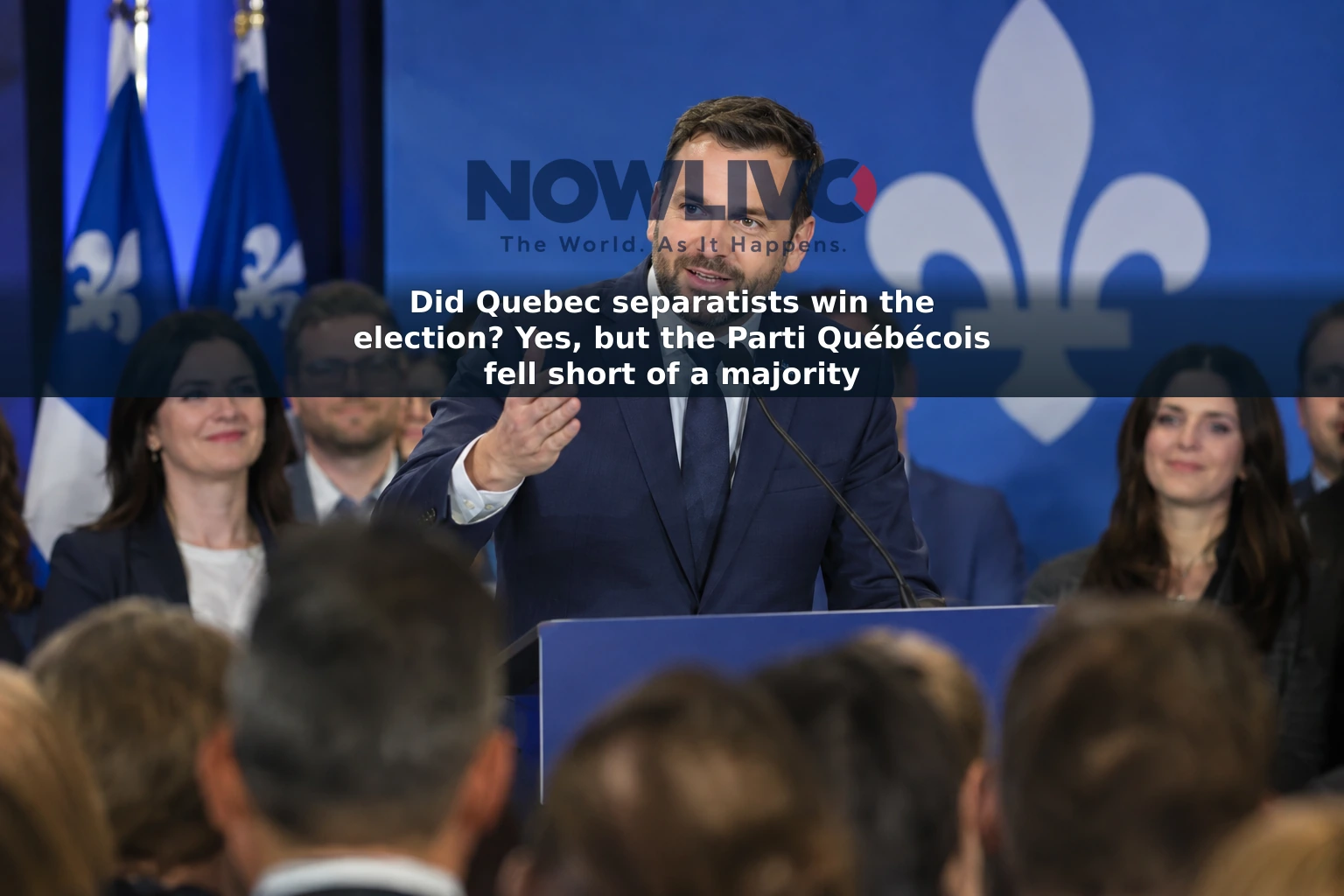
Yes. The separatist Parti Québécois (PQ) won Quebec’s provincial election on October 5, 2026, ending eight years of Coalition Avenir Québec rule. But the party fell short of a majority, so its leader, Paul St-Pierre Plamondon, is poised to head a minority government that will need support from other lawmakers. The result revives the debate over independence from Canada; it does not set a date for a referendum.
Who won the Quebec election?
The PQ won the most seats in Quebec’s National Assembly. It was on course for roughly 60 seats as the final votes were counted, below the 64 needed for a majority in the 127-seat legislature. St-Pierre Plamondon acknowledged on election night that voters had chosen a government expected to work with other parties.
The result brings the PQ back to power for the first time since 2014. It also marks a sharp defeat for the Coalition Avenir Québec, which had governed since 2018. An election win gives the PQ the first opportunity to put forward its governing agenda, but winning the most seats is not the same as having enough votes to pass it alone.
What does a minority government mean in Quebec?
A minority government holds fewer than half the seats in the National Assembly. The PQ can govern without forming a formal coalition, but it will have to find opposition support—or persuade some lawmakers not to vote against it—to pass budgets, advance major legislation and survive votes on its confidence in the Assembly.
That support can vary from issue to issue. Other parties may back a measure, seek changes to it or oppose it. A minority result therefore gives opposition lawmakers more influence over the government’s plans, including any steps toward an independence vote. It does not, by itself, prevent the PQ from governing.
Will Quebec hold an independence referendum?
There is no referendum scheduled. St-Pierre Plamondon has promised one during the PQ’s first term in office, but he has also said he would wait until U.S. President Donald Trump is no longer in office. That puts a vote no earlier than January 20, 2029, under the timetable he has stated. Whether the PQ can carry out the pledge will depend in part on how long its government lasts and what support it can secure in the Assembly.
A referendum would require more than an election-night promise. Under Quebec’s Referendum Act, the National Assembly approves the question to be put to voters, and the government then issues a writ setting the vote in motion. Because the PQ lacks a majority, it cannot assume that lawmakers will approve its preferred question without support from another party.
The PQ’s victory is also not a vote to leave Canada. Quebecers elected representatives to govern the province, not to decide its constitutional future on this ballot. Voters rejected independence proposals in referendums in 1980 and 1995, with the latter decided by a narrow margin.
Would a referendum vote make Quebec independent?
Not automatically. Canada’s Supreme Court has said a clear vote in favour of secession on a clear question would create an obligation to negotiate, rather than give Quebec a right to leave unilaterally. Any such process would involve Quebec, the federal government and other participants in Canada’s constitutional order.
For now, the immediate question is how the PQ will make a minority government work. Its election win puts independence back on the governing party’s agenda, but a referendum still depends on future political and parliamentary decisions—and Quebec voters would have the final say on the question put to them.