Essar-Backed Company Plans $15 Billion Steel Complex in Iowa
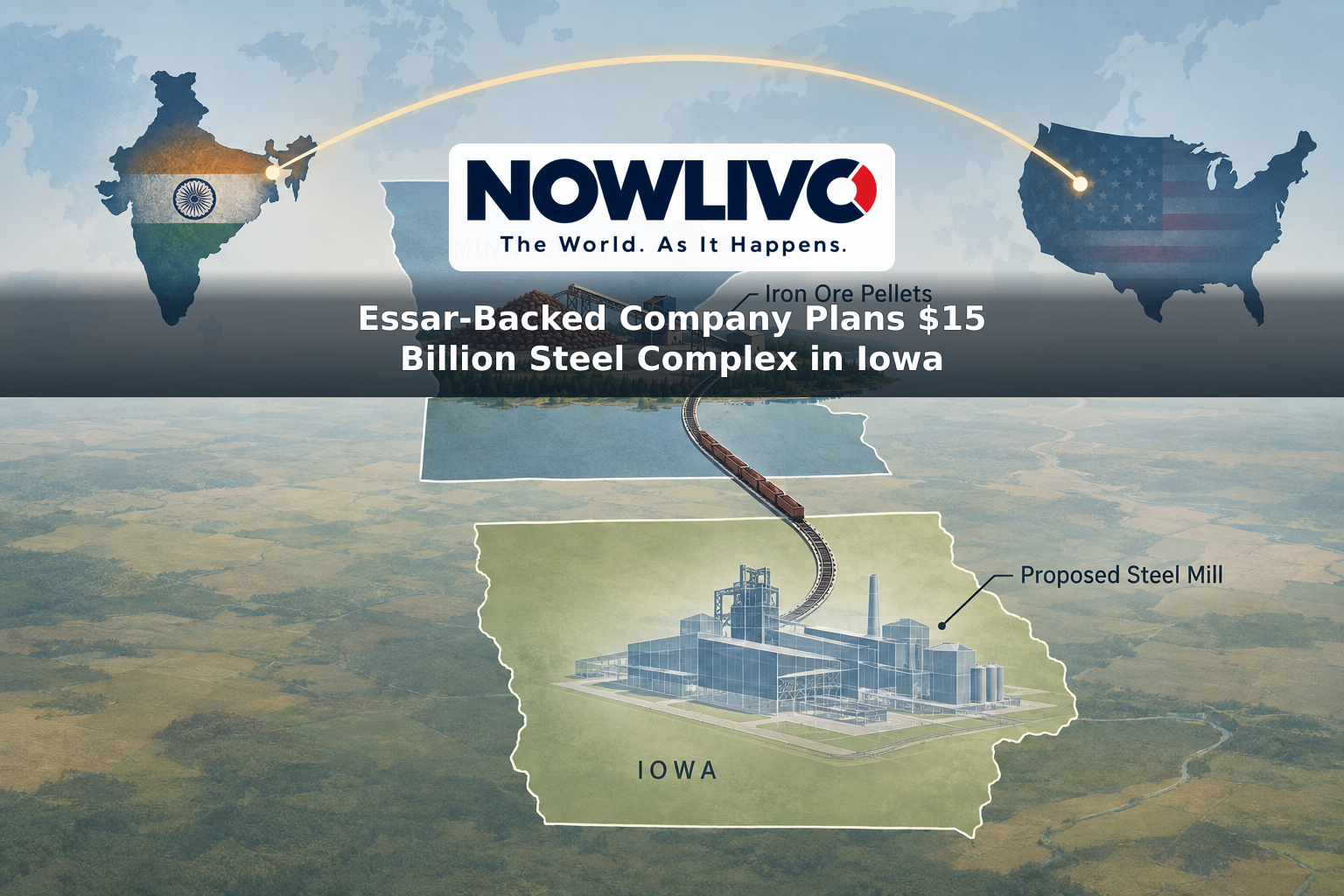
An India-backed steel venture has announced plans for a $15 billion manufacturing complex in Iowa, pairing a proposed new mill with an iron ore operation in Minnesota. Mesabi Metallics, whose project sponsor is India’s Essar Group, unveiled the plan at the White House on September 28, 2026, alongside President Donald Trump and Iowa Governor Kim Reynolds.

The Iowa facility accounts for $15 billion of Mesabi’s stated $18 billion investment across the two states. The company says the remaining $3 billion is being spent to complete its mine and pellet plant near Nashwauk, Minnesota. Those figures describe the company’s proposed mine-to-mill system, not an $18 billion plant located entirely in Iowa.
Where the plant is planned
Iowa lawmakers have identified Lee County, in the state’s southeast corner, as the intended location. Mesabi’s public announcement describes an Iowa complex but does not identify a specific parcel within the county. That distinction matters for a project of this scale: a county-level location establishes the broad destination, while a final site would bring questions about land, transport links and local infrastructure into sharper focus.
Mesabi plans to send iron ore pellets from Minnesota to Iowa for conversion into steel. The company describes an integrated operation using direct-reduced iron and electric arc furnaces. In that process, iron made from ore would be combined with scrap steel and melted to produce finished material. Mesabi says the plant could supply industries including vehicles, construction, energy and shipbuilding.
The White House has described a first-phase target of 7.5 million tons of steel a year, rising to roughly 10 million tons after expansion. Those are proposed production capacities, not current output. Trump has characterized the project as one of the largest steel plants in US history; whether it reaches that scale will depend on the complex being built and brought into operation.
Who is involved
Mesabi Metallics is the company developing the Iowa proposal and the Minnesota iron ore project. Essar Group is its India-based sponsor, giving the venture a direct cross-border investment dimension even though the planned mine, mill and steelmaking would be in the United States. Reynolds has welcomed the company to Iowa and described the state as a partner in the effort. That expression of support does not, by itself, establish a joint venture or spell out a state incentive agreement.
A separate US federal financing decision concerns the Minnesota operation. The Export-Import Bank of the United States said its board approved a $770 million direct loan for Mesabi’s iron ore mine and pellet plant in September. That approval should not be confused with financing for the full $15 billion Iowa steel complex. The company has not set out a complete public funding package for the proposed Iowa build.
Mesabi projects more than 6,000 jobs during construction and at least 1,750 permanent positions once the Iowa plant is operating. These are forecasts tied to a completed project, rather than jobs already created at an Iowa steel mill. The company has also projected substantial wider economic activity, but those estimates likewise depend on the investment proceeding as planned.
Why the announcement matters
If carried through, the venture would be a prominent example of Indian industrial capital establishing manufacturing capacity in the US. Its commercial appeal rests on connecting an American ore source to American steelmaking, while Essar brings the backing of an India-founded industrial group. That combination could make the project a significant case study in India–US business ties: investment crossing borders to produce for customers within the US market.
For Iowa, the proposed complex offers the prospect of a large new manufacturing employer and work for suppliers, contractors and transport businesses. For Mesabi, it would provide a planned destination for output from its Minnesota operation. Neither outcome is assured by the announcement alone.
The next measures of progress will be a clearly identified Iowa site, fuller financing and construction plans, and a timetable the developer can substantiate. Until then, the $15 billion figure and the projected jobs are best understood as the scale of Mesabi’s announced ambition—not evidence that the Iowa plant is already under construction or producing steel.