
Humanoid Robots Are Leaving the Demo Stage: Where Are They Actually Being Used?
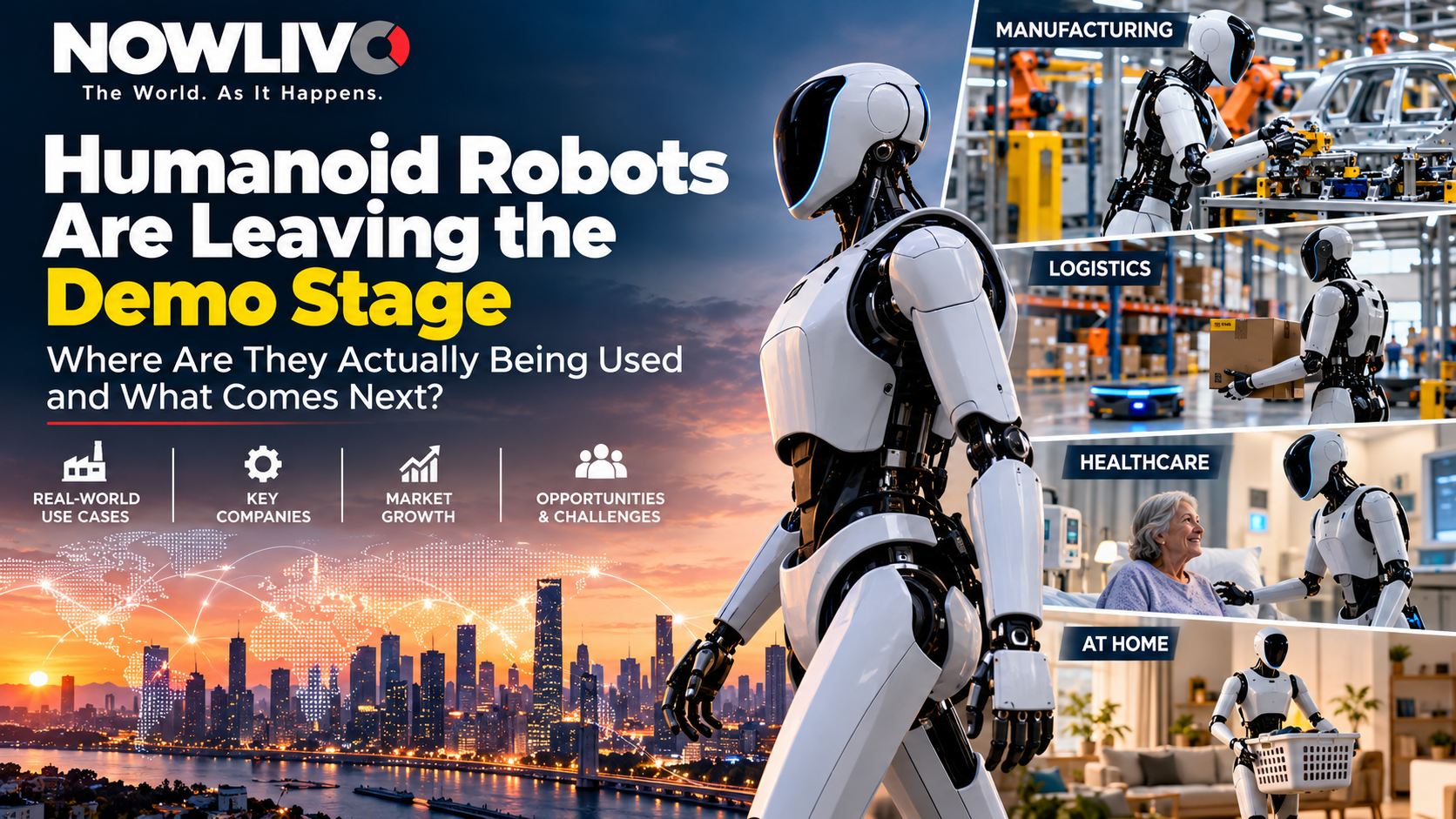
For years, the humanoid robot industry has been exceptionally good at producing moments that look like the future.

Robots walk across stages, carry boxes, sort objects, dance, run and perform increasingly sophisticated movements in videos watched by millions.
But an impressive demonstration and a useful worker are very different things.
A robot operating for a few minutes in a carefully prepared environment does not necessarily prove that it can work through a factory shift, recover from unexpected situations, interact safely around people or perform the same task thousands of times without failure.
In 2026, however, something important is changing.
Humanoid robots are beginning to accumulate measurable experience outside laboratories. Automakers are testing them on production lines. Logistics operations are becoming another target. Companies are collecting enormous quantities of real-world training data. China is building a rapidly expanding humanoid ecosystem, while US companies are pursuing increasingly capable AI-powered machines.
The commercial market remains tiny compared with conventional industrial robotics—but it is no longer purely theoretical.
Approximately 7,000 humanoid robots were sold worldwide in 2025 for industrial and professional service applications, according to figures compiled by the International Federation of Robotics (IFR). The figure is one of the first industry-wide benchmarks for a sector attracting billions of dollars in investment.
That 7,000 figure also provides a useful reality check.
The humanoid revolution may be beginning.
It has not arrived at mass scale yet.
What actually counts as a humanoid robot?
The term “humanoid” can create the impression that every machine must look almost exactly like a person.
That isn’t necessarily the case.
Under the IFR criteria used for its new market statistics, a humanoid robot needs a human-like appearance and the ability to operate autonomously in an environment designed for humans. It does not necessarily need legs.
That distinction matters.
Human environments—from factories and warehouses to offices and homes—were generally built around the dimensions and abilities of the human body.
Doors are human-sized. Shelves are positioned for human reach. Tools have handles designed for human hands. Stairs, workstations, aisles and controls all reflect the same assumption.
Traditional industrial robots solve this problem differently. A factory can be redesigned around a machine.
Humanoid robotics attempts something more ambitious:
design the machine to operate in a world already designed around us.
If that works reliably, businesses could theoretically automate some tasks without rebuilding an entire facility around specialized machinery.
That is one reason the humanoid form has attracted so much attention.
The numbers show how early the market still is
Seven thousand robots sounds substantial until it is compared with the wider robotics industry.
Around 542,000 conventional industrial robots were installed worldwide in 2024, while approximately 199,000 professional service robots were sold for applications including transportation, hospitality and cleaning.
Humanoids therefore remain a tiny fraction of today’s robot workforce.
There is another important qualification.
Many humanoids sold in 2025 went to research institutions or companies using the machines for testing, data collection and AI development rather than putting them into continuous productive employment. Carmakers have been among the early adopters, but many deployments remain relatively small pilots.
So where can we find stronger evidence that humanoid robots are doing real work?
One of the clearest examples comes from the automotive industry.
BMW has moved beyond a short demonstration
BMW’s experience in South Carolina provides an unusually concrete measure of what a humanoid can already accomplish.
The company initially tested Figure AI’s Figure 02 robot at its Spartanburg plant, using the humanoid to handle sheet-metal components.
That project subsequently became much more substantial.
BMW says that over approximately ten months in 2025, Figure 02 assisted production of more than 30,000 BMW X3 vehicles.
The robot operated ten-hour shifts, five days a week. It retrieved and positioned sheet-metal parts used in the welding process.
During the deployment, Figure 02 moved more than 90,000 components, accumulated approximately 1,250 operating hours and took around 1.2 million steps. BMW Group
Those numbers matter more than a spectacular demonstration video.
They represent sustained operation inside an actual automotive production environment.
BMW says the system demonstrated an ability to perform repetitive positioning tasks with millimetre-level precision, while the trial also exposed practical requirements involving safety, factory IT infrastructure, logistics and connectivity.
That is closer to the evidence the humanoid industry ultimately needs.
Not whether a robot can perform a task once.
Whether it can perform it reliably enough to become useful.
The next challenge is logistics
BMW is already pushing its experiment into another area.
Its next Spartanburg project involves Figure 03, the successor to Figure 02, and focuses on more complex sequencing work in logistics.
This is significant because logistics may eventually become one of the strongest use cases for general-purpose humanoids.
Warehouses and factories contain countless objects that need to be picked up, moved, sorted, sequenced or delivered from one workstation to another.
Many of those jobs were designed for people rather than specialized robots.
A machine capable of walking or navigating through those environments, manipulating differently shaped objects and learning multiple tasks could potentially perform jobs that currently require several different forms of automation.
But that word—potentially—is important.
The industry still has to demonstrate reliability, economics and scale.
Humanoid robots are also entering European factories
BMW’s robotics work is no longer confined to the United States.
In September 2026, the company announced a humanoid pilot at its Leipzig plant in Germany using the AEON robot.
The machine has a human-like upper body but moves on wheels rather than walking on two feet—an illustration of how humanoid design may evolve according to the job rather than trying to reproduce every aspect of human anatomy.
BMW is testing AEON in areas including high-voltage battery assembly and component manufacturing.
The wheeled design highlights an interesting engineering question.
If a robot spends its entire working life on a smooth factory floor, does it actually need legs?
Walking is an extraordinarily complicated problem involving balance, energy consumption, mechanical durability and control.
Wheels may be more efficient for some industrial applications.
The most commercially successful “humanoid” may therefore not necessarily resemble the science-fiction robot people imagine.
Its body may simply contain enough human-like characteristics to use workplaces and tools originally designed for people.
Mercedes-Benz is experimenting too
BMW isn’t alone.
Mercedes-Benz has been testing Apollo, a humanoid developed by Apptronik, as part of its work on AI and digital manufacturing.
The company has incorporated humanoid-robot testing into its Mercedes-Benz Digital Factory Campus in Berlin, where new manufacturing technologies are evaluated in real production environments.
Automotive manufacturing is becoming an important proving ground because car factories combine several conditions that are attractive for robotics.
Tasks are repetitive.
Facilities are highly structured.
Production volumes are large.
Manufacturers already have decades of experience integrating industrial robots.
And some jobs involve repetitive movements or handling components that companies would prefer to automate where practical.
That does not mean humanoids will replace the enormous population of traditional industrial robot arms already found in automotive factories.
In many applications, a fixed industrial robot remains faster, cheaper or more reliable.
Humanoids become interesting where flexibility matters.
Why not just use ordinary robots?
This is one of the most important questions surrounding the entire industry.
Factories have used robots successfully for decades.
A robotic arm does not need a head, torso or two legs to weld a vehicle.
Autonomous mobile robots can move goods through warehouses without looking remotely human.
Purpose-built machines often outperform general-purpose ones at a particular task.
So why build humanoids at all?
The industry’s argument is essentially about flexibility and compatibility.
Traditional automation frequently requires the environment to be designed around the robot.
A sufficiently capable humanoid could reverse that relationship.
Instead of rebuilding the workplace for the machine, the machine adapts to the workplace.
A general-purpose robot might eventually move between tasks: handling materials in the morning, assisting assembly later and performing another logistics function when production requirements change.
That could be particularly valuable for tasks that are too variable or too low-volume to justify expensive dedicated automation.
But for this economic argument to work, humanoids have to become reliable enough, capable enough and inexpensive enough.
Those are substantial conditions.
Physical AI is the technology underneath the robot
The humanoid story is not simply about mechanical engineering.
It is increasingly part of a larger field often described as physical AI or embodied AI.
Large language models learned patterns from enormous quantities of text.
Image models learned from enormous visual datasets.
Robots need to understand something considerably messier:
the physical world.
A robot must perceive where objects are located, understand instructions, plan an action, control its body, manipulate an object and adapt when reality does not exactly match its training.
A box might be rotated differently.
A component may be slightly out of place.
A person might walk into the robot’s path.
An object could slip.
Lighting could change.
The machine needs to respond appropriately rather than simply stop functioning.
That is one reason companies want robots operating in real environments even before the machines are ready for widespread commercial deployment.
Real-world operation generates information that can be used to improve the AI controlling future robots.
The robot is therefore both a potential worker and a source of training experience.
China is emerging as a major humanoid robotics center
The global competition is also becoming geographically distinct.
China already dominates conventional industrial robotics demand and has developed an increasingly visible humanoid ecosystem.
Chinese manufacturers including Unitree and UBTECH have become prominent participants in the sector, while the country’s broader strengths in manufacturing, batteries, electric motors and electronics provide an industrial base from which robotics companies can develop. Reuters reported this month that China has become particularly strong in humanoid hardware, although the United States retains advantages in leading embodied-AI software.
That combination makes humanoid robotics part of a broader international technology competition.
The United States has a powerful AI software ecosystem and companies developing sophisticated humanoids.
China possesses enormous manufacturing capacity and an extensive robotics supply chain.
Europe has major industrial companies capable of providing demanding real-world test environments.
Success may ultimately depend on combining all three capabilities:
AI intelligence, sophisticated hardware and mass manufacturing.
What about robots in homes?
This is where expectations should be considerably more cautious.
A factory is structured.
A home is chaotic.
A production-line robot might repeatedly manipulate a known component in a known location.
A household robot could encounter toys on the floor, pets, children, stairs, liquids, fragile objects, unusual furniture and thousands of items it has never previously encountered.
Humans navigate those situations effortlessly because we possess extraordinary perception, dexterity, reasoning and common sense.
For a robot, they represent an enormous collection of edge cases.
Domestic tasks also require delicate manipulation.
Folding clothes, loading a dishwasher, preparing food and cleaning a cluttered room may appear simple because people perform them every day.
From a robotics perspective, they are exceptionally complex.
That is why industrial environments are likely to provide the clearest near-term evidence of humanoid value.
Factories can constrain the problem.
Homes cannot.
Healthcare brings an even higher bar
Healthcare and elder care are frequently mentioned as future applications for humanoid robots.
The demographic argument is understandable.
Many countries face ageing populations and shortages of healthcare and care workers.
A robot capable of moving supplies, assisting with repetitive physical tasks or performing basic support functions could theoretically reduce some workload.
But healthcare introduces additional requirements involving safety, regulation, reliability, privacy and human interaction.
The IFR’s new 7,000-unit humanoid tally does not include medical robots, which it categorizes separately. Reuters
So images of humanoids caring independently for patients should not be confused with evidence of large-scale deployment today.
The industrial sector remains considerably further ahead.
The hardest problem may be reliability
Humanoid robots do not need to be perfect to become useful.
But commercial machines need to be reliable enough that using them makes economic sense.
A robot that performs an impressive task 90% of the time may be a remarkable research achievement.
It could also be a terrible factory worker.
Production environments care about uptime, repeatability, maintenance and predictable performance.
A machine that frequently requires human intervention can eliminate much of the labor advantage automation was supposed to provide.
There are also mechanical realities.
Motors wear.
Joints experience stress.
Batteries need charging.
Sensors can fail.
Hands must repeatedly grasp objects.
Falls can damage expensive equipment.
The path from an impressive prototype to an industrial product is therefore not merely an AI problem.
It is a reliability-engineering problem.
Battery life and energy remain constraints
Humanoid robots also carry their energy supply with them.
People can work for hours after eating a meal.
Robots need batteries capable of powering processors, sensors, actuators and continuous movement.
Increasing battery capacity adds weight.
Additional weight can require more energy to move.
That creates a fundamental engineering trade-off.
Factories can work around the issue with charging periods, battery swapping or duty cycles that allow several robots to alternate.
But widespread general-purpose deployment will benefit greatly from improvements in battery technology, motors and overall system efficiency.
Cost will determine whether the revolution actually happens
Even if a humanoid can perform a job, companies still have to answer a simpler question:
Is it cheaper or more useful than the alternatives?
The relevant comparison isn’t always a robot versus a human worker.
It can be:
a humanoid versus a fixed robotic arm;
a humanoid versus an autonomous mobile robot;
a humanoid versus redesigning the production process;
or automation versus simply leaving the task to people.
A general-purpose robot has an economic advantage only if its flexibility produces enough value to offset the complexity of building and maintaining it.
That is why today’s pilots matter.
They provide companies with the data needed to determine whether the economics work outside a laboratory.
Don’t confuse forecasts with today’s reality
Humanoid robotics has attracted extremely ambitious projections.
Bank of America Global Research, for example, estimates that humanoid shipments could reach 90,000 units in 2026 and 1.2 million by 2030. Those are forecasts, not confirmed sales, and should be interpreted accordingly. Reuters
The verified historical benchmark remains far smaller: approximately 7,000 professional and industrial humanoids sold globally in 2025 under the IFR’s methodology.
That gap between current deployment and projected deployment is arguably the most important number in the entire humanoid story.
If the optimistic forecasts prove accurate, the industry is approaching an extraordinary period of growth.
If technical reliability, economics or manufacturing prove more difficult than expected, adoption could progress much more slowly.
The next several years will determine which scenario is closer to reality.
So, are humanoid robots finally here?
Yes—but not in the way viral videos sometimes suggest.
Thousands of humanoids exist in professional and industrial settings. Real factory deployments are producing measurable results. BMW’s experience demonstrates that at least some humanoid systems can perform repetitive production work for extended periods.
But the technology remains at an early commercial stage.
The world’s factories are not suddenly full of humanoid workers.
Your next colleague is probably not a robot.
And a machine capable of reliably handling every household chore remains a much harder challenge than a robot performing a carefully defined factory task.
The meaningful transition in 2026 is subtler.
Humanoid robotics is moving from a period dominated by “Look what this robot can do” toward a much more demanding question:
“Can this robot do something useful, reliably, every day?”
For the first time, there are enough real-world deployments to begin answering that question with operating data rather than demonstrations.
That may ultimately prove more important than any robot dance.