
India Pours ₹63.84 crore into GalaxEye’s OptoSAR Multisensor Satellite Project, Backing ₹247.69 crore Programme
The Technology Development Board (TDB), under the Department of Science & Technology, on September 24, 2026 signed an agreement with Bengaluru‑based GalaxEye Space Solutions Pvt. Ltd. to provide ₹63.84 crore in Research, Development & Innovation (RDI) support. The grant is part of a larger, approved project budget of ₹247.69 crore to develop an indigenous multisensor satellite based on the company’s OptoSAR approach.

What OptoSAR is and how it works
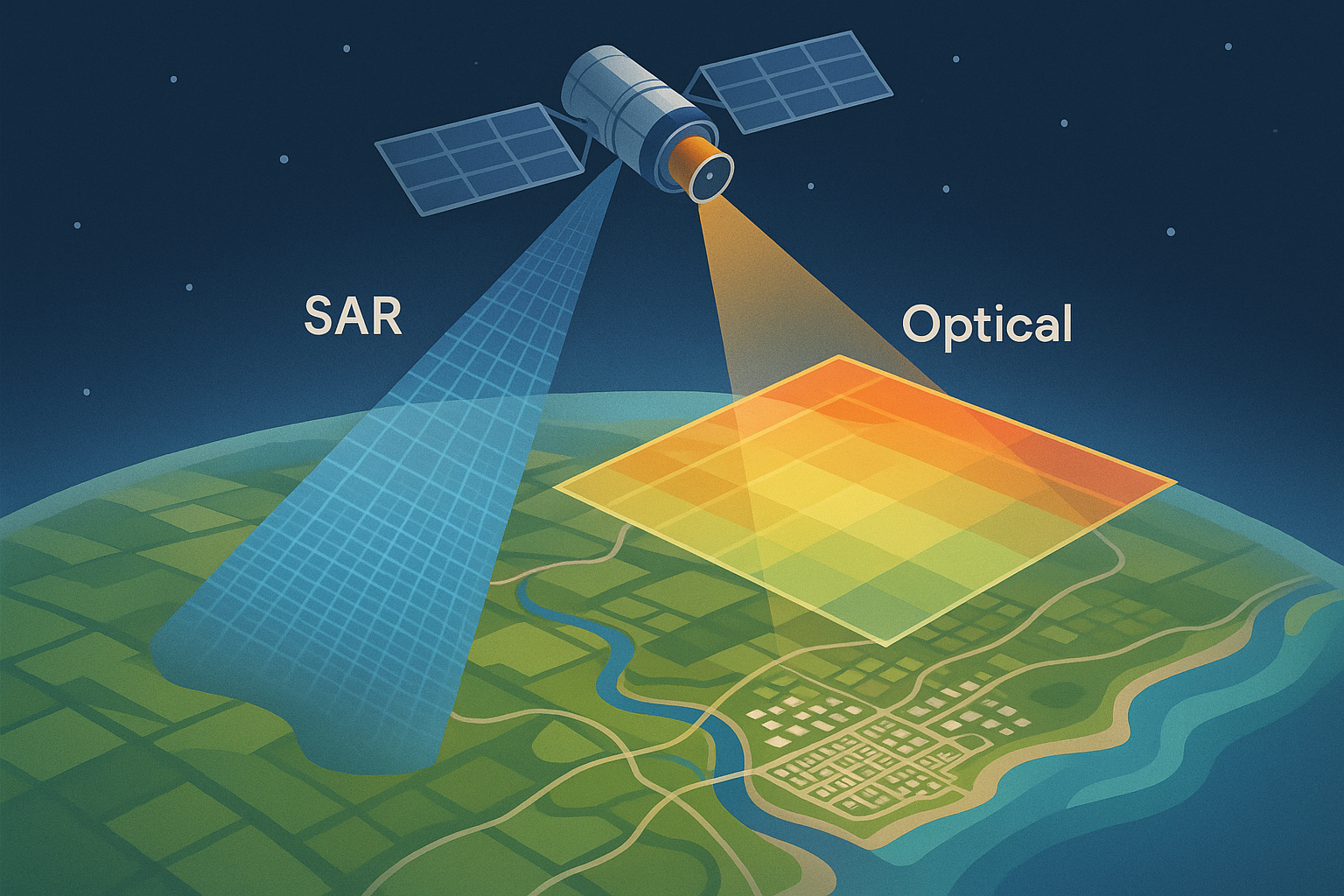
OptoSAR is a multisensor architecture that co‑locates and fuses Synthetic Aperture Radar (SAR) and electro‑optical (EO) sensors on a single satellite platform. SAR uses microwave radar pulses to image Earth regardless of cloud cover or daylight, while EO sensors capture high‑fidelity visual and multispectral data when skies are clear. By combining the two in a synchronized, correlated data stream and processing them with fusion algorithms, OptoSAR aims to produce imagery that retains the penetrating, all‑weather advantages of SAR while adding the interpretability and color/detail of optical data.
Why fusion matters: complementary strengths
Each sensor type brings strengths and gaps. SAR excels at detecting structural changes, surface roughness and moisture contrasts — critical for flood mapping, ship detection and activity‑based monitoring — but its images can be harder for non‑specialists to interpret. Optical imagery is intuitive and rich in spectral information but is limited by clouds and lighting. When fused, the data set becomes both resilient to weather interruptions and richer in actionable detail, enabling applications that require continuity plus semantic clarity: precision agriculture, disaster response, coastal surveillance, and infrastructure monitoring.
Performance targets and development stage
According to the agreement, GalaxEye’s project targets high‑resolution imaging with ground sample distances finer than 0.5 metre and seeks to advance the OptoSAR system from Technology Readiness Level (TRL) 6 to TRL 9 — taking it through final engineering, qualification and flight validation. The TDB support covers system development, engineering, testing and validation activities needed for operational readiness.
Scale and public‑private funding share
The approved cost of ₹247.69 crore places the programme among the larger private‑sector Earth‑observation efforts in India to date. The ₹63.84 crore RDI contribution represents roughly a 26% public share of the total approved budget, reflecting a model of targeted government support designed to de‑risk complex technology maturation while leveraging private investment and engineering capacity.
What this means for India’s private space and EO capabilities
The funding boost strengthens the ecosystem of Indian private space firms that are moving from technology demonstrations to operational services. An indigenous OptoSAR capability promises more resilient, higher‑value Earth‑observation products from domestic providers, reducing reliance on external suppliers for certain high‑resolution, all‑weather data. For downstream users — state agencies, insurers, utilities, agritech companies and disaster‑management bodies — fused OptoSAR products can shorten decision cycles by delivering continuous, interpretable imagery and analytics.
Context and next steps
GalaxEye has previously moved to operationalise OptoSAR concepts and has launched at least one OptoSAR mission earlier in 2026; the TDB agreement is aimed at scaling that capability toward routine, validated service offerings. With this RDI support, the firm will focus on systems engineering, integration, qualification testing and in‑orbit validation to meet TRL‑9 objectives. If successful, the programme could accelerate plans for a small constellation of multisensor satellites to increase revisit frequency and product availability.
Beyond technology, the announcement signals continued government willingness to underwrite strategic R&D in private space ventures — a trend that could broaden India’s industrial base in satellite manufacturing, sensor development and geospatial analytics. For users, the prospect of sub‑0.5 metre, all‑weather fused datasets from an Indian supplier offers both national resilience and new commercial opportunities in geospatial services.
GalaxEye and the TDB have framed this agreement as a partnership to move indigenous OptoSAR from a promising demonstration into a validated, serviceable capability; the coming 12–24 months of engineering and validation work will determine whether the promise is realised at operational scale.