October 4 Bahrain Grand Prix: Why the start was delayed and what drivers said about engine rules
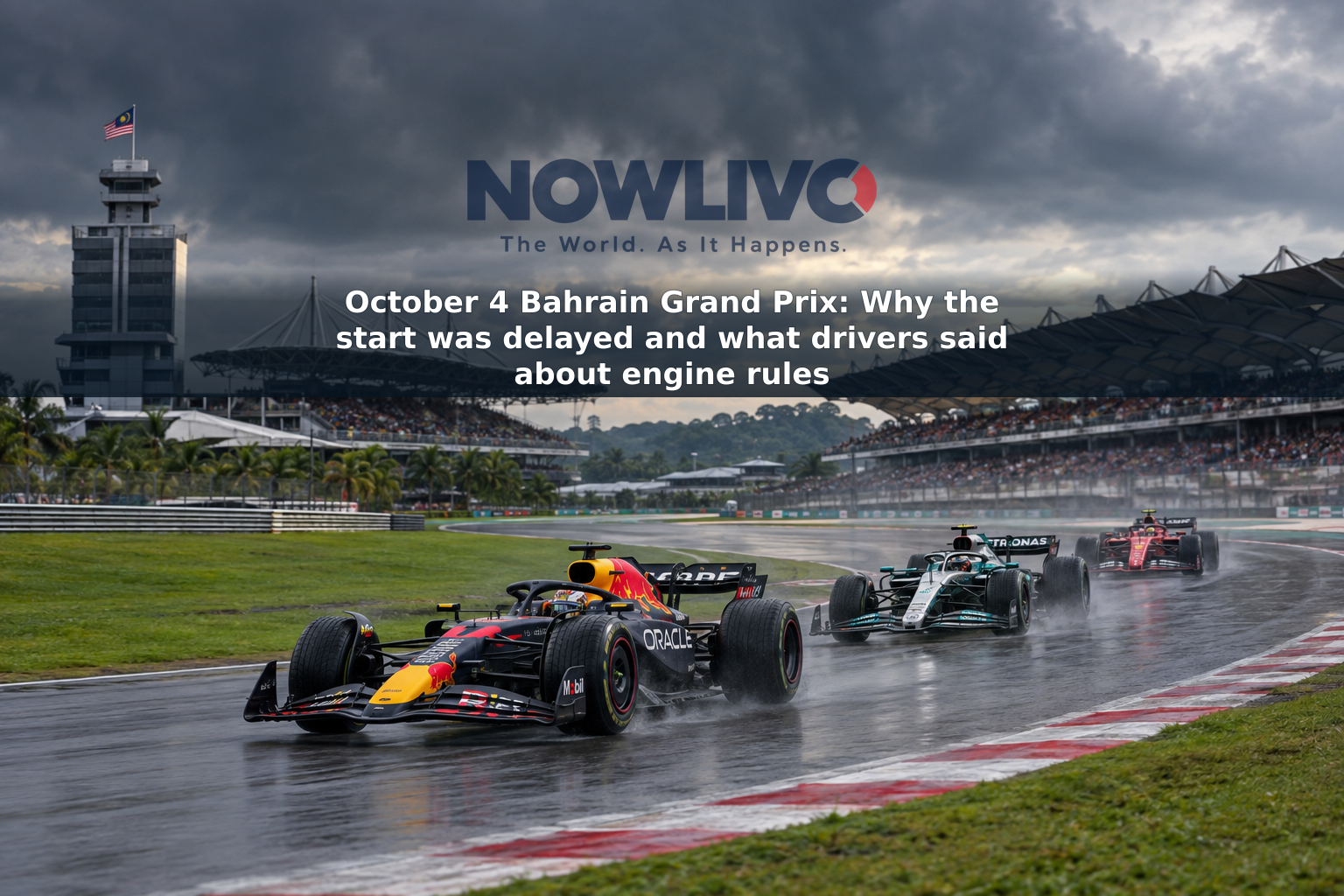
Max Verstappen won the October 4, 2026 Bahrain Grand Prix in Malaysia, but the race began more than an hour and a half later than scheduled. Heavy rain first delayed the start by 40 minutes. When cars finally went out for formation laps, several lost power, forcing officials to suspend the start for another 53 minutes while teams installed a software update. Verstappen and Lewis Hamilton later criticized the complexity of Formula 1’s engines. Their criticism was not an announcement that the engine regulations had changed.
Why was the Bahrain Grand Prix held in Malaysia?
Despite its name, this edition of the Bahrain Grand Prix took place at the Sepang International Circuit near Kuala Lumpur, not at Bahrain’s usual venue in Sakhir. Formula 1 and the FIA had arranged for Malaysia to host the October event under the Bahrain Grand Prix name. Sepang’s tropical weather became central to the race before the cars could complete a competitive lap.
The Grand Prix was scheduled to start at 3 p.m. local time. A thunderstorm left standing water on the circuit, and an inspection showed conditions were unsuitable for a start. Race control pushed the formation lap back to 3:40 p.m. That first postponement was a weather decision: officials needed the track to become safe enough for cars to circulate.
The next interruption had a different cause. As the field drove behind the safety car, Verstappen reported that his car would not accelerate properly. Hamilton also lost power and stopped on the start-finish straight before restarting his Ferrari. Other cars struggled to maintain speed. Race control suspended the start, sent the field to the pit lane and retained the original grid order for the next attempt. Cars went out again at 4:33 p.m., 53 minutes after the first formation-lap attempt.
What caused the power trouble?
The FIA said an unusual combination of low engine speed, limited grip, wet-weather energy-management settings and Sepang’s circuit configuration caused unintended power loss in several cars. During the stoppage, its technical department distributed a software update that removed an energy-limit constraint in the affected sectors, allowing teams to update their power units before the race began.
That distinction matters. Rain caused the initial 40-minute delay; the disrupted formation laps and the work needed to get the cars running caused the further wait. The software intervention addressed a problem encountered at this event. It should not be confused with an announced rewrite of Formula 1’s engine regulations.
Speaking after the race, Verstappen argued that the engines and their software had become too complicated, describing the slow-moving cars as a situation the sport did not want. Hamilton said he had never previously had to stop on track, switch off his car and restart it in those circumstances, and hoped lessons would be learned. Both drivers were describing their experience and pressing for answers, not setting a new rule.
How did the race finish?
Once racing began, the drying track split teams over tyre choice. Verstappen started on intermediate tyres but lost places to Mercedes drivers Kimi Antonelli and George Russell at the standing start. He recovered as conditions changed, moved back into the lead and held on through a late safety-car period for his first victory of the 2026 season and the first Grand Prix win for Red Bull Ford Powertrains.
Antonelli finished second, 2.307 seconds behind Verstappen. Hamilton finished third after his decision to start on slick tyres initially sent him tumbling down the order. His Ferrari became more competitive as the track dried, and he recovered to the podium. Russell, who had been running near the front, retired late in the race with a power-unit problem.
For fans, the outcome and the rules question are separate: the race result stands, and a software fix was applied before the start. Verstappen’s and Hamilton’s objections may prompt further scrutiny, but criticism after the Bahrain Grand Prix in Malaysia was not itself a confirmed regulation change.