
Supreme Court declines to pause UPI merchant fee ahead of October 15
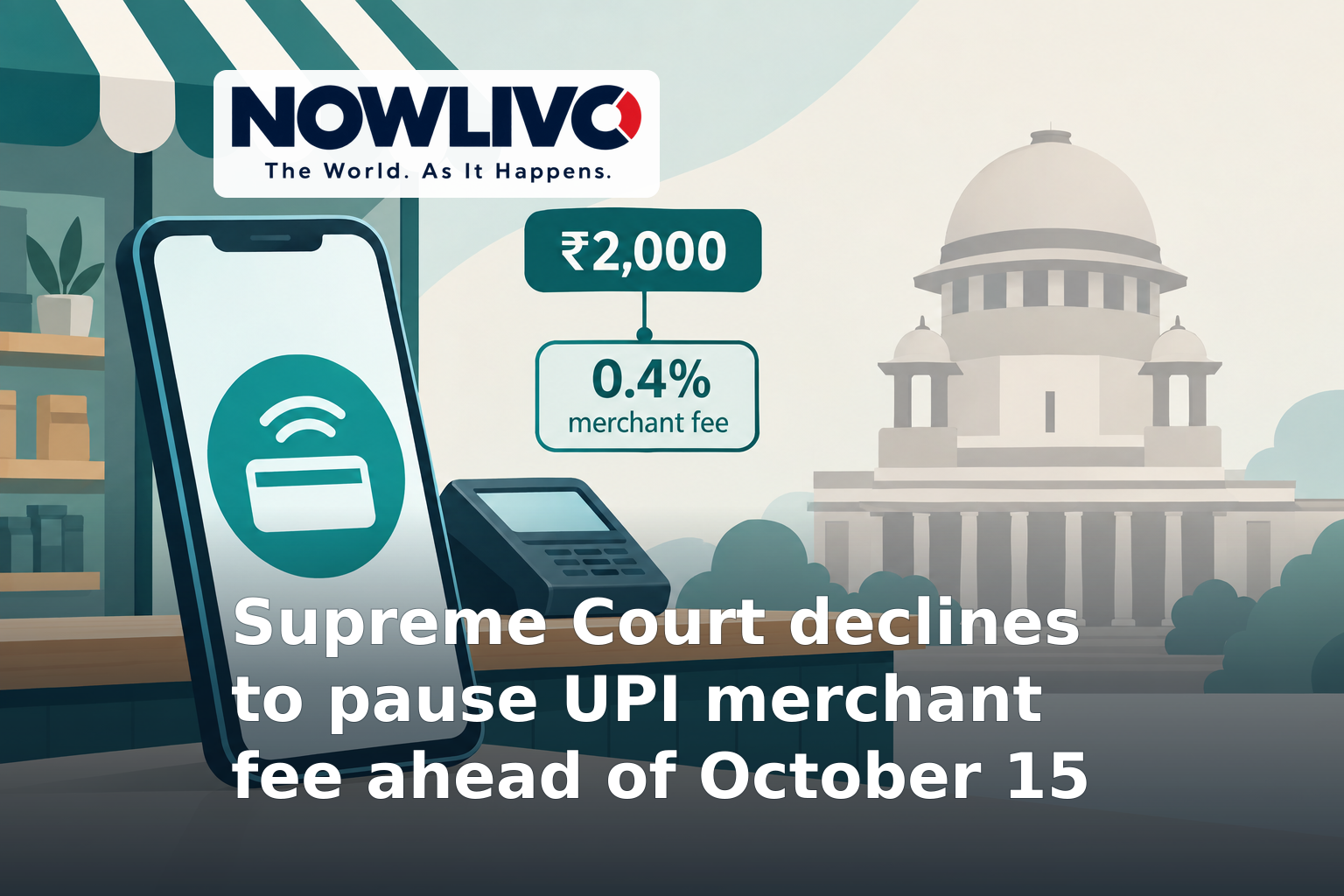
India’s Supreme Court declined on September 28, 2026, to put a new UPI merchant-charge framework on hold while it considers a petition challenging the measure. The court sought responses from the Centre, the Reserve Bank of India (RBI) and the National Payments Corporation of India (NPCI). The framework is scheduled to take effect on October 15, 2026.

At the centre of the case is a 0.4% merchant discount rate, or MDR, for specified person-to-merchant UPI transactions above ₹2,000. The distinction matters: the proposed charge concerns eligible merchant payments. It does not mean that every person sending money through UPI will be charged 0.4%, or that every purchase above ₹2,000 will carry the same rate.
What the court did—and did not—decide
The court was hearing a public-interest petition filed by advocate Anjan Datta against the government’s September changes to the UPI charging framework. The petition sought, among other relief, a pause on the planned MDR while the challenge is heard. The bench declined that interim request and asked the respondents to put their positions on record.
Refusing an interim stay is not a final ruling that the charge is lawful. The petition remains before the court, and the Centre, RBI and NPCI have been asked to respond. For now, the reported October 15 start date has not been blocked by the September 28 hearing.
The petition questions the legal basis for the framework and the way it was introduced. It also challenges the distinction between UPI and RuPay debit-card payments and raises concerns that added costs for merchants could ultimately affect customers. Those are arguments put forward in the case, not findings made by the court.
Which payments are covered?
Under the announced framework, the general MDR for eligible person-to-merchant UPI payments above ₹2,000 is 0.4%. That works out to ₹20 on an eligible ₹5,000 transaction. The general charge is capped at ₹300 for transactions of ₹75,000 or more. Separate, lower arrangements apply to some categories of payments, including certain essential services and capital-market transactions.
Person-to-person UPI transfers remain outside this merchant-charge framework, regardless of the amount transferred. Merchant payments of up to ₹2,000 also remain outside the new MDR. The framework retains a zero-MDR category for qualifying small merchants receiving up to ₹1 lakh a month through UPI QR payments. The Centre told the court that most transactions would remain unaffected; that is the government’s assessment, rather than a finding established by the court.
MDR is a charge associated with accepting and processing an eligible merchant payment. It should not be confused with a universal fee taken from a customer’s account whenever they use a UPI app. The government’s position is that customers will not be required to pay this MDR separately. The petitioner, however, argues that merchants might eventually pass costs on indirectly—one of the concerns the court has yet to resolve.
What happens next?
The Centre has been asked to explain the legal and policy basis for the arrangement in its response, alongside replies from the other parties. Those filings will give the court a fuller record on how the charge is intended to work and under what authority it was introduced.
Until the case progresses or the framework changes, the practical takeaway is narrow. The Supreme Court has allowed the planned October 15 rollout to remain on course for now; it has not ordered consumers to pay a fee on all UPI transfers. Anyone assessing whether a payment falls within the MDR should distinguish a transfer to another person from a payment to a merchant, then check the transaction amount and whether the merchant or payment category qualifies for an exemption or different rate.