
Why Francis Halzen Won the 2026 Nobel Prize in Physics — and How IceCube Detects Neutrinos
Francis Halzen won the 2026 Nobel Prize in Physics for his decisive contributions to the IceCube Neutrino Observatory and the discovery of high-energy neutrinos of astrophysical origin. Announced on October 6, the award recognizes both his leadership in creating an enormous detector beneath Antarctic ice and the discoveries made possible by the international team that built and uses it—not one isolated observation.
IceCube has given astronomers a way to study distant, energetic parts of the universe using particles rather than light. Its findings established that some exceptionally energetic neutrinos reaching Earth come from beyond the solar system, opening a new way to investigate where they originate.
What are neutrinos?
Neutrinos are tiny particles with no electric charge. They are extraordinarily common, but most pass through matter—including our bodies and even the Earth—without leaving a trace. That makes them difficult to catch and potentially valuable to astronomers: unlike charged particles, neutrinos are not bent off course by magnetic fields as they travel through space.
Neutrinos have many origins. The astrophysical neutrinos central to Halzen’s award are unusually high-energy ones produced by powerful processes in the cosmos, beyond the neutrinos commonly generated in Earth’s atmosphere. Finding them took a detector large enough to give even a small number a chance to interact with matter.
How does the IceCube Observatory detect a particle that passes through almost everything?
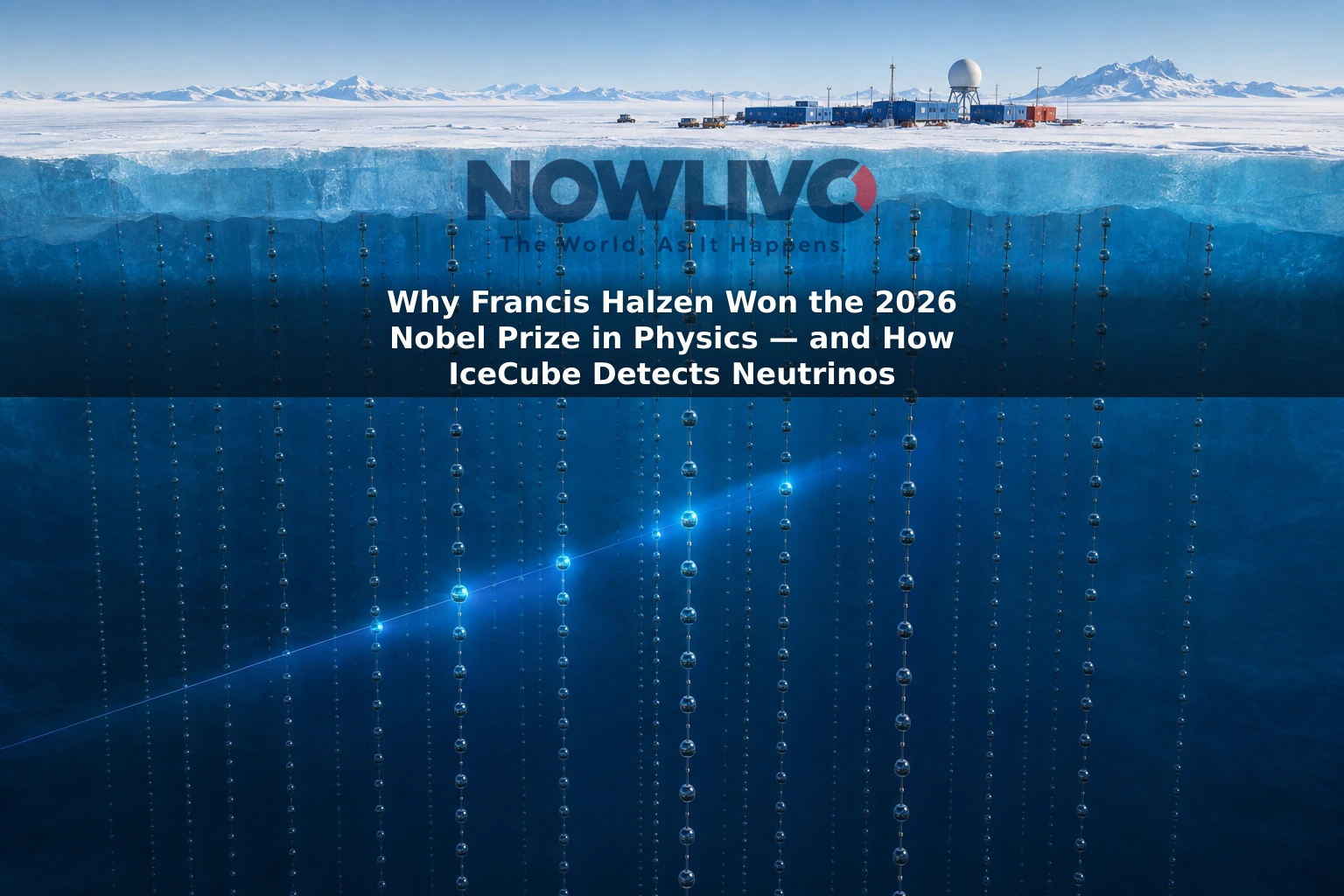
IceCube uses roughly a cubic kilometer of Antarctic ice near the South Pole as part of its detector. Suspended deep within that ice are 5,160 light sensors on 86 vertical strings. Most neutrinos pass straight through. Occasionally, one interacts with material in or near the ice and produces electrically charged particles.
Those charged particles can create faint flashes of light as they move through the ice. The effect, called Cherenkov radiation, occurs when a particle travels faster than light travels through ice—not faster than light travels in a vacuum. The buried sensors record when the light reaches them and how bright it is. By comparing signals across the array, researchers can estimate the energy and direction of a particle event.
Think of it less as photographing a neutrino and more as reconstructing the path of something unseen from the brief flashes it leaves behind. The deep, clear ice provides both a vast target and a medium through which that light can travel to the sensors.
What did Halzen and the IceCube team discover?
Halzen, a physicist at the University of Wisconsin–Madison and IceCube’s principal investigator, helped turn the idea of using South Pole ice into a working observatory. The detector’s scale matters: high-energy neutrinos from space are rare, and a much smaller instrument would have fewer opportunities to register them.
In 2013, the IceCube collaboration reported evidence of a population of high-energy neutrinos that could not be explained by expected atmospheric backgrounds. The finding showed that neutrinos from beyond the solar system were reaching the detector. Researchers subsequently gathered evidence connecting high-energy neutrinos to particular objects, including the distant blazar TXS 0506+056 and the active galaxy NGC 1068.
The 2026 Nobel recognizes the scientific vision and sustained work that made those advances possible. Halzen is the named laureate, but IceCube is an international collaboration: its discoveries depend on the researchers and engineers who built the instrument, operate it and analyze its signals.
For astronomers, the payoff is another way to investigate the universe. Light reveals a great deal about distant objects; neutrinos can provide a different clue about the powerful processes occurring within them. IceCube’s achievement was to make that clue observable at high energies.