
Researchers Trace Auroral Radio Bursts to Exoplanet Beta Pictoris b
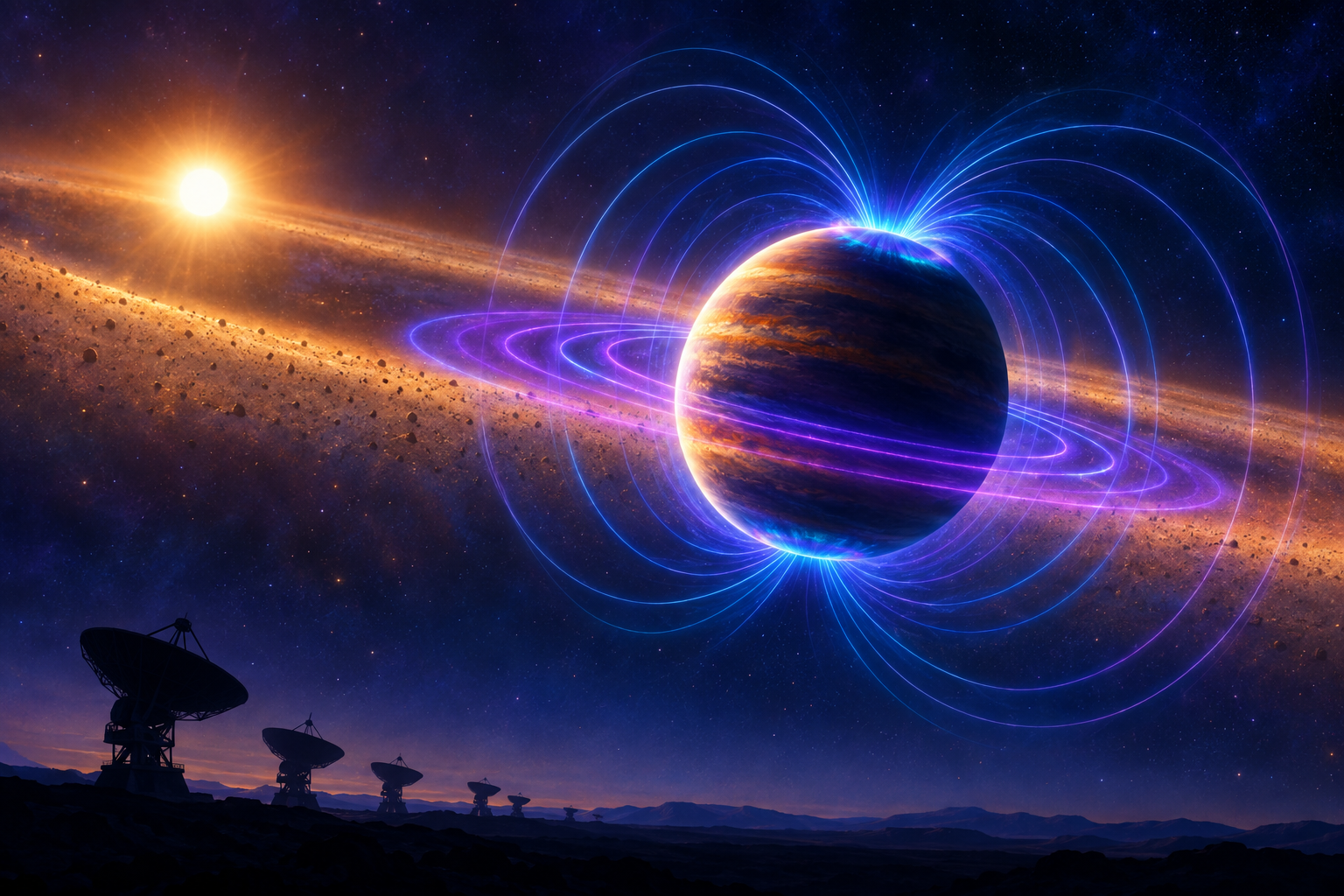
Astronomers have reported a potential milestone in exoplanet research after tracing recurring radio emissions to Beta Pictoris b, a massive young world about 63 light-years from Earth. If the result withstands further review, it would mark the first time auroral radio emission has been directly localized to a confirmed planet beyond the Solar System.

The finding was described in a research preprint posted in September 2026. Because the study has not yet completed peer review, its conclusions remain subject to independent scrutiny. However, the researchers say the signal’s position, polarization and rapid variability strongly indicate that it originates from the planet rather than its host star or surrounding debris disk.
A natural signal, not an alien transmission
Despite the attention generated by the phrase “radio signals from an exoplanet,” the reported emission is not considered evidence of extraterrestrial intelligence. The team interprets it as a natural product of charged particles moving through Beta Pictoris b’s powerful magnetic environment.
Similar processes create auroral radio emissions within the Solar System. On Earth, energetic particles guided by magnetic field lines help produce the northern and southern lights. Jupiter also generates intense radio bursts through interactions involving its magnetosphere, rapid rotation and charged particles.
The emissions attributed to Beta Pictoris b were highly circularly polarized, meaning the radio waves showed a strong preferred rotational direction. This property, combined with the bursts’ short-term variations, points toward a mechanism called electron cyclotron maser instability. That process can occur when energetic electrons travel along magnetic field lines and release coherent radio waves.
MeerKAT observations pinpointed the planet
The researchers observed the Beta Pictoris system on four occasions during 2025 and 2026 using the MeerKAT radio telescope array in South Africa. They detected both rapidly changing bursts and a weaker, more persistent component across frequencies ranging from approximately 0.85 to 3.5 gigahertz.
Identifying the source was a major challenge because Beta Pictoris b appears extremely close to its star when viewed from Earth. The team aligned the radio images with a precise celestial reference frame built from distant quasars and other fixed objects. After accounting for statistical and systematic uncertainties, the measured radio position matched the known location of Beta Pictoris b and was strongly inconsistent with the positions of the host star and another planet in the system.
This spatial localization is what distinguishes the reported discovery from earlier candidate radio detections involving exoplanet systems. Previous observations sometimes found unusual emissions near stars known to host planets, but researchers could not conclusively separate a planetary source from activity on the star itself.
A remarkably strong magnetic field
The highest frequency at which the polarized emission appeared allowed the team to estimate the minimum magnetic-field strength at its source. Their calculations indicate a field of at least 1.25 kilogauss, substantially stronger than the magnetic fields associated with planets in our Solar System.
That would represent the first direct measurement of an exoplanet’s magnetic-field strength. Magnetic fields can influence how planets interact with stellar winds, retain or lose atmospheric material and evolve over millions or billions of years. They may also provide clues about internal structure, heat flow and the movement of electrically conducting material deep inside a planet.
Beta Pictoris b is an unusually favorable target for such work. The planet is estimated to be roughly 12 times the mass of Jupiter and orbits its star at about 10 times the Earth-Sun distance. It is also young, hot and rapidly rotating, completing one spin in approximately nine hours. Those characteristics could help power the magnetospheric currents responsible for the reported radio bursts.
A new way to study distant worlds
The detection does not mean astronomers can yet routinely tune in to exoplanet auroras. Beta Pictoris b is a particularly large and energetic world with a strong field, while smaller or older planets are likely to produce much fainter emissions. Confirming the result will also require additional observations that reproduce the bursts and track how they change with the planet’s rotation.
Nevertheless, the technique could open a new observational window on worlds that are otherwise difficult to characterize. Future radio arrays may be able to examine the magnetic environments of more exoplanets, test planetary dynamo theories and investigate how magnetic protection affects atmospheric survival.
For now, Beta Pictoris b offers a compelling demonstration of what radio astronomy may reveal: not an artificial message from another civilization, but the natural electromagnetic activity of a distant planet with a magnetosphere unlike anything found close to Earth.