India’s LNG-Diesel DEMU Makes Sabarmati–Mahesana Inaugural Run
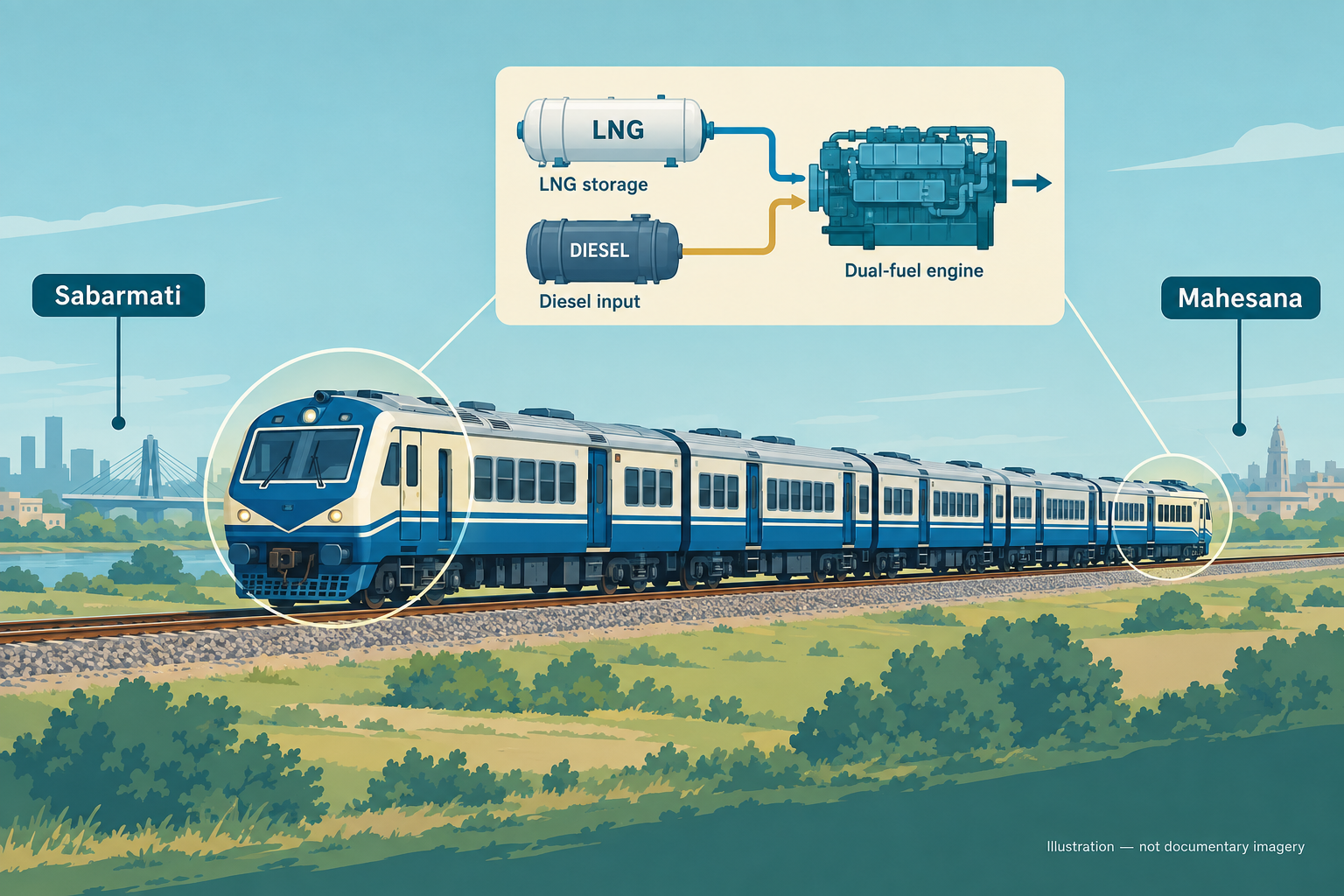
An eight-coach diesel-electric multiple unit fitted to use liquefied natural gas alongside diesel was flagged off from Sabarmati station in Gujarat on September 27, 2026. Its inaugural journey ran to Mahesana Junction, giving passengers a first look at a train intended to use less diesel without replacing its existing engines with an entirely new type of propulsion.

Union Home Minister Amit Shah flagged off the train. The September event was a formal launch, not the beginning of the engineering work: Western Railway’s Ahmedabad division had reported in January that its converted power cars had completed field trials and were already being used in passenger service.
What route will it run?
Sabarmati to Mahesana was the inaugural run. That distinction matters for anyone planning a journey. The Ahmedabad division had not confirmed that the same stretch would be the train’s permanent assignment or announced a final regular-service timetable for the newly flagged-off rake. Passengers should therefore not assume that a continuing Sabarmati–Mahesana service follows automatically from the launch trip.
The launch train was described as an eight-coach, non-air-conditioned chair-car rake. It will be operated and maintained by Western Railway’s Ahmedabad division. No change to the basic passenger accommodation is the point of the project: the significant modification is in the equipment that supplies power to move the train.
What changed on the train?
At Sabarmati’s Integrated Coaching Depot, two driving power cars, each rated at 1,400 horsepower, were converted for LNG-diesel dual-fuel operation. In a DEMU, driving power cars supply the power for a self-propelled train, rather than a separate locomotive hauling an otherwise unpowered rake. The conversion lets the existing diesel-based system use natural gas for part of its fuel requirement.
LNG is natural gas cooled into liquid form for storage. Each converted power car has a storage system with a capacity of about 2,200 litres; the equipment stores and prepares the gas for engine use. Dual fuel does not mean diesel-free. Diesel remains part of normal operation while LNG substitutes for a portion of it. The arrangement also gives operators the flexibility to rely on diesel when LNG is unavailable.
Western Railway’s stated target is to substitute LNG for approximately 40% of the diesel the converted power cars would otherwise consume. That is a design and operating aim, not evidence that every journey has achieved the same percentage. Actual fuel use can vary with the service pattern and operating conditions.
Before the formal flag-off, the two modified power cars had covered more than 2,000 kilometres in field trials, according to railway officials. Those trials address whether the equipment can work in rail service; they should not be confused with a published, route-wide measurement of long-term fuel or emissions savings.
What benefits are being sought?
The railway’s case for the conversion is lower diesel consumption and fuel costs, alongside reduced carbon dioxide, nitrogen oxide and particulate emissions. Trial-based projections put potential annual fuel-cost savings at about ₹11.9 lakh per power car, or approximately ₹23.9 lakh for an eight-coach rake using two of them. These are estimates, not audited savings from a full year of operation.
The emissions claims also need that qualification. Using less diesel is the intended result of the retrofit, but the launch did not establish how much each pollutant fell during regular passenger journeys. LNG is still a fossil fuel, and the train still uses diesel; describing it as a zero-emission service would be inaccurate.
For passengers, the immediate development is a dual-fuel rake that has made a public inaugural journey. The practical questions now are where Western Railway assigns it for regular service, what timetable it publishes, and whether sustained operating data bears out the projected fuel and emissions benefits.