Google’s Project Suncatcher: What Its First Satellite Tests—and What It Doesn’t
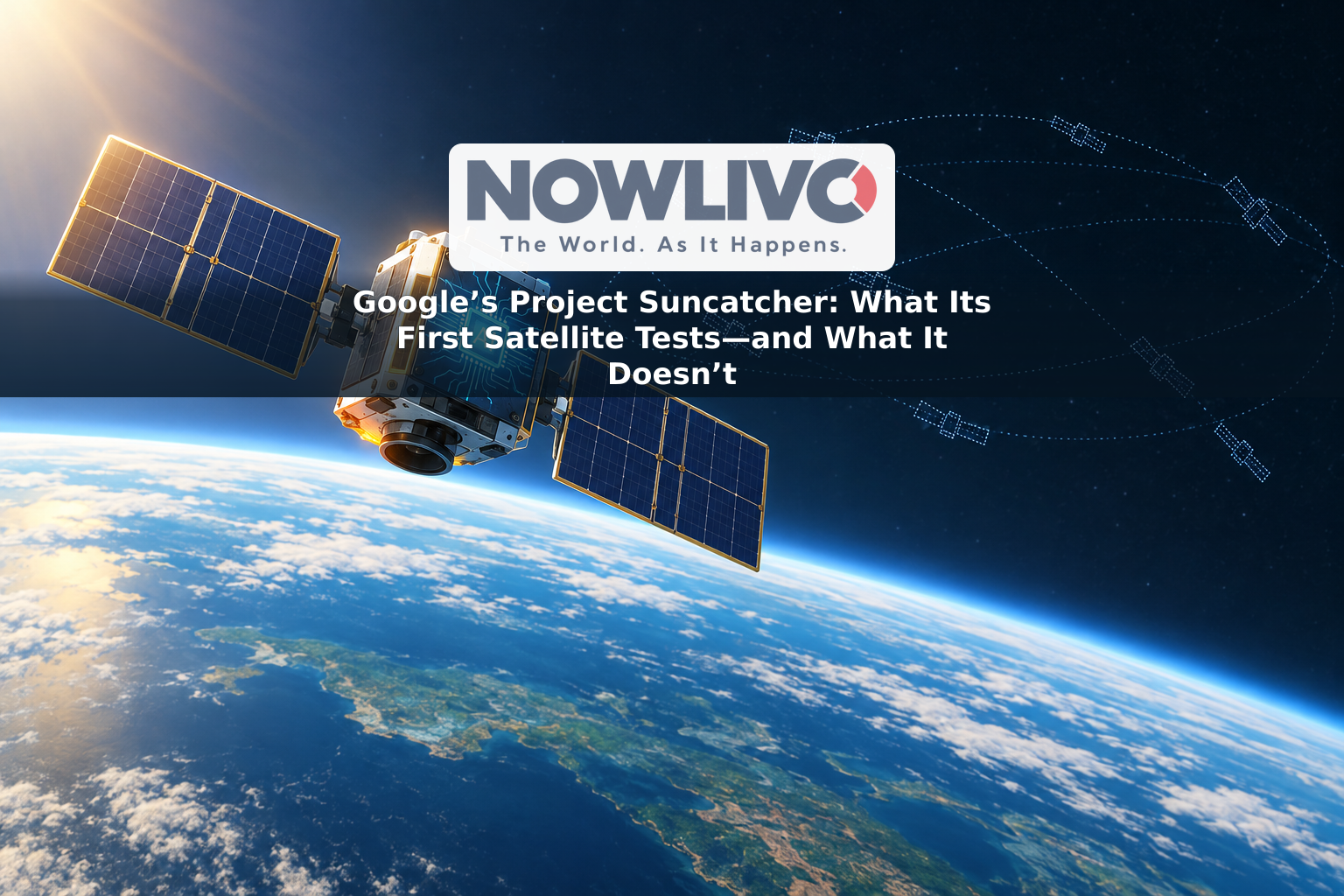
Google launched a Project Suncatcher prototype satellite into orbit on October 1, 2026, to test whether its AI hardware can operate through the stresses of launch and the conditions of space. The satellite, built with Planet and carried on a SpaceX rideshare mission, is an early research experiment. It is not an operating space data center, and its launch does not establish that large-scale AI computing in orbit is practical.
What did Google launch?
The newly launched satellite is a test platform for Google’s Tensor Processing Units, or TPUs—the chips it uses to accelerate machine-learning work. Google says it has made contact with the spacecraft and that it is operating as expected. Over the coming weeks, the team plans to collect data on how the hardware handles conditions it cannot fully reproduce on Earth.
Those conditions begin with the vibration and acceleration of a rocket launch. In orbit, the chips face radiation and temperature extremes. The test also gives engineers a chance to examine their cooling approach in a vacuum, where there is no air to carry heat away from electronics. For now, the reported milestone is a successful launch and initial contact, not a demonstrated system for serving AI customers from space.
What is Project Suncatcher trying to build?
Project Suncatcher is Google’s longer-term proposal for groups of solar-powered satellites carrying AI chips. In that envisioned system, satellites would fly close together and exchange data through high-bandwidth laser links, allowing many processors to work on larger machine-learning tasks. A suitable orbit could provide nearly continuous sunlight, giving such a system access to solar power without drawing its operating electricity from a terrestrial grid.
That is a different proposition from putting a conventional data-center building into space. Each satellite would need to generate power, run its hardware, dispose of waste heat and communicate reliably with other spacecraft and the ground. The current prototype addresses only an early part of that list. Google has described a later two-satellite test, planned for 2027, as a way to investigate links between spacecraft; this first satellite does not demonstrate an orbital computing network.
Could orbit ease data-center energy constraints?
Potentially—but only if an orbital system can perform useful computing at a viable cost. AI growth is increasing electricity demand from data centers. The International Energy Agency projects that global data-center electricity use will roughly double between 2025 and 2030. Solar-powered computing in orbit could, in principle, shift some future demand away from power grids on Earth.
Access to sunlight is only one part of the energy equation, however. Solar panels and cooling equipment add mass that must be launched. Processors still produce heat, which spacecraft must release through radiators rather than ordinary airflow. Large AI workloads would also require fast, dependable connections among chips on separate moving satellites, followed by a practical way to move data to and from Earth.
Google has reported promising ground tests of TPU radiation tolerance and a laboratory demonstration of a fast optical connection. Neither proves that a large constellation can keep its position, maintain those connections, operate for years or compete economically with data centers on the ground. Launch expense, maintenance, reliability and the full environmental costs of deployment remain important questions.
What would count as progress?
The immediate result to watch is whether the prototype continues to function and yields usable measurements of chip performance and cooling in orbit. A subsequent test connecting two satellites would address another necessary piece: communication between processors on separate spacecraft. Beyond that, showing sustained computing workloads across a larger network—and accounting for its total cost and energy use—would be needed to assess the data-center idea.
Project Suncatcher has therefore moved from ground research to an in-orbit hardware test. It has not moved AI data-center operations off Earth. The distinction matters: this mission can reveal whether parts of the proposed system survive and function in space, while the question of whether orbital computing can meaningfully relieve terrestrial energy constraints remains open.