Indian IT Layoffs: Routine Jobs Face AI Pressure as Specialist Skills Keep Hiring
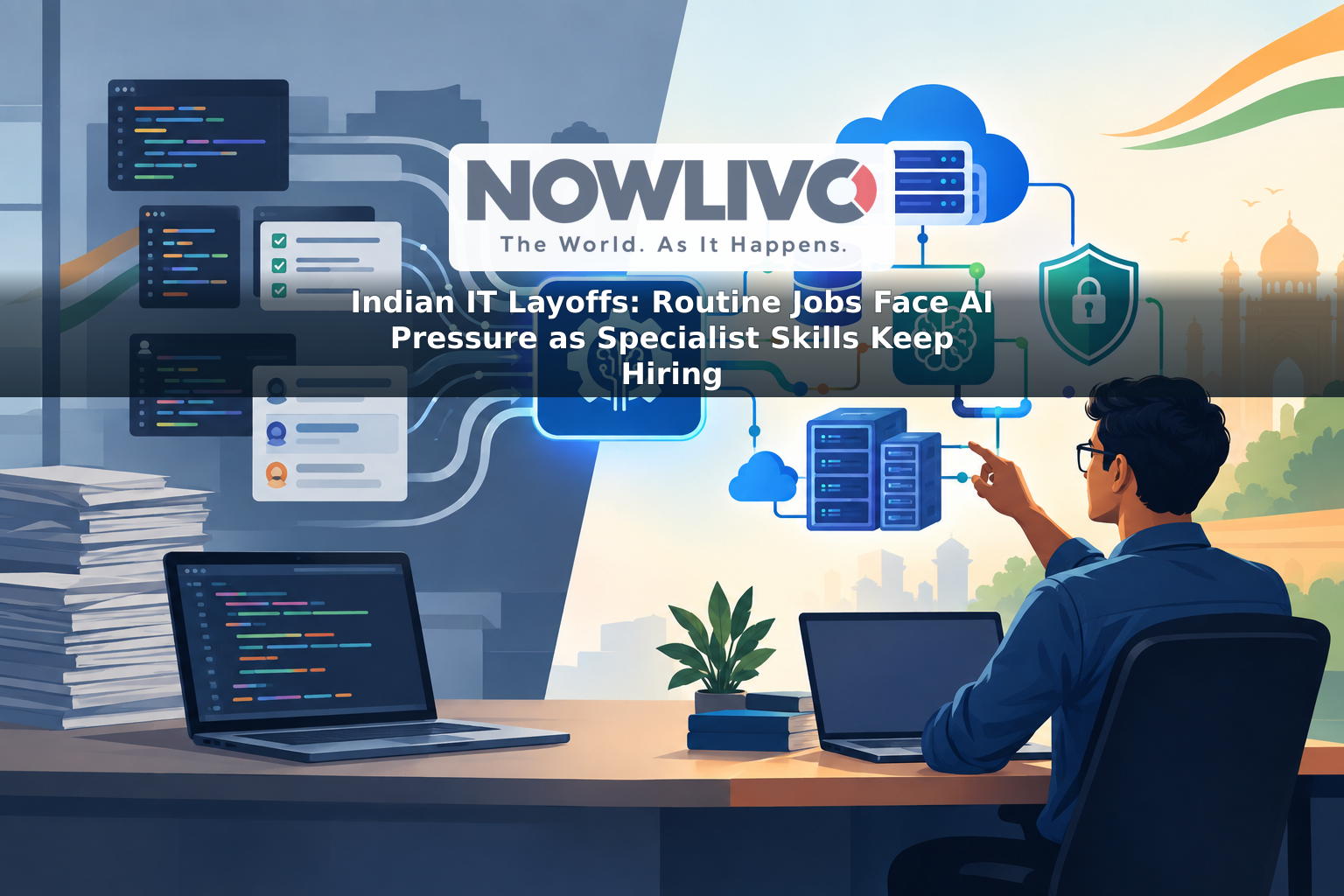
Indian IT jobs built mainly around repeatable tasks face the greatest pressure from AI: manual testing, standard code changes, basic support responses and routine back-office processing. The stronger hiring prospects are in AI engineering, data engineering, cloud, cybersecurity and roles that combine technical delivery with industry expertise. That is a distinction between tasks, not a prediction that every job with one of those titles will disappear.
Recent figures show why both layoffs and hiring can be part of the same story. In August 2026, recruitment platform foundit recorded 11% fewer postings in India’s IT software and services industry than a year earlier, even as hiring across IT functions rose 5%. Those measures cover different groups: one tracks an industry, the other a type of work across industries. They point to a market in which employers are still recruiting technical talent, but not necessarily through the large, generalist intake associated with earlier expansion.
Which work is most exposed?
Exposure is highest where a client can specify a task clearly and check the result quickly. An AI-assisted team may need fewer hours to draft familiar code, produce documentation, generate initial test cases or answer common service requests. Workers whose roles consist largely of those activities could face slower replacement hiring, reassignment or pressure to take on more complex work.
Manual testers who execute the same scripts repeatedly may be particularly exposed if their teams automate test creation and execution. That does not remove the need to test software: someone must design coverage for unusual failures, judge whether an AI-generated test is useful and investigate defects. Similarly, entry-level developers who only make straightforward changes face a different outlook from engineers who understand a system’s architecture, security requirements and production failures.
Routine help-desk and business-process work also faces pressure as companies use AI to classify requests, retrieve answers and process documents. More complex cases still need people to resolve exceptions, deal with customers and check decisions. The practical question for a worker is how much of the job depends on judgment and accountability, rather than how much of it involves a computer.
Layoffs should not, however, be counted as layoffs caused by AI without evidence. TCS disclosed restructuring initiatives announced in July 2025 under which some employees would leave the company. Its global workforce stood at 593,798 at the end of June 2026, compared with 613,069 a year earlier. That change in headcount is not itself a layoff count: hiring, resignations and other departures also affect the total. Client demand, project availability and changes in required skills matter alongside automation.
Which skills are employers seeking?
AI hiring is increasingly about putting systems to work, rather than simply demonstrating a chatbot. In foundit’s review of 2025 AI postings, generative AI and large language models appeared in 22% of roles, while MLOps and model deployment appeared in 10%. Python appeared in nearly three-quarters of the AI roles it tracked, and SQL and data-engineering skills in more than half. These are shares of the platform’s postings, not shares of all jobs in India.
That demand creates several distinct paths. AI engineers connect models to applications and assess whether their outputs are reliable. Data engineers prepare and maintain the information those applications use. MLOps specialists deploy, monitor and update models. Cloud and cybersecurity professionals keep the resulting systems available and protect access to data. Domain knowledge matters too: a banking or healthcare project needs people who understand its processes, not only its software tools.
The market is selective. Foundit’s August 2026 tracker showed annual hiring growth only among workers with seven to 10 years of experience; postings for those with up to three years of experience were down 9%. Its earlier estimate that AI job postings could grow 32% during 2026 was a forecast, not a confirmed count of jobs filled. A rising number of specialist vacancies therefore does not mean an easy transition for every displaced worker or fresher.
What should workers focus on?
A useful reskilling plan starts with the worker’s existing role. A tester can learn test automation and how to evaluate AI-generated tests. A support specialist can move toward handling exceptions, improving knowledge systems and checking automated responses. A developer can strengthen debugging, system design, data handling and secure deployment. In each case, a small completed project that demonstrates those abilities is more concrete than listing AI tools without showing how they were used.
For fresh graduates, the fundamentals remain important: programming, SQL, software testing and an understanding of how applications reach production. AI tools can help with each step, but employers still need people who can spot a wrong result and fix it. The dividing line in Indian IT is increasingly whether a worker can supervise and improve an automated workflow, rather than only perform its most repeatable steps.