Is a Regime Change Operation Underway Against India? What the Modi X, Starlink and US Visa Claims Show
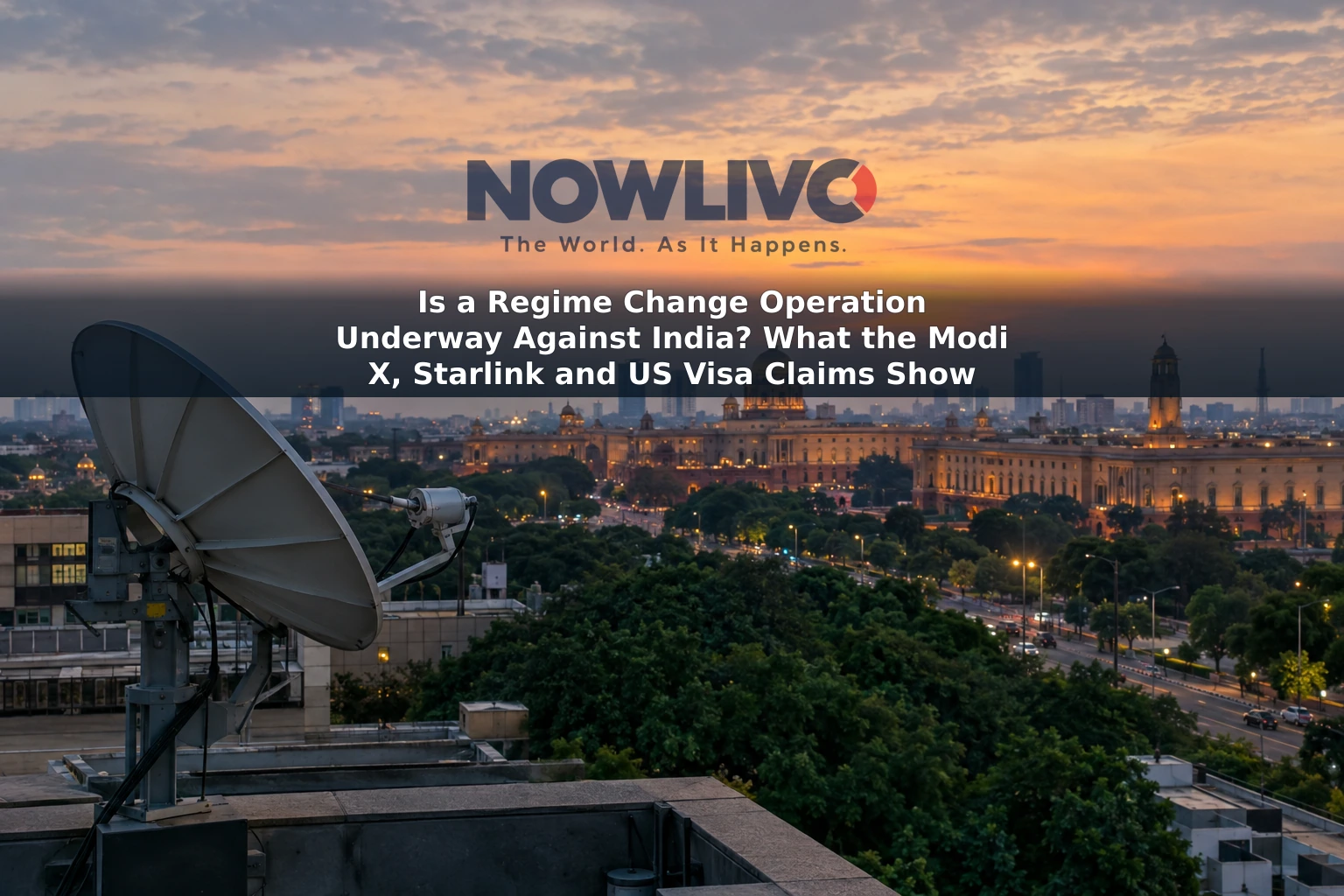
Is a full-scale regime change operation underway against India? As of October 8, 2026, there is no verified evidence connecting the developments cited in that claim to a coordinated effort to remove Prime Minister Narendra Modi’s government. Some of the underlying events are real: the US has announced a suspension affecting several IT firms’ permanent labour certification applications, Elon Musk and Rahul Gandhi have exchanged posts about Starlink, and foreign investors have sold substantial amounts of Indian equities. Claims that Modi’s X account is being secretly throttled, or that these events share a single organiser, have not been established.
Was Narendra Modi’s X account shadow-banned?
There is no verified finding that X shadow-banned Modi’s account or deliberately reduced its reach. A change in a post’s view count alone would not establish such an action: reach can vary with audience behaviour, timing, ranking and other factors. X says it can limit the visibility of individual posts under its rules and ranking systems, but that general policy is not evidence of action against the prime minister. Establishing the specific claim would require more than comparisons of public engagement figures.
What happened between Elon Musk and Rahul Gandhi over Starlink?
Musk publicly questioned why Starlink had not been cleared to start commercial satellite internet service in India and raised an allegation about Mukesh Ambani’s influence. Gandhi responded on X with a remark about another powerful figure; Musk thanked him and called the situation troubling. Their exchange is public. It does not, by itself, show that they are collaborating on a political operation or that X is changing its algorithm to favour Gandhi.
India’s communications ministry rejected the suggestion that domestic business interests were blocking Starlink. It said Starlink, Reliance Jio’s satellite venture and Eutelsat OneWeb were at broadly the same stage of security assessment. The distinction matters: the dispute concerns the remaining requirements for a commercial launch, not proof that Starlink alone has been denied entry.
Are CJP and foreign-funded accounts being amplified?
The Cockroach Janata Party, or CJP, is a youth protest movement that has organised demonstrations over education and election-related issues. Allegations that it receives foreign money or benefits from engineered algorithmic promotion require funding records or credible platform evidence; a fast-growing account or well-attended protest does not prove either claim. When asked about alleged foreign involvement in CJP protests in July, India’s Ministry of External Affairs said it had no information to share. No verified funding trail or X disclosure establishes the broader amplification allegation.
Claims that Western NGOs or influence networks have pumped crores into a campaign to unseat Modi likewise need identifiable transactions, recipients and evidence linking the money to such a campaign. Foreign funding and political interference are not interchangeable descriptions.
Did the Trump administration suspend TCS, Infosys and other firms from PERM?
Yes. On October 8, US officials announced suspensions from the Permanent Labor Certification programme, known as PERM, affecting Tata Consultancy Services, Infosys, Wipro, HCL, Cognizant and Capgemini, as well as Microsoft and Adobe. Officials framed the action as part of a crackdown on alleged misuse of foreign-worker programmes. Those allegations should not be treated as findings that every named company committed fraud.
PERM is a labour-certification step used in many employer-sponsored green-card applications. The announcement was not a blanket suspension of H-1B visas, a ban on Indian IT services or a finding that India itself had done anything wrong. Its effects on particular workers and applications depend on the scope and duration of the US action.
Do foreign selling and Middle East energy risks point to coordination?
Foreign portfolio investors have sold Indian equities heavily: September’s net equity selling was about ₹35,861 crore, with further outflows reported in early October. Higher crude prices amid Middle East tensions and rising US Treasury yields offer economic reasons for investors to reassess Indian assets. Those pressures can be serious for an oil-importing economy, but market outflows do not reveal a political motive without evidence connecting investors’ decisions to one.
The strongest conclusion the available facts support is narrower than the regime-change claim. India faces genuine disputes over satellite regulation, protests, foreign investment and US immigration policy. Treating their timing as proof of a single covert operation would turn separate, partly documented events into a claim the evidence does not currently establish.