Jio’s 1,600-Satellite Plan vs Starlink: Did It Trigger Elon Musk’s Ambani Remarks?
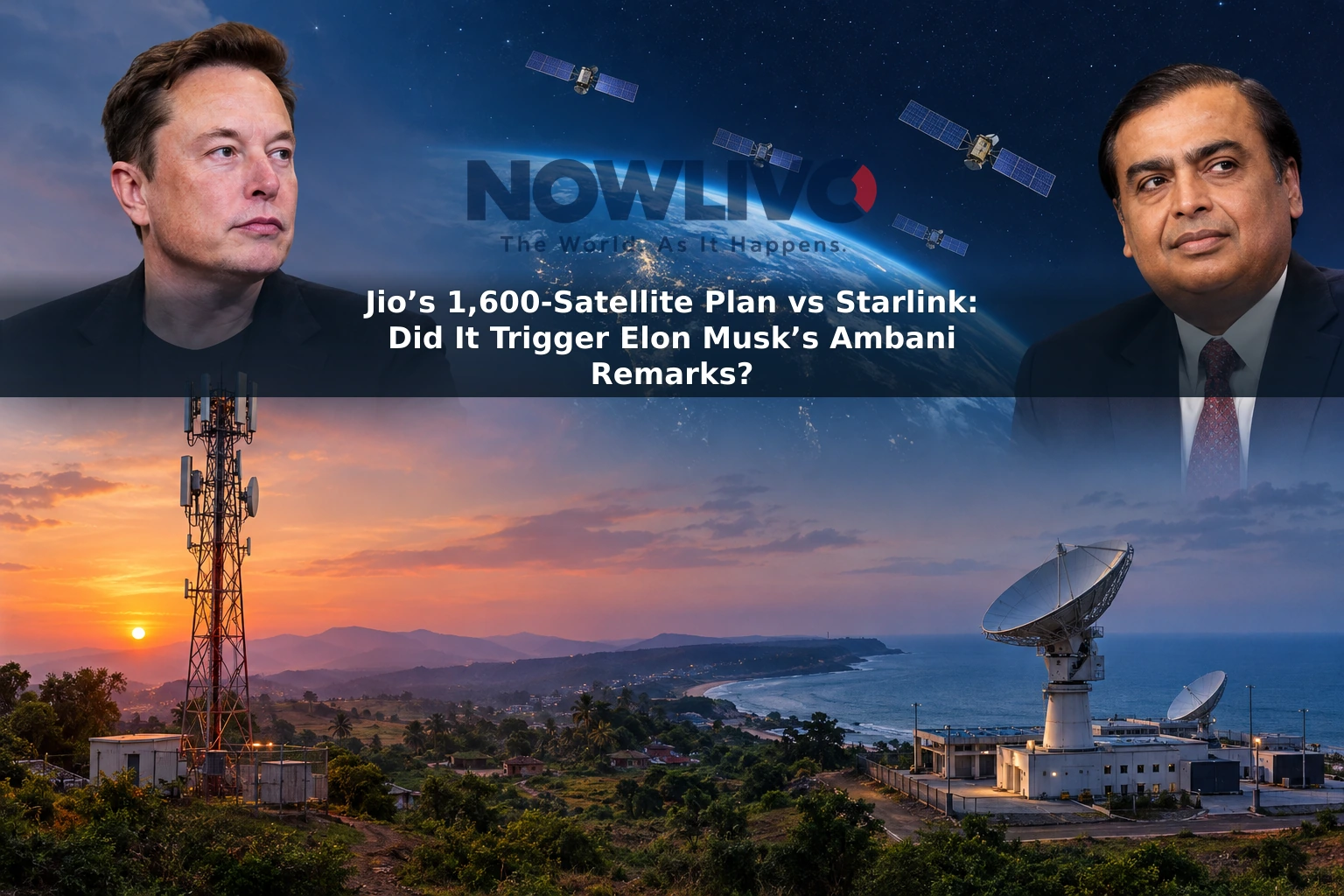
Did Jio’s satellite plan trigger Elon Musk? There is no evidence that it did. Musk accused unnamed Indian business interests of obstructing Starlink on October 7, 2026, before Jio showcased its proposed 1,600-satellite network at India Mobile Congress in New Delhi on October 8. He questioned Mukesh Ambani’s influence in a further post on October 8, but did not identify Jio’s presentation as the reason for either statement.
The timing has nevertheless put two developments in the same spotlight: Jio’s ambition to build a satellite network for India and Starlink’s continuing wait to begin commercial service there. Musk’s allegation about interference is disputed by the Indian government; it has not been established as fact.
What did Jio announce at India Mobile Congress 2026?
Reliance Jio presented a plan for approximately 1,600 low-Earth-orbit satellites supported by 23 ground stations across India. Under the banner “Sovereign Satellite Connectivity,” the company wants the network to work alongside its existing mobile and fibre infrastructure, extending service to places where towers or cables are difficult to deploy.
Jio described remote villages, islands, border areas and maritime locations as potential beneficiaries. It also outlined possible uses in enterprise connectivity, aviation, disaster response and direct-to-device calling in rural areas. Its stated ambition is to keep the satellite value chain in India, from design and engineering through integration, testing, launch, deployment and operations.
The satellites and ground stations are proposed, not an operating network. Jio did not announce a commercial launch date for the constellation at the October 8 presentation. The figures describe the scale of its plan, not connectivity already available to customers.
What did Musk say about Starlink and Ambani?
On October 7, Musk alleged on X that unnamed “oligarchs” were blocking Starlink’s entry into India to protect their businesses. He offered no public evidence identifying anyone responsible. On October 8, after the government rejected the suggestion that its satellite-communications rules were being applied unfairly, Musk raised a question about Mukesh Ambani’s influence in India. Ambani chairs Reliance Industries, Jio’s parent company.
Those posts make the Jio–Starlink comparison newsworthy, but the sequence matters. Musk’s initial accusation preceded Jio’s October 8 showcase. His later reference to Ambani concerned Starlink’s regulatory delay, not an explicit response to the newly displayed 1,600-satellite plan. It would be misleading to say the unveiling caused his reaction.
India’s Ministry of Communications said on October 8 that its authorization framework is fair and non-discriminatory. According to the ministry, security assessments were underway for all three licensed satellite-communications operators, and they were broadly at the same regulatory stage. Completion of that process would allow an operator to seek spectrum assignment. That distinction helps explain why holding a licence does not, by itself, mean a company can start selling satellite internet service.
Are Jio and Starlink rivals or partners?
Potentially both. Their satellite ambitions could put them in competition to serve customers beyond the reach of conventional networks. Yet Jio Platforms announced an agreement in March 2025 to offer SpaceX’s Starlink services through Jio’s channels in India, subject to the required authorizations. Jio has also been developing its own satellite-communications platform.
For people waiting for satellite internet, neither Jio’s presentation nor Musk’s posts establish when either service will become commercially available in India. The immediate development is a more detailed Jio proposal alongside a public dispute over Starlink’s regulatory progress—not proof that one caused the other.