Why Tesla Renamed Full Self-Driving in Europe—and What Assisted Driving Means for Drivers
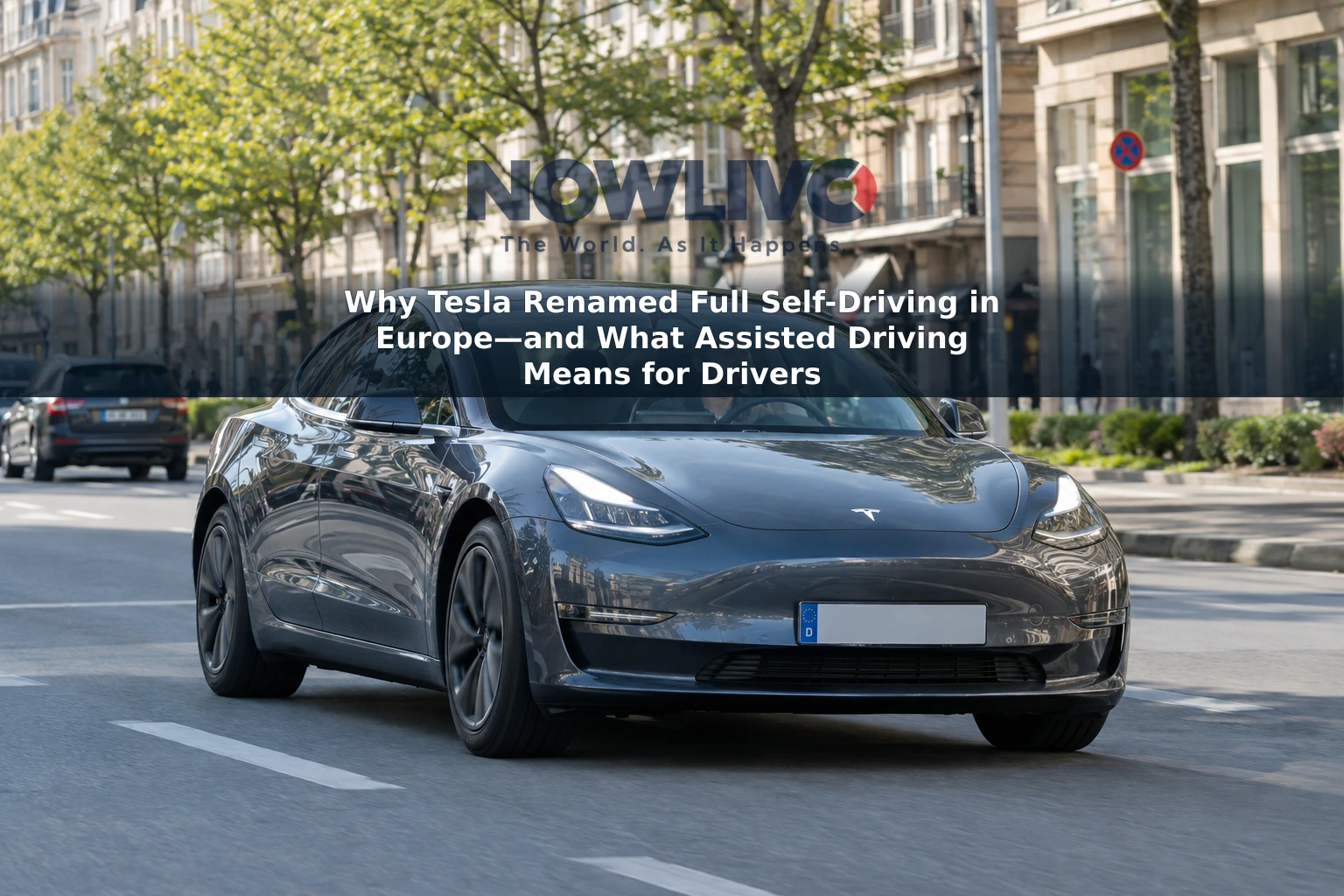
Tesla renamed its Full Self-Driving (Supervised) driver-assistance system Tesla Assisted Driving on European websites because the old name suggested a level of autonomy the software does not provide. Germany’s transport ministry said Tesla offered the change as officials consider wider European approval. For drivers, the distinction is straightforward: the car can assist with driving, but the person behind the wheel must remain attentive and responsible.
Reuters reported the website change on October 9, 2026, after Germany announced Tesla’s offer earlier that week. The new name appears on Tesla pages for countries including Germany, Spain and the Netherlands. Its appearance on a country’s website does not, by itself, mean the full system has been approved for use there.
Why did Tesla change the name?
Germany’s transport ministry described “Full Self-Driving” as somewhat misleading because the system does not take over the entire driving task. It can help with actions such as steering, braking and accelerating, the ministry said, but the driver must stay alert. Following discussions with Tesla, German Transport Minister Steffen Bilger said he would support efforts to secure approval across the EU.
The rename addresses how the technology is described to customers; it is not an announcement that the software has become autonomous. Tesla’s own European materials say the currently enabled features require active driver supervision and do not make the vehicle autonomous.
Where is Tesla Assisted Driving approved in Europe?
As of October 11, Tesla lists the Netherlands, Lithuania, Estonia, Denmark, Belgium, Slovenia, the Czech Republic and Croatia as EU markets where eligible vehicles can subscribe to Tesla Assisted Driving. That is eight EU countries, not the entire bloc. Germany and Spain are not on that list, despite the updated branding on their Tesla websites.
The Netherlands’ vehicle authority, RDW, granted an approval valid for use there in April 2026. RDW says further steps, including a vote by EU member states, are needed for an approval covering the whole union. National availability and EU-wide authorization are therefore separate questions.
Eligibility also depends on the vehicle and its software. Tesla says the full Tesla Assisted Driving package is available only when the vehicle is registered in a country where regulators have approved it; driving a car registered elsewhere across the border does not unlock the feature.
Does the new name change what a Tesla can do?
The reported development is a name change, not proof of a new software capability. Tesla describes Tesla Assisted Driving as able, where available, to navigate roads, steer, change lanes and park under the driver’s active supervision. Its owner guidance warns that intervention may be needed, including in construction zones or at complex intersections.
Drivers should also distinguish Tesla Assisted Driving from Tesla Assisted Driving Basic. Tesla describes Basic as a separate package with features whose availability varies by country and vehicle. It says a qualifying Basic subscription switches to the full package only after the vehicle becomes eligible through local regulatory approval and receives the required software update. Seeing either name in an advertisement or an app is no substitute for checking which functions are actually enabled on a particular car.
The practical takeaway is that “Assisted Driving” more accurately signals the driver’s role. Approval determines where the system may be used; the branding does not. Even where the full package is permitted, the driver must watch the road, be ready to take over and remain responsible for driving safely.