Goa Village Residents Say Rail Expansion Has Cut Off Homes, Raised Dust
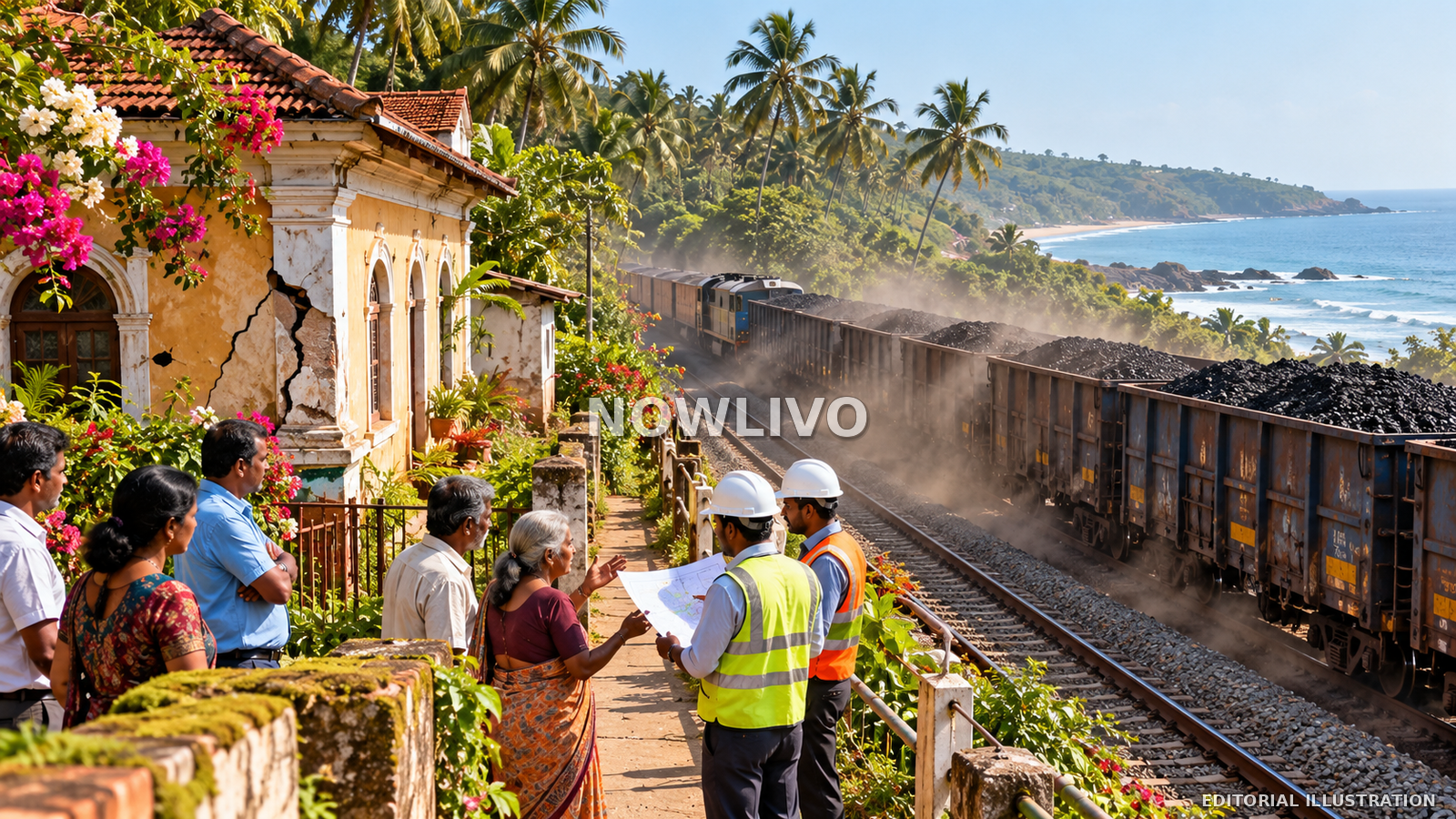
Residents of Velsao in South Goa say work connected with the Hospet–Tinaighat–Vasco da Gama railway double-tracking project has restricted access to homes and intensified worries about coal dust, pollution and vibration. The project, being carried out by Rail Vikas Nigam Limited, is intended to increase the capacity of a route used by both passenger and freight traffic. But residents argue that the costs are being borne disproportionately by communities beside the line. Their complaints raise questions about how transport upgrades are planned around homes, local roads, heritage properties and ecologically sensitive landscapes. The allegations require technical assessment, but they describe practical effects that residents say are already shaping daily life.
What residents say has changed
Residents have described homes that are difficult to reach by car and properties they say have become effectively landlocked as construction and railway boundaries reshape access. Sandra Rodrigues, who lives in a centuries-old ancestral house beside the tracks, told The Indian Express that debris dumped near the property obstructed a traditional road and right of way, forcing her to cross a neighbour’s property. She said emergency vehicles could struggle to reach the house and that her car had become unusable because of the blocked access.
Other residents have reported cracks in walls that they associate with vibration from trains. Oscar Goes said he had noticed cracks in his property, while residents argued that the planned expansion could increase the effects of freight traffic. These accounts are important indicators of concerns requiring inspection, but they are not by themselves a final engineering finding. Assessments should compare building conditions, vibration measurements, property records and the project’s approved plans.
The project’s transport rationale
The Hospet–Tinaighat–Vasco da Gama double-tracking project stretches for roughly 363 kilometres and is intended to increase capacity. Rail capacity can support passenger movement and freight operations, reduce bottlenecks and improve connections between industrial areas, ports and inland markets. Rail is often promoted as an efficient way to move bulk goods compared with sending the same volumes by road, although the overall benefit depends on which goods move, the route used and operational choices.
Those objectives do not automatically resolve local impacts. A line can improve regional throughput while creating difficult access or pollution conditions at individual settlements. Project evaluation therefore needs both network-level metrics and a close look at the communities along the route. Residents may recognise the importance of rail transport while still asking for design changes that preserve local access and reduce harm. The policy challenge is to balance broader capacity gains against the obligations attached to homes, roads and the environment beside the tracks.
Coal dust and health concerns
Residents told The Indian Express that about seven goods trains carrying coal pass through the area daily and that dust settles on nearby homes. Dust from bulk freight can affect outdoor surfaces, gardens, ventilation and the comfort of people living beside a line. The specific exposure in Velsao requires measurement; an individual observation does not replace air-quality data, but it can identify a problem that warrants systematic investigation.
A useful assessment would measure particulate pollution at homes and along the track, compare readings on train and non-train days, and examine how wind, wagon covers, loading practices and train speed affect dust. If elevated levels are found, controls might include improved coverings, maintenance, barriers, cleaning or operational changes. The remedy should be chosen after measuring the source and the pattern of exposure rather than assuming that one intervention will solve every problem.
Environmental and legal background
The project has faced wider environmental objections, particularly around sections near the Western Ghats. In 2022, the Supreme Court overturned wildlife clearance for the Castle Rock–Kulem section after considering concerns about ecological effects. That ruling related to a specific section and should not be treated as a blanket judgment on every part of the project. It nevertheless illustrates why environmental assessments and public accountability are central to railway expansion in sensitive landscapes.
The Western Ghats are an important biodiversity region and include wildlife corridors. Infrastructure in such areas requires careful consideration of alternatives, mitigation and cumulative impacts. Legal clearances and project boundaries matter: decisions affecting one segment may not settle the status of another, but they can establish constraints that future work must observe. Residents’ access concerns and environmental questions are related in the broad planning debate, yet they may require different evidence and remedies.
Property access is a design issue
For a household, access is not an abstract planning variable. Residents need to move vehicles, receive deliveries, reach public roads and obtain emergency services without avoidable detours. Where a rail line passes close to a property, a change to a fence, road or crossing can alter daily life even when the physical track occupies a relatively narrow strip. The difficulty can be greater in older settlements where roads and rights of way developed before modern project boundaries were drawn.
A complete project review should map each affected property and record how access changed before and after construction. If a driveway or lane is blocked, the response may require a legally recognised access route, safer crossing, revised boundary or compensation depending on the facts and applicable rules. These details are often easier to address before construction is finished than after the new layout becomes fixed. Clear records help distinguish a legitimate property claim from a broader argument over the project’s merits.
What happens next
The reported concerns point to three immediate needs: verify property-access claims, measure pollution and vibration, and explain which remedies are available under project documents and local law. Residents’ accounts should be taken seriously without being treated as a final technical finding. The railway’s stated capacity objective should also be assessed against any promised mitigation and the effects on communities along the route.
A clear response would identify which properties were inspected, what the findings showed, what changes can be made and how unresolved complaints can be appealed. The longer-term test is whether rail capacity can improve without leaving individual communities to absorb unaddressed impacts. Velsao’s experience could inform how other freight-corridor projects engage coastal settlements, protect rights of way and monitor environmental effects after operations expand.