Oregon Father Recounts Confronting School Shooter, Calls for Safer Schools
Kaylub Giamanco, a father whose children attend Silver Rail Elementary in Bend, Oregon, has spoken publicly for the first time about confronting the gunman who killed a teacher and three children at the school on October 15. In an interview with Oregon Public Broadcasting, Giamanco described calling 911, following the attacker and entering the school after hearing children in danger. His account has drawn national attention, but it is also a story about trauma, grief and the limits of what one bystander can do during a sudden emergency. Giamanco has called for stronger school safety measures. His testimony offers a personal perspective on the event, while investigators and the school community continue to deal with its consequences.
What Giamanco said happened
Giamanco, a 36-year-old carpenter, said he was near the school because he had decided to return home for lunch rather than eat the meal he had brought to work. At first, he thought the sight of a person carrying a gun might be a prank. He then saw the person fire a weapon and climb over the school fence, prompting him to call 911 and move toward the campus. His account describes a series of decisions made with limited information and immediate danger.
He said he followed the attacker after hearing children pleading for their lives. According to the interview, he crawled through a broken window and reached a classroom where a teacher was struggling with the gunman. Giamanco fired, the attacker fell, and he fired again when he believed the teenager might still reach for his weapon. The description is his account of a rapidly unfolding event, not a substitute for the full official investigation into the shooting.
The school and the victims
The shooting at Silver Rail Elementary killed a 25-year-old teacher, Megan Lambert, and three children, including five-year-old Rhoam Summer. Reports said six people were shot. The attacker was identified as Griffin J. John II, a 16-year-old former student at the school. The deaths devastated a school community where many children, teachers and parents knew one another and where families expected a normal school day to be safe.
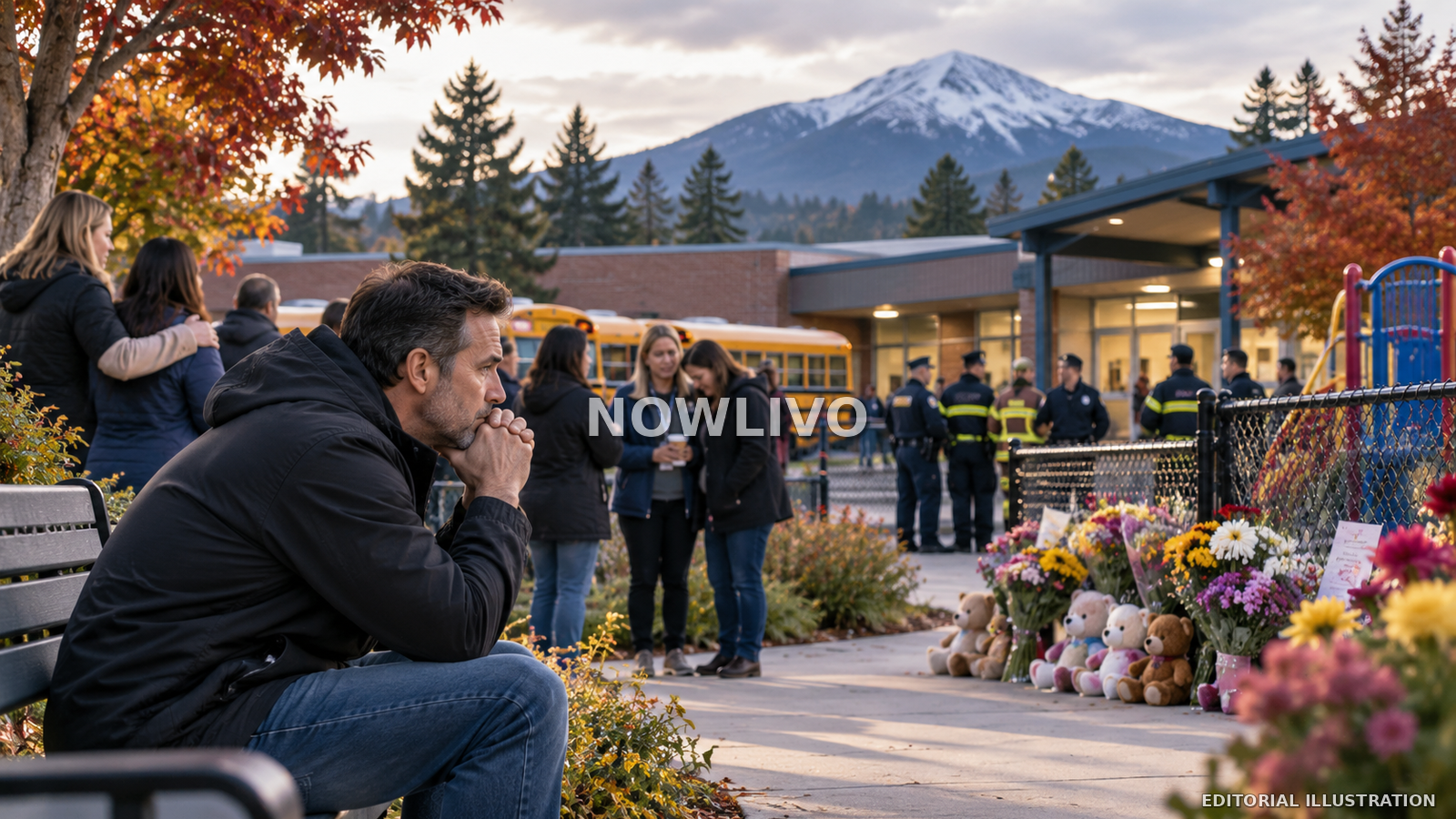
News coverage should not reduce the victims to a backdrop for the dramatic actions of one adult. Their lives, families and classroom community remain central to the event. The memorial outside the school, with flowers, notes and stuffed animals, reflects the scale of the grief. It also reminds readers that the effects of a school shooting extend far beyond the minutes of violence and continue through funerals, counselling, disrupted routines and a difficult return to ordinary school life.
A bystander’s decision under pressure
Giamanco said he told the 911 operator that he needed to go in because people would die if nobody acted. His account describes a decision made with incomplete information and immediate risk. Such circumstances cannot be recreated from a calm distance. Emergency responders and bystanders often make decisions in seconds, and the details they can see or hear may change from moment to moment. Their actions may involve life-saving courage, but they also expose them to serious danger.
His actions have been praised by people who view them as helping stop further killings. A responsible account should avoid turning an extraordinary act into an expectation that parents or teachers must confront armed attackers. The danger is severe, and the safest response depends on the situation, training and available options. The public story can recognise courage without minimising risk or implying that a bystander is responsible for what occurs when a person chooses not to enter a dangerous scene.
The emotional aftermath
Giamanco described lying awake at night thinking about what he saw and wondering whether he could have done more. He also expressed sorrow that he was unable to save every child who was attacked. Those comments show that being praised as a hero does not erase the trauma of witnessing violence or the grief of people who lost loved ones. Public attention can be difficult when a person is still trying to process an event that has changed the course of daily life.
Survivors and witnesses may experience intrusive memories, guilt, disrupted sleep or difficulty returning to ordinary routines. Responses differ, and public admiration can sometimes make it harder for someone to speak openly about distress. The school community may need counselling and long-term support well after immediate emergency services withdraw. Support services should be easy to access and offered without forcing witnesses to recount details before they are ready.
His call for school safety officers
Giamanco said he wants schools to have school resource officers and wants to help raise funding for safety efforts. His view reflects a common debate over the presence of trained security personnel on campus. Supporters argue that they can respond quickly to threats; critics ask whether such measures are effective, how they affect students and whether resources would be better spent on prevention, mental-health services or building improvements. The debate involves trade-offs that should be evaluated against evidence rather than slogans.
A school-safety plan usually combines several layers: access controls, communication systems, staff training, relationships with local police, counselling and clear emergency procedures. No single measure can guarantee safety. Policies also need to avoid making schools feel like prisons or disproportionately exposing some students to discipline. The appropriate mix is a local decision that should be supported by evidence, consultation and a review of what the investigation shows about the Silver Rail incident.
What happens next
The school district, investigators and families will continue to deal with the consequences of the attack. Giamanco’s call for school resource officers may become part of local policy discussions, alongside questions about training, access control and student support. Any reforms should be assessed through concrete evidence and public discussion, not only emotional reactions. The district’s decisions will affect students and staff who need to feel safe without losing the character of a school community.
For now, Giamanco’s account shows both the urgency of a moment when children were in danger and the lasting emotional weight carried by people who respond. The broader work is to support victims and survivors, establish the facts and turn lessons from the investigation into safety measures that can be examined and improved. A durable response must consider prevention, recovery and the needs of students who will continue learning in the aftermath of the shooting.