ISRO Says NVS-03 Satellite Is Healthy After First Orbit-Raising Manoeuvre
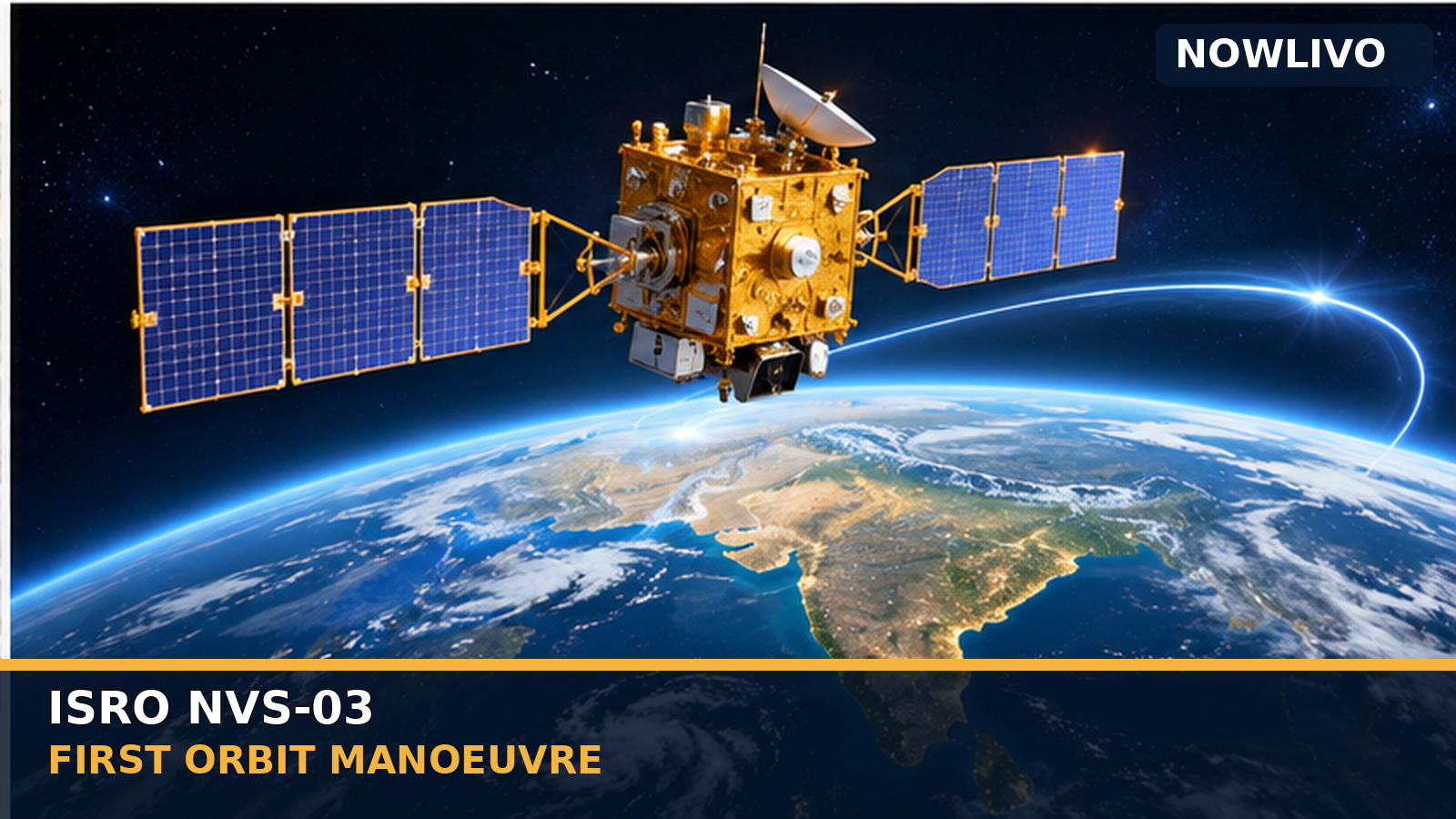
India’s NVS-03 navigation satellite has completed its first planned orbit-raising manoeuvre, and the spacecraft is healthy, the Indian Space Research Organisation said in an update dated October 31. That is a distinct development from the GSLV-F18 launch itself. A successful liftoff places a satellite on the beginning of its journey; subsequent engine burns are needed to move it toward the orbit where it will eventually operate. ISRO’s confirmation provides the first public checkpoint on that process after the late-night launch from Sriharikota.
According to the agency, GSLV-F18 injected NVS-03 into an initial orbit of approximately 170.3 kilometres by 38,080 kilometres on October 30 at 11:51 p.m. IST. The first manoeuvre took place on October 31 at 4:48 p.m. IST and involved a liquid apogee motor burn lasting 2,174.8 seconds. ISRO estimated the new orbit at about 5,477.6 kilometres by 37,833.4 kilometres. Those figures are orbital dimensions, not a distance that the satellite traveled in one straight line.
Why the first burn is important
The rocket’s job was to deliver the satellite to a transfer orbit. The spacecraft then has to use its own propulsion system to alter that orbit in stages. Raising the low point of the orbit reduces the difference between the near-Earth and far-Earth portions of its path, bringing it closer to the intended operational configuration. A successful first burn therefore verifies that critical spacecraft systems can function after separation. It is not the same as declaring the satellite fully commissioned or its navigation signals available for routine use.
ISRO said additional manoeuvres are planned over the coming days before NVS-03 reaches its designated geosynchronous orbital location at 111.75 degrees east. That means the October 31 announcement is an intermediate status report, not a final arrival notice. The agency’s statement that the satellite is healthy is encouraging, but normal mission discipline still requires subsequent checks, orbit adjustments and testing. The next important development will be a further official confirmation of progress toward the target slot. The east-longitude figure identifies the intended orbital position, not a launch location or the direction in which the satellite was fired. That distinction helps explain why the spacecraft needs several manoeuvres after the rocket has already completed its part of the mission.
What NVS-03 is designed to support
NVS-03 is the third satellite in India’s next-generation navigation series, which is intended to maintain and strengthen the services of the Indian Regional Navigation Satellite System, widely associated with NavIC. Regional navigation systems supply positioning and timing information that can be used by compatible receivers and services. Their value depends on a constellation working reliably over time, rather than on any one spacecraft acting alone. Replenishment and modernization are therefore part of the system’s long-term operation.
The satellite carries an indigenous atomic clock alongside procured clocks, according to ISRO. Precise timekeeping is fundamental to satellite navigation because a receiver calculates position by measuring differences in signal travel time. Even very small timing errors can become meaningful positioning errors. The inclusion of Indian-developed clock technology is consequently a notable technical element of the mission, although performance will still need to be evaluated through the spacecraft’s operational testing.
The additional L1 signal
ISRO also identifies an L1 navigation signal on NVS-03, in addition to the L5 and S-band signals used in the system. The L1 frequency is familiar to many satellite-navigation receiver designs, which may help broaden future compatibility with supported devices. That does not mean every existing phone will immediately begin using the new satellite. Actual reception depends on receiver hardware, software, constellation status and whether the relevant service is enabled.
The system is designed to cover the Indian landmass and a surrounding region extending roughly 1,500 kilometres beyond India’s geographical boundary. That regional focus is an important distinction from global navigation systems. NavIC’s intended service area and technology choices reflect India’s effort to maintain an independent navigation capability for users within its region. The new spacecraft contributes to continuity and modernization, but it should not be described as a replacement for all other positioning systems.
The next mission milestones
GSLV-F18 was the twentieth flight of India’s Geosynchronous Satellite Launch Vehicle, and the launch marked the beginning of NVS-03’s operational journey. Its success should be measured in stages: rocket injection, orbit manoeuvres, arrival at the planned orbital slot, satellite health checks and eventual navigation-service readiness. The October 31 update addresses the second of those stages and reports that the spacecraft remains in normal condition.
For readers following Indian space missions, the most meaningful fresh information is therefore precise and limited: ISRO completed the first scheduled engine burn, published the resulting orbit estimate and said NVS-03 is healthy. Further manoeuvres remain ahead. Reporting that distinction avoids turning a successful early step into a premature claim that the satellite is already delivering full navigation services.