
Bengaluru Rider Says Traffic Camera Mistook Guitar for Helmetless Pillion
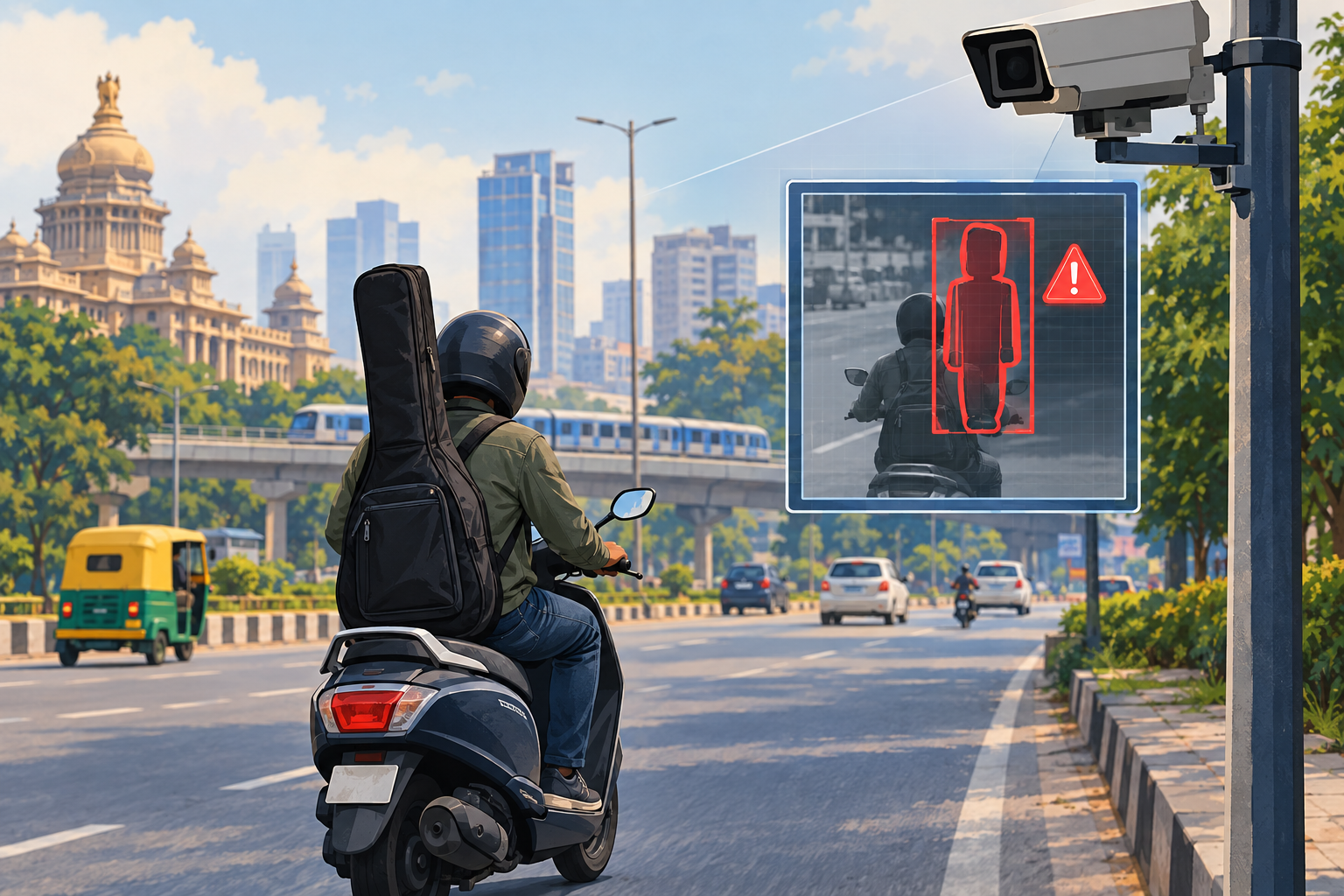
A Bengaluru motorist’s unusual traffic challan has gone viral after he said an automated camera apparently mistook the guitar strapped to his back for a pillion rider without a helmet.

Souvik Dutta said he was travelling alone on his wife’s electric two-wheeler, wearing a helmet and carrying the instrument behind him. The vehicle’s registered owner subsequently received a ₹500 notice describing the offence as a pillion rider not wearing protective headgear.
The alleged violation was recorded at about noon on September 15, 2026, while Dutta was travelling from Hebbal towards Tin Factory. The challan was generated the following day, according to the notice details shared publicly.
What the traffic-camera image shows
The enforcement image posted by Dutta appears to show one helmeted rider on the scooter, with a dark guitar case rising behind his shoulders. No separate pillion passenger is clearly visible. Dutta argued that the shape of the case had been classified as another person and asked Bengaluru Traffic Police to withdraw the notice.
The original image is not reproduced here because independent reuse permission has not been confirmed. An editorial illustration accompanying this report is a conceptual representation and should not be treated as evidence from the incident.
Dutta’s account has not been independently reconstructed from the original camera system. However, a senior traffic police officer acknowledged that the reported violation appeared to be a false flag and said automated systems can occasionally make such errors. The officer said the case would be rectified after verification.
How automated traffic enforcement works
Automated enforcement typically combines several technologies. Roadside cameras capture still images or video, while computer-vision software looks for possible violations such as riders without helmets, drivers without seat belts, red-light offences or vehicles travelling in prohibited directions.
Automatic number-plate recognition software then reads the registration plate. The number is matched with vehicle-registration records so that an electronic notice can be issued to the registered owner. The image and detected offence are generally retained as supporting evidence.
The software is not reasoning about a scene in the way a person would. It identifies visual patterns learned from previous images. Unusual shapes, poor lighting, overlapping objects, motion blur and partially hidden people or safety equipment can produce incorrect classifications. A guitar case extending behind a rider could, in principle, resemble some of the visual features associated with a second person.
Bengaluru introduced AI-assisted traffic surveillance to process large numbers of vehicles more quickly. Traffic police have previously said that images flagged by the system are manually validated before a challan is issued, a safeguard introduced after complaints involving incorrectly read number plates and seat belts that cameras failed to detect. The guitar dispute raises the question of whether that review missed an obvious anomaly in this instance.
Police response and appeal process
Bengaluru Traffic Police responded to Dutta’s public complaint by directing him to contact its automation section for “violation rectification.” The department asked him to email the challan details and evidence to automationpubbcp@ksp.gov.in or call 080-22943381 or 080-22942883.
Joint Commissioner of Police for Traffic Karthik Reddy also said the matter would be examined and that the violation would be revoked if Dutta’s account was verified. Officials were reportedly directed to contact him and review the case.
Motorists disputing a Bengaluru challan can submit the vehicle number, notice information and supporting image through the traffic police’s official grievance channels or ASTraM services. A disputed notice should be checked against the original enforcement image before any correction is made.
Was the challan cancelled?
As of September 27, 2026, Bengaluru Traffic Police had acknowledged the complaint and provided a rectification route, but neither the department nor Dutta had publicly confirmed that notice number 86202541 had been cancelled. The most accurate description is that the challan was being taken up for verification, with police indicating it would be revoked if the claimed error was established.
The episode is amusing because of the object involved, but it illustrates a serious design requirement for automated civic systems: fast detection must be matched by meaningful human review and a simple, responsive appeal process when the machine gets the scene wrong.