Google unveils Gemini 4 Argon, but most users cannot try it yet
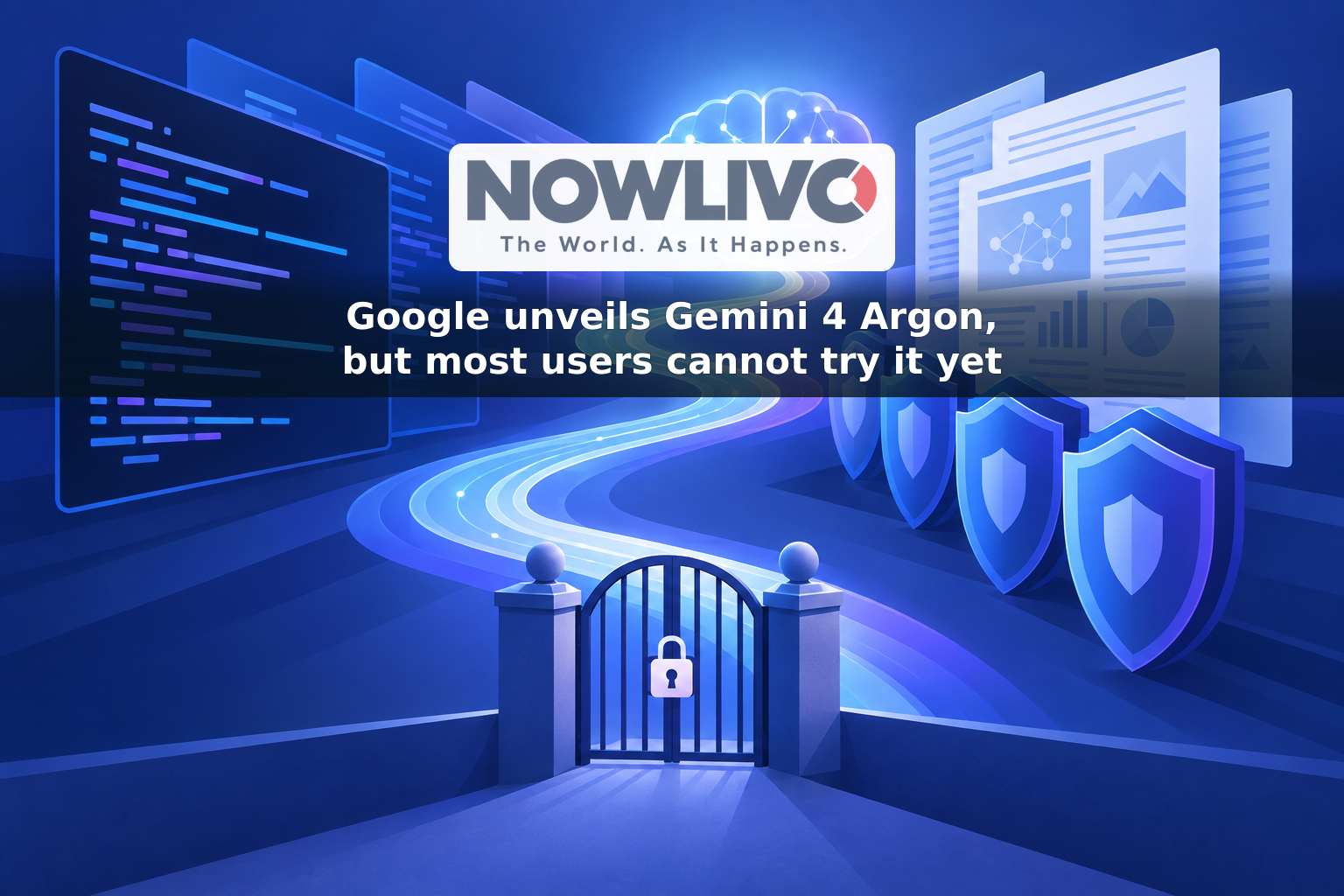
Google unveiled Gemini 4 Argon on September 30, 2026, presenting it as a model built for demanding tasks that take many steps to complete. The announcement covers software engineering, research, business work and cybersecurity. It does not, however, amount to a general release: Argon is beginning to roll out to selected cyber defenders, while most Gemini users must wait.
That distinction matters for anyone hoping to compare the new model with the tools already on their screen. Google has described what Argon can do and who should receive access first, but it has not announced a date when the public can test it.
What is new about Argon?
Google says Argon can sustain reasoning across long workflows rather than tackle only a short prompt and response. It is intended to help with activities such as debugging software, working through large codebases, examining financial material, drafting legal work and analyzing documents or video. These are announced capabilities, not a promise that every feature will be available in every eventual product.
One striking specification is a limit of up to one million output tokens, compared with a previous limit of 64,000. Output tokens measure how much the model can generate during a task. This figure should not be mistaken for a one-million-token input or context-window claim. The additional output capacity could give an agent more room for a lengthy sequence of reasoning and actions, although a larger limit alone does not establish that its answers will be more reliable.
Google points to internal engineering work as evidence of Argon’s potential. It says teams have used the model on code migrations, performance improvements and research problems. Some of those projects are still undergoing review rather than being deployed automatically. Google also reports strong results on tests of long-running software engineering, business automation and other professional tasks. Benchmark scores offer a way to compare systems under specified conditions, but they cannot predict how well a model will handle every customer’s files, tools or approval process.
Who can use it?
For now, Argon is rolling out to a group of trusted cybersecurity defenders through Google’s Fairwind Program. Google employees are also using it internally. The company says feedback from early users will inform its safeguards before access expands to developers, enterprises and consumers.
Google says paid API customers and Google AI Ultra subscribers will be among the first groups in that broader release. It has not given a date for either group. Nor has it specified which consumer interface will offer Argon or announced an Argon rollout across products such as Search, Sheets or the standard Gemini app. An Ultra subscription should therefore not be taken as confirmation of access today.
Google has set out planned introductory API pricing of $2 per million input tokens and $10 per million output tokens, with a discount for cached input. It says those rates will later rise to $4 and $20, respectively. Those are prices for a planned launch, not evidence that general API access is already open.
How does it compare with existing Gemini tools?
The clearest difference at present is availability. Gemini 3.8 Flash is already offered through developer tools, and Google says eligible subscribers can use it in the Gemini app, AI Mode in Search and Sheets. Argon has no equivalent announced product rollout. Someone who needs to work in those interfaces now should not assume they have silently switched to Gemini 4.
The models also have different stated priorities. Google positions Flash as a faster, lower-cost option for everyday and agent-based work. Argon is aimed at harder, longer-running problems where its additional capacity may be useful. On cybersecurity, Google says Argon improves on its earlier Gemini 3.8 Flash Cyber model in vulnerability discovery and ties for the top score in a cited patching evaluation. Such comparisons depend on the test and do not mean one model is the best choice for every task.
For readers weighing Argon against other AI assistants, the practical conclusion is similarly limited. Google claims leading results in several evaluations, but broad comparisons will be easier to judge once independent users can run the model on comparable tasks. Until then, Gemini 4 Argon is a significant announcement with restricted access—not a new chatbot that everyone can open today.